


Working with and for real estate agents is mostly rewarding. There are some, however, who frustrate me with their absolute refusal or inability to call attention to their successes.
Instead, they rely on the same, trite garbage that they’ve copied from other agents:
- “We go above and beyond for our clients”
- “I’ll help you make a house your home”
- “You’re my number 1 priority!”
- “A local expert”
- “A name you can trust”
The list of smarmy real estate agent slogans seems endless, but you get the idea. These communicate nothing and produce, at best, an eye-roll from the reader.
Then there are those agents who can and do promote their successes, but end up with marketing pieces that are overly self-promotional.
None of these help consumers to get to know, like and trust you. “Trust me,” is far too easy to say and today’s consumer doesn’t believe you’re trustworthy without proof.
Social proof – which is provided by testimonials. Not from you, from your mama or spouse or from a marketing company, but from people who have worked with you.
Testimonials can take many forms, although the ones agents most commonly use are those one- or two-liner quotes.
There is another, more powerful way to get your expertise across to potential clients and that is the case study, or social proof, with you as the hero.
Don’t tell them what you offer — prove what you deliver

A case study does precisely that. In a nutshell, it’s an explanation, typically in story form, of how a business provided a solution to a customer’s problem. It provides social proof of your ability to deliver without bragging.
Many large companies incorporate case studies in their marketing efforts. Check out some of them at:
While they’re far more popular in the B2B sector, the power of case studies hasn’t been overlooked by B2C companies either, which we’ll get into in a minute. Take a look at some B2C examples:
Jolenta Averill, Broker/Owner, Lake and City Homes (Madison, WI)
Think you can DIY your case study?

Since few agents have case studies, yours will certainly stand out, even if it’s a DIY piece. A little bit of Canva magic, and it may turn out to be a showstopper.
It’s the content, however, not the design, that will require most of your concentration. At CrazyEgg.com, Ryan Bozeman compares the best case studies to a favorite novel.
“… the protagonist (the client in the case study) runs into several roadblocks before overcoming them with your help and reaching the ultimate goal.”
To begin, think of a challenge a client presented you and how you overcame it. Then, reach out to that client, requesting an interview. You’ll want as many compelling quotes as possible. What will provide the best example of social proof
During the interview, ask your client to tell the story, from his or her point of view, from the beginning.
Then, arrange the case study, according to best practices:
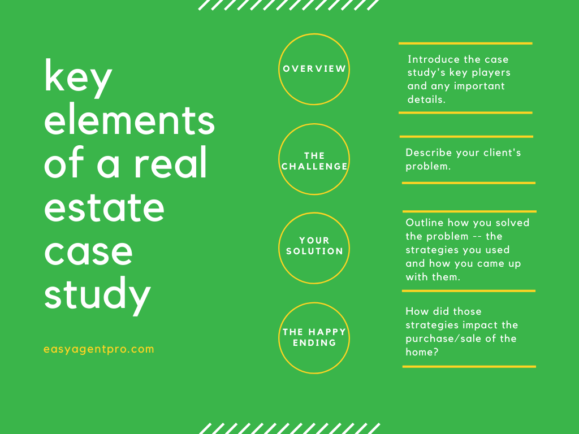
Take a look at the case study samples we included, above, to see the various ways companies present the key elements.
If the client highlighted in yours was a listing client, be sure to include the case study in all of your listing packets. For buyers, slip a hard copy of the case study into the buyers’ packet.
Share it in drip email and snail mail campaigns, on social media and post it prominently on your website.
“Case studies give you momentum, valuable content, and a reason to reach out to your existing prospects,” cautions Andrew Woodberry, director of sales at SnapSolv, a mobile messaging solution for businesses.
From selling a home with no front door to finding the needle-in-a haystack home for your buyers, you have stories to tell. Social proof is worth its weight in gold.