



Build better campaigns with these 6 FREE proven tips to more engaging newsletters:
Dear real estate agent,
You know those emails you send to me every other week, like clockwork? Sure, you do – the ones that beg me to refer you to a friend or family member.
Please stop it. As a real estate consumer, I’m seeking information on the process and, quite frankly, I couldn’t care less that you need clients.
Until you have something of value to communicate to me, please take me off your email list.
Regards,
Someone who is sick of your real estate marketing emails.
Is this you?

I see you back there, slinking away. It’s you, right? Guilty as charged.
Millions of Americans despise the real estate marketing emails that show up in our email inboxes. Oh, sure, the opt-in companies want you to think that the medium is the end-all, be-all in marketing.
They will tell you how many people “use” email, how often they check their email and on which devices.
If they’re honest, they will tell you that the average open rate is a smidge under 23 percent, but they don’t tell you that this is the rate for all emails opened – from friends and family, from the boss, from co-workers as well as marketers.
You can bet that because they don’t mention the specific open rate for marketing emails, the number is puny.
That’s because nearly 54 percent of consumers think real estate marketing emails are spam
What we do know is that if you’re lucky enough to have someone open your real estate marketing emails, there’s only a 3.7 percent chance the reader will click through.
With the industry currently under fire for certain cold-calling practices, and many agents loathe to spend money on marketing, email use is poised to explode in popularity (again).
It’s time, then, for a refresher course and we start with the two most critical elements of your marketing email pieces, the beginning and the end.
1. What’s the first thing they see?

Scroll through your emails and notice what you’re looking at first. Usually, it’s not the sender’s name, but the subject of the email.
This is why email pros say that the subject line is more important than any other part of your real estate marketing emails.
Even the most motivated potential buyers or sellers aren’t going to read an email with a topic that isn’t of interest or value to them.
Here’s an example. I’m a big believer in that, someday soon, baby boomers are going to figure out that they need a smaller home, want to live closer to the grandkids or move into managed care.
So, I subscribe to some of the largest baby boomer blogs.
One of them uses the same subject line in every email they send, regardless of what’s said inside. I usually toss them without reading them.
Last week I opened one and, in big, bold blue letters it said: “Are You Making This Big Retirement Mistake?”
Think about how many of their subscribers would’ve opened that email if that sentence was used in the subject line.
While there are several email subject line best practices, three concepts top the list when it comes to real estate marketing emails:
- Personalization: If you segment your CRM then you most likely know the value of personalizing your content to where a lead falls in your funnel. According to Olivia Allen at Hubspot.com, personalization of the subject line will increase open rates.
- FOMO: The fear of missing out is a well-known motivating tactic. Add urgency to your subject line.
- Pique their curiosity: That baby boomer email we discussed earlier is the perfect example of this.
2. The signature
If you haven’t joined the Raising the Bar in Real Estate Facebook group, you’re missing out on some lively discussions. Recently, an agent shared his email signature, hoping for feedback. And, true to form, agents were happy to pick it apart.
We removed the identifying stuff from it, but here’s the gist of his signature:
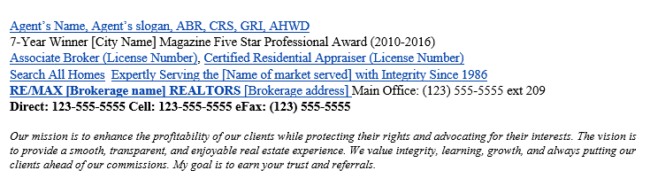
We agreed with most of the advice offered, so let’s take a look at some the suggestions:
Designations truly mean nothing to the average real estate consumer. Unless you have a PhD or an MBA or something else that is universally recognized, the advice was to ditch the alphabet soup after his name.
It’s very cool that the agent won the city magazine’s award, but he needs to dump the dates. It’s almost 2020 and his last award was in 2016. We wonder what’s happened since then that he wasn’t given the Five Star Professional Award.
If the law requires that you state your professional license numbers, by all means, do so. If not, leave them off.
The one suggestion that he received the most was to get rid of some of the phone numbers, especially the eFax number.
We agree that the mission statement is just clutter. A brilliant, one-line testimonial would be far more impressive and valuable.
Did you notice the lack of his social media links and, most important, a link to his website?
The phone numbers should be more consistently formatted, punctuation mistakes fixed.
Finally, one group member mentioned something we hadn’t thought of: all those links in his signature are very likely to trigger spam filters.
The signature, overall, was viewed as self-serving. “It’s an email signature, not a resume” one member said.
Keep your email signature short – include only the information the recipient needs to contact you or reach out to you online. And include a short testimonial at the end.
Learn from these 200 marketing techniques, and develop some of your own
Set up amazing retargeting audiences on Facebook – here’s how to start: