



The folks at realtrends.com are about to release their annual real estate website builder rankings. Those rankings, regardless of the company compiling them, are always a fun read.
Realtrend’s criteria for a kick-hiney real estate website includes “best design.” In fact, they’re looking for “show-stopping websites.”
Not the “best-designed website to increase organic SEO.”
Not the “best-designed to capture leads.”
Nope.
It’s the prettiness factor that proves a real estate website builder “… has what it takes.”
We beg to differ with them. Pretty is as pretty does and the “best” real estate websites actually work for their agent-owners.
They do this by ranking in organic searches, by helping to convert leads, educate visitors about the buying and selling process and by informing them about the area and its attractions.
And they do it while not annoying the visitor, making them search for the information they need, by loading at lightning-fast speeds and more.
And the very best real estate agent websites do a lot of the heavy lifting in lead generation so that you no longer have to buy leads.
There’s an old Duke Ellington-composed song that says it all: “It Don’t Mean a Thing (If It Ain’t Got That Swing).”
Download the free guide! 5 Real Estate Landing Pages To Make Now:
The best real estate websites are not only pretty, they “got that swing”
No, it’s not pick-on-RealTrends day here at Easy Agent Pro. The site is packed with valuable information. Their writers do, however, sometimes miss the mark, especially when referencing the in’s and out’s of how to choose your real estate website builder.
Another blog post, “What to Consider when Choosing a Website Vendor,” is a case in point. Testimonials, contract length and pricing are what the author considers three “critical” aspects of choosing a real estate website vendor.
Yes, those are important considerations– if they’re of concern to you. Many agents don’t care about pricing if the website brings in leads.
Many aren’t concerned with contract length either. And, testimonials?
Isn’t reading reviews before you purchase most anything nowadays a no-brainer?
The “swing” doesn’t include any of those. A real estate website builder that has it:
- Features responsive design (don’t yawn–we’ll explain, in plain English)
- Is attractive in its simplicity
- Converts visitors, or leads, into prospects
- Attracts organic search engine traffic
- Gets you through the entire process
- Is user-focused
Let’s take a look at each aspect of a real estate website builder in more detail. Then, feel free to use the information when shopping for a real estate website builder.
The best real estate website builder provides responsive design

This is one of those phrases that makes eyes glaze over.
What it refers to is a website that adapts its “… content based on the browser space available. This allows consistency between what a site shows on a desktop and what it shows on a handheld device,” according to Mads Soegaard at interaction-design.org.
Think of a real estate website with responsive design as “mobile-friendly.”
Why is this important? Responsive websites load quicker on mobile devices. And, since 77% of digital minutes are consumed via mobile devices, responsiveness is critical.
Furthermore, 73% of homebuyers use a mobile device as their chief source of information in home searches according to NAR’s “Real Estate in a Digital Age” report.
Attractive in its simplicity
Think “clean” when it comes to a real estate agent’s website layout. Don’t let anything detract from your branding, from your CTAs and from the user’s experience (fluff won’t be read anyway).
Leave a lot of white space, use short sentences and paragraphs and take advantage of bulleted and numbered lists.
Ensure that the websites on offer from a particular vendor “… are simple and clean with easy-to-navigate buttons and tabs,” suggests the pros at quicksprout.com.
Simplicity is key, they say, because sites “… with simple designs have higher conversion rates.”
It’s gotta convert
Let’s read that again: “… simple designs have higher conversion rates.”
And, again, the home page should be the simplest of all.
We know how tempting it is for agents to tell visitors right off the bat that they’re the best agent on the planet and why.
But cluttering up the home page by listing all of your services, your resume, designations, awards and endless ways to contact you makes the page look far too busy.
That, in turn, alienates visitors and you lose those valuable 50 milliseconds that you have to make a good first impression.
Know what’s important to your visitors and jettison the rest, again, at least on the site’s homepage. You can’t convert visitors who split the second they land on your site.
So, what’s important to them? Here are the no-brainers:
- Buyers are looking for an agent, listings and knowledge about the buying and mortgage process.
- Sellers are looking for an agent and knowledge about the selling process. They, too, may be looking at listings to find their next home.
They want to find this information easily, so don’t make them guess where it is on your site.
The “above the fold” portion of your homepage should include the name of the market you serve. Sadly, we see few agents doing this.
If I were looking for a home in San Diego, I’d like to know immediately that Google didn’t send me on a wild goose chase and land me on the site of a Santa Monica agent.
San Diego agent Courtland Young nails it.
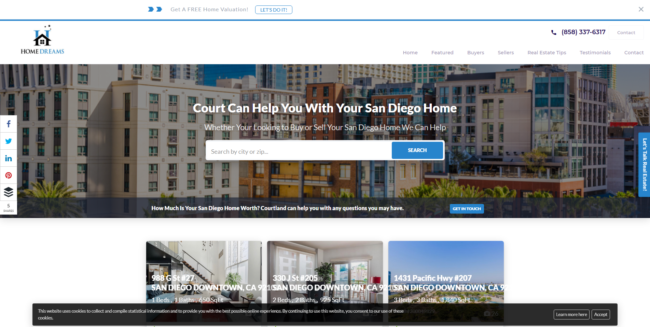
So, now I know that I’m on a local real estate agent’s website. What else would and should immediately catch my eye – to help me decide to hit the back button or scroll down?
Something that tells me that Court is the best agent in town and, therefore, the best for me. A testimonial will do just that.
We see two spots for a testimonial. The first is just above the search box and the second is the text just before the “Get in Touch” button. Sort of like this:
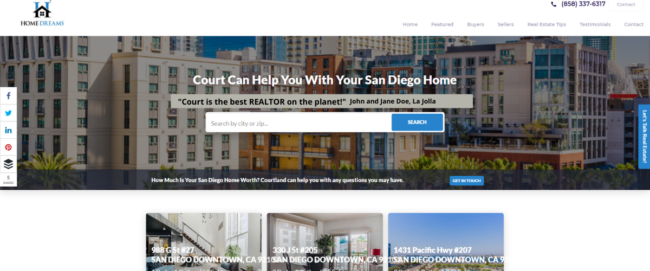
Now, what else are they looking for? If I’m looking for listings, I don’t even have to scroll down Court’s page to know that they’re at my fingertips.
This doesn’t mean you should switch to a carbon copy of his website, though.
What it means is that you don’t force visitors to guess the location of the information they seek. Ensure that the website’s vendor provides clear navigation to buying, selling and information about you (with plenty of testimonials).
And ensure that the site is easy for you to edit the way you want. And with a LeadSite, both tasks are a snap.
Attracts organic search engine traffic
If you currently buy leads, how’s that working for you?
If you aren’t buying from a reputable source and you haven’t maximized the power of free lead generating sources, such as your website, you’re wasting money.
“In our experience, website-generated leads convert significantly better than a cold, purchased lead,” according to Lukas Termini, our marketing manager here at Easy Agent Pro.
So, how do you turn your real estate website into an even bigger lead-generating monster? Start by performing small changes to several pages on your site.
Localize the free blog posts you receive twice a week from EAP. It only takes minutes to add local search terms. Here’s an example from a recent post about appraisal problems in hot markets:
Fiery real estate markets such as what we’re experiencing are a dream come true for sellers, unless prices are rising so fast that the market can’t keep up.
Stick the name of your market in that post to boost its SEO value.
Fiery real estate markets such as what we’re experiencing here in Vallejo …
For even more value, link the name of the city to its page in your site. These types of links are called “internal links” and each of your blog posts should contain at least one.
Why?
Internal links “… give Google an idea of the structure of your website,” according to Meike Hendriks, a digital marketer on the Yoast SEO team.
“So using the right internal linking strategy can boost your SEO,” she continues. Learn more about internal linking and how you can use it to boost your site’s visibility in organic searches at Yoast.com.
Every post includes numerous opportunities for you to localize them, even those we write for your sphere. Take a post on landscaping and add to it:
Check out the trees for sale in Memphis at Dabney Nursery, 5576 Hacks Cross Rd. and Dan West Garden Center, 4763 Poplar Ave.
Then, work on your neighborhood pages by adding local photos and alt tags to go with them.
Right about now you’re wondering what happened to helping me find the right real estate website builder.
Regardless of the real estate website company you choose, your site will need to be localized.
A real estate website builder should get you through the entire process

“A lot of agents struggle with finding the time to work on their own sites, which is why having a site that can take some of the work out of the process can be so important,” according to Termini.
Compare vendors on whether or not they offer the “goodies” to help make your work day easier:
- Template-based pages that make adding and deleting information a snap
- Help building landing pages
- Twice weekly auto-blog content
- CRM integration that will help you convert website visitors into leads
- A slew of apps to help with everything from lead capture and management to boosting SEO and increasing website traffic.
The best real estate website builder maximizes an agent’s brand and optimizes his or her online activities with one simple goal in mind: To help you get more leads, sell more houses, and improve your professional and personal brand.