


I’ll be selling my house soon. I have a listing agent standing by and I’m just putting the finishing touches on getting the house ready.
I interviewed five listing agents. One of the first questions I asked each agent I interviewed was who they used for listing photos.
Only one of them used a pro; three used their smartphones and one agent used a “Canon digital SLR” to shoot photos of his listings himself.
That’s a $2,500 camera yet the photos in his listing presentation looked like my 3-year-old niece took them. I wasn’t surprised, really. I’d spent weeks checking comps online to get a feel for how much my home is worth. I couldn’t believe the number of blurry, dark, unprofessional photos I ran across.
Do I need to mention that I made a point of not interviewing any of those listing agents?
I wanted a pro, not someone who penny-pinched and cut corners.
Here it is, 2021. If an agent can’t afford to hire a professional real estate photographer, he or she should either offer the seller a discounted commission (because what is on offer is not “full service”) or become a buyers’ agent.
Sounds harsh, I know, but it’s nonetheless true. Homeowners depend on their listing agents to protect every last penny they’ve invested in their homes.
Then, consider the hypocrisy of urging sellers to increase the home’s curb appeal, to clean, declutter and stage—all to create a compelling first impression. What good does all that work do if the first image most potential buyers will see looks something like this?

Why quality listing photos matter
“… every single second of the day, every day of the week, there’s a person somewhere in the world buying a new pair of beSwooshed sneakers …” according to Jake Woolf at gq.com.
How successful would Nike be if Phil Knight insisted on taking his own advertising and marketing photos?
Is advertising and marketing of a pair of sneakers more worthy of drop-dead gorgeous photography than a client’s largest financial investment?
Ocular tracking studies show that, when viewing a listing online, buyers “overwhelmingly” look at the photos first (Journal of Real Estate Research). They then move on to the description. Only 40% of them read the agent’s remarks.
But, back to that photo. When viewers like what they see, they will move on to the next photo of the home. If not, they begin perusing the rest of the page or click off the page.
Other studies show that online listings accompanied by professionally-shot photos not only receive 61% more views than homes photographed by an amateur, but they sell for more as well. Often, they sell for substantially more (between $934 and $18,819), according to a Redfin study.
Listing photos matter because “You have to grab people’s attention within two seconds,” according to the lead researcher in the study, Professor Michael Seiler.
Photos snapped by an amateur on an iPhone simply cannot and do not meet that two second test.
Still not convinced?
Real estate agents wear a lot of hats in running their small businesses. Delegation isn’t a process that comes easy to them. Especially when it comes to saving money, agents stubbornly resist hiring help.
Even if you do own the latest, greatest premium camera, if you’re not a pro, you lack the skills and knowledge required to take compelling listing photos.
A professional brings much to the table, including the ability to capture color and light, exposure control, composition. Then there are the post-production skills the pro brings to the project.
Finally, consider what those fuzzy, dark, amateur listing photos say about your brand and the services you offer. They scream that “Here’s an agent who cuts corners!” and cares little about his or her clients’ success.
Just as owning a scalpel doesn’t make one a brain surgeon, owning the latest SLR camera won’t make one a professional real estate photographer.
Money, money, money
“A Real estate photographer costs too much” is an oft-heard lament in online agent forums.
The Redfin study, however, shows us that homeowners whose listing agent’s use professional photos to market their homes make more at closing than owners of listings with crummy photos.
If the homeowner nets more, so do the listing and selling agent. The professionally-shot photos, therefore, pretty much pay for themselves.
Although real estate photographer fees vary from region-to-region, we’ve rounded up some prices we’ve seen quoted on various websites.
“A basic real estate photography shoot from a professional real estate photographer generally costs anywhere between $110 and $300 per shoot for photos only (no video),” according to Jim Harmer at improvephotography.com.
Harmer goes on to say that this price typically covers the photog’s transportation costs and “… 25-50 photos.”
“In my local market, there are real estate photographers who charge anywhere from $100 to $500,” according to Natalia Robert at experphotography.com.
“And this is for photos only. Rates go up for things such as twilight photos or video tours. Larger-than-usual homes also mean higher rates,” she concludes.
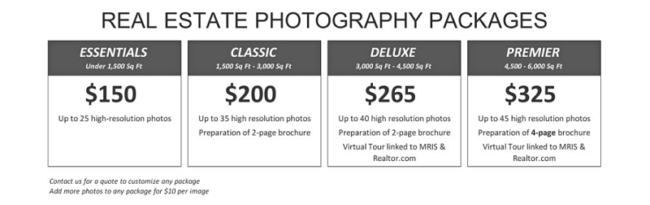
Many real estate photographers charge by the type of services the agent needs. Robert Miller in Northern Virginia, for example, offers bundled packages:
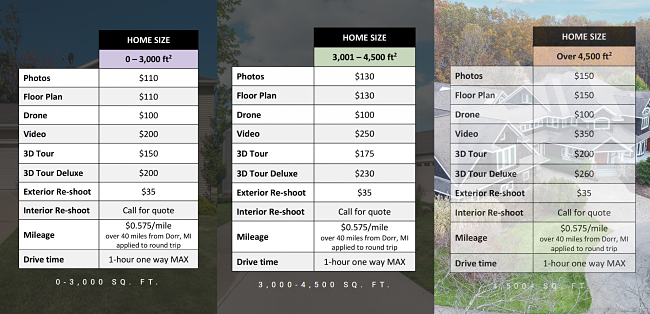
West Michigan real estate photographer Scott Wycoff, on the other hand, offers real estate agents ala-carte pricing:
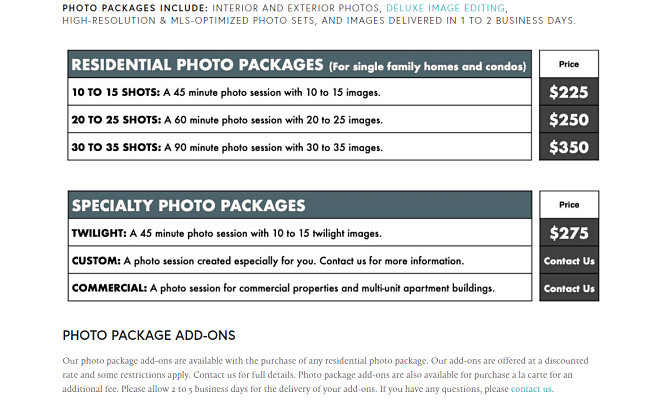
Others base their fees on the number of photos required, such as Pro Property Shots in Los Angeles:
While price is important to many struggling agents, quality is as well. Listings that catch attention, also catch additional clients. Your listing presentations, with photos snapped by a professional photographer, will stand out among those of other agents.
Good, quality photography in your marketing pieces adds a professional edge to your business that those agents who cut corners just don’t have.
How to hire a real estate photographer
A good first step in finding your new real estate photographer is to cull through the latest MLS listings to find those with amazing photos. If the photographer is credited, look online for his or her website. If not, call the listing agent.
Naturally, agents might be reluctant to share their vendors, but it’s worth a shot.
If that doesn’t work, check for real estate photogs with good reviews on Yelp.com. Then, run a Google search for the same.
You’ll also find online directories, such as Real Estate Photographers of America & International®, a trade association that allows agents to search for photographers by state.
By now, you’ll have a nice-sized list of candidates to interview. Before the interviews, however, check their websites for a portfolio of work performed for past clients. Make notes about each photographer as to what you like and don’t like about their photos.
During the interview, ask some of the same questions you would hope that real estate consumers ask agents:
- May I view some of your recent work?
- May I interview your last three clients?
- What, exactly, does your fee include?
- Do you charge a licensing fee and, if so, how much?
- Will the photographer retain the copyrights?
- Ask about the post production process (editing, etc.) and how much of the process is included in the real estate photographer’s fee.
- What other services does the photographer offer? Video tours, 3-D walkthroughs and drone photography are offered by most full-service photographers. If these services are of interest to you, ensure the photographer offers them and ask for prices.
Finally, perform your due diligence and call references. Your photographer is someone that, hopefully, you will work closely with on future listings and other marketing projects.
Ask the agents who used the one you’re considering:
- Is the photographer reliable?
- Is he or she punctual?
- Is he or she honest?
- Is he or she amiable and easy to work with?
- Does he or she project a professional image?
Remember, this person will be in your clients’ homes and is a reflection of your brand.
The need to pull out all the stops when marketing a home for sale isn’t as necessary in a hot seller’s market as it is when homes for sale have lots of competition.
It is, however, always the listing agent’s duty to ensure the seller gets every last penny possible.
New York City agent Steven Gottlieb boils it all down: “Good photos can turn online views into showings, but conversely, bad photos can dissuade potential buyers from giving a great house a second thought,”
At realestate.usnews.com, he cautions home sellers to “Leave it to the experts” by hiring an agent. The same caution can be offered to those agents:
If you aren’t a professional photographer, leave your marketing photos to the experts.
Ready to use your photographs as a lead gen source? Here’s how: