


It’s no secret that the holy grail of real estate digital marketing is the first page of Google search results. It’s a futile pursuit, really, as long as Zillow, Realtor.com and Trulia are in business.
And, as long as Google “thinks” that company websites like Redfin and Century 21 are more authoritative than agent sites.
This is why agents are admonished to scale back their elusive, page-one dreams to pursuing local searchers with local keywords instead.
And, that’s good advice, but it shouldn’t stop there. On-page SEO is the name of the game if you want to beat both the big page one hogs and other agents using the same or similar local keywords.
While there are various ways to improve on-page SEO, today we’re going to talk about backlinking – what it is, why is is important and how to use backlinking.
The basics of backlinking

Backlinks, sometimes called “inbound links,” are links from another website to yours. If the site originating the backlink is one that Google considers a quality site, or authoritative, your site gets extra Google love.
“In some circumstances, incoming links can affect Google’s opinion of a page or site,” according to Google.
Crawling inbound links is one method Google uses to check your “reputation.” Remember, the quality of the site that originated the link is of the utmost importance.
Check your site for toxic links

The first step to building a backlinking strategy isn’t to figure out how to get them, but to figure out who is already linking to your site and the quality of these sites.
The higher quality the backlinks, the bigger the boost in your ranking.
Known as a backlink audit, the process is easier if you use the tools offered by various online companies such as Ahrefs, SEMRush or even Google Analytics, although you can do it manually. SearchEngineLand.com walks you through the process of performing a manual backlink audit.
Your backlinking audit should consist of:
- Discovering all of your backlinks
- Getting rid of what SEMRush calls “toxic” backlinks (those from spammy or otherwise low-rated sites)
- Disavowing these toxic backlinks with Google
Get rid of the toxic backlinks by contacting the sites and requesting that they remove the links. If that doesn’t work, follow the link above to ask Google to disavow the links when crawling your site.
Beef up the number of good inbound links

While this is the most challenging aspect of the process, getting inbound links from sites with high authority is what is going to really boost your SEO.
Make a list of sites that have high domain authority that you hope to get links from. Thanks to the 2018 SEMRush.com study of the “backlink profiles of the real estate, law, and accounting firms,” we know just what to look for when seeking the best sites for backlinks.
- Professional directories (try to get listed on sites like trulia.com and homefinder.com)
- General directories (yellowpages.com and chamberofcommerce.com)
- Industry media (get mentioned at rismedia.com and inman.com)
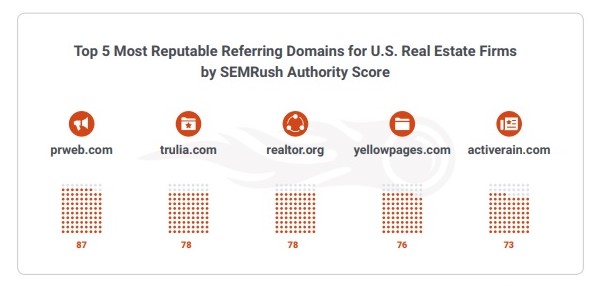
Courtesy: SEMRush.com
At any rate, get listed by as many of these types of sites as possible (Zillow, HomeFinder, YellowPages, Chamber of Commerce, etc.)
Next time you have some news, create a press release and post it at prweb.com. Yes, there is a fee, but for $99 they will permanently host your press release about your latest efforts to give back to your community, your new office announcement or whatever you choose to promote.
Now all you need to do is continue to post quality content with brilliant backlink profiles.
Here’s what the top agents know about having a great website that you don’t
Have more questions about backlinking? Check out this handy guide of do’s and dont’s: