All posts by Shannon

Summer Marketing Ideas For New Agents

We’re halfway through the year and we have a question for you: Will this be the year you “make it” in real estate or the year you leave the business?

Is this the year you’ll fine-tune your SEO and social strategy, maybe experiment with new marketing methods or buckle down and focus on conventional lead gen tactics?

Many agents spend most of the year spinning their wheels, waiting for that magic bullet piece of technology, or the latest innovative marketing idea. If you are among them, stop it.

Stop waiting for the newest, flashiest, shiniest gadget or idea. Chasing after squirrels will get you nothing but nuts.

The real estate industry is full of marketing methods and tips, some old, some more recent and most of them work, if you work them.

With that in mind, here are some summer marketing ideas for real estate you cant afford to miss.

Make an Old Idea New

The divide is sharp in the battle between high tech and conventional marketing methods. Adherents to tech typically consider the “old ways” of marketing archaic, while those that use those methods, and succeed, sputter and spit in defense of them.

Why can’t we marry the two and come up with hybrid summer marketing ideas for real estate?

“A lot of my ideas are just old ideas that I made better,” marketing wiz and broker Kris Lindahl with Kris Lindahl Real Estate in Minnesota.

During a chat we had some time ago he told me that “I never stop looking for new ideas. I’m always on the internet and anything that I see, whether it’s real estate-related or not, if it’s catchy, I’ll try to figure out how to make it my own and make it better,” Lindahl continues.

One of these oldies is the agent charity event. In 2015, Lindahl took this idea and started The Great Pumpkin Giveaway. For each pumpkin given away, the team donated $1.00 to the local homeless charity. Sounds pretty conventional, right?

Through his marketing efforts, however, the event drew 3,000 attendees (in a not-so-big city) and they ended up giving $2,000 to the homeless shelter. He persuaded local businesses to donate the music, food and beverages so the cost of the event for the team was negligible.

He used Facebook as his primary marketing vehicle, pushing the flyer out via both his business and personal page. Repeatedly.  He also used his blogs to get the word out.

Then, he relied on some old-school marketing – he hired Anoka County Achieve, a group that works with adults with developmental disabilities — to deliver flyers door to door.

“Real estate agents have been doing charity events forever, but now we can use technology, combined with old school methods, to spread the word,” he suggests.

It’s a phrase that’s ready for the dust heap, but it fits when thinking about summer marketing ideas for real estate: “think outside the box.” Whether you’re planning a charity event or a client appreciation party, don’t be afraid to give that old idea a makeover.

The makeover happens when those old-school summer marketing ideas for real estate is combined with new-school marketing methods.

It works. For almost no money out of his pocket, Lindahl got his name, his brand and his team in front of thousands of prospective clients.

Spend More Time Nurturing Past Clients

Referrals and repeat business are the life blood of every successful real estate practice. With them, you can ease off on the dialing for dollars or whatever method you use to chase after new business.

The Chartered Institute of Marketing estimates that “it costs between four and 10 times more to acquire a new customer than it does to retain an existing one.”

Hear that my tight-fisted-hate-to-part-with-a-buck REALTOR® friends? Nurturing past clients is cheapo lead generation – every agent’s dream-come-true.

If you’ve been in the business for some time and have built up a healthy book of past clients, maybe now is the time you reach out and make them fall in love with you.

Again, marketing techniques to woo this group of people can include the high-tech, low-tech, or a hybrid of both.

Even in the Covid age and beyond, a client appreciation event that includes both past clients and your SOI can be amazing an lead generator.

They don’t have to be in-person events, either. We found a brilliant list of virtual client appreciation events you can hold from your laptop. Download your free copy of 30 Virtual Event Ideas at flodesk.com.

We’re also rather fond of the email newsletter. Cheap, easy (once it’s set up) and effective – they’re the epitome of the ideal marketing vehicle – if they’re done right.

You’ll need a content strategy so that you aren’t sending out new listings all the time or blabbing that because of low rates “it’s the perfect time to buy!” Find out what information folks are craving and give it to them.

How the heck do you know what that is? Ah, an old writer’s secret: research. I went to Pinterest and found out that the most popular topic, among both men and women is “Food and Drink.”

Hey, remember the stupid recipes agents used to send out? Maybe they were more forward-thinking than we gave them credit for.

Seriously, though, here’s an opportunity to take old summer marketing ideas for real estate and make them new. Put your own spin on it, review a restaurant or happy hour, rave about a meal, suggest date night and tell them where to go and what to order.

How about a menu for a housewarming or holiday get together sourced from locally-produced items?

While we’re at Pinterest you may be interested in knowing that women prefer crafts and home décor topics too. Men like photography, art, design and, believe it or not, home décor.

Decorating articles, then, seem like the ideal thing to entice your recipients to open and read those newsletters.

Don’t neglect the power of social media to stay connected with past clients – many of the topics you write about in the newsletter will make great shares on Facebook.

Be the Ray Donovan of real estate

Solve problems – agents are admonished to use this mantra when considering what topics to include in their website content, what to write about on their blogs and in their marketing materials.

Why solve problems from a distance? Bloomington, Ind. agent Deb Tomaro sure doesn’t. Again, here’s an agent that has taken an old idea – the seminar – and put her own twist on it.

Years ago, she was holding 90-minute “educational” seminars for potential homebuyers. Still pretty traditional stuff, right? The seminars, however, became so successful that she made this aspect of real estate her niche.

It had expanded to the point where she partnered with several large Bloomington employers who just love offering her seminars as an employee benefit. Ca-Ching!

So, maybe you don’t want to put the effort into holding seminars. It’s not the only way to address real estate consumer’s fears, concerns and problems.

Maybe you can spend the rest of the year becoming the expert on every last nuance of your business and the community in which it is located, from the mortgage process to the title process to closing, to local issues and everything in between. Being the problem solver is a great step to getting creative with summer marketing ideas for real estate.

In other words, be the “fixer” of real estate problems.

The SEO glossary every new real estate agent needs

If you don’t have a spiffy new real estate website, you’ve skipped a step in your reach for the top in the real estate industry. An online presence is a must for real estate agents and a real estate website should be one of the first purchases you make when you learn you’ve passed the license exam.

No, getting started in the business isn’t cheap. This is why you may want to learn all you can about SEO to gain organic traffic for that new website.

To help you out, we’ve compiled a glossary of some of the most common SEO terms that befuddle new agents.

Alt text

You may hear this term also referred to as “alt attributes.” Short for “alternative text,” it is text used “… within an HTML code to describe the appearance and function of an image on a page,” according to SEO specialists at moz.com. Alt text describes an image if it fails to load properly.

Typically one or two sentences in length, alt text is important for your real estate website SEO in that it “… can influence the content for which search engines consider a website to be relevant,” claims the moz.com website. They also suggest that the alt descriptions should contain the search terms “… for which the website is optimized.”

Here’s an example of how you might use alt text on a neighborhood page:

Arnas Goldberg, CC BY 3.0, via Wikimedia Commons


For this photo, the alt text may look like this: <img src=”Kings Landing.png” alt=”Homes in the Kings Landing neighborhood in the Seven Kingdoms”>

Learn more about alt text at moz.com.

Anchor text

“… link building is one of the countless critical factors for boosting your search engine rankings in the eyes of the Google Gods,” according to Julia McCoy at semrush.com.

In a nutshell, anchor text describes the words you choose when including a link in your text, as part of your real estate website SEO. For example, Easy Agent PRO blog is anchor text. “Semrush.com” in the paragraph before this, is also an example of anchor text.

So, what does this have to do with real estate website SEO?

Google’s algorithms uses anchor text to glean the topic of the content on the page. Also, anchor text, according to McCoy, “… tells your readers what to expect before they click the link. Anchor words are THE promise about what is on the other side of the link, so they must be highly relevant.

To start, one ranking metric that Google employs is link relevancy. Huh?

“… how related the topic of page A is to page B if one links to the other. A highly relevant link can improve the likelihood of both page A and page B ranking for queries related to their topic,” the pros at moz.com state.

Backlinks

Also known as inbound links, backlinks are those that link from another website to yours.

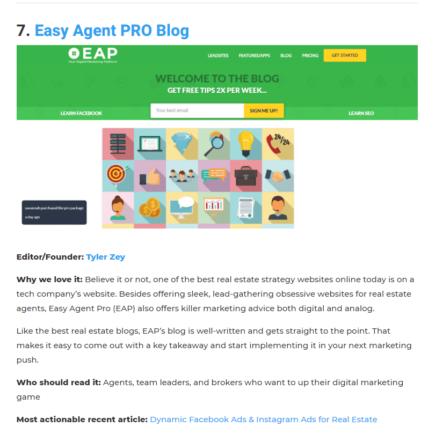
For example, the folks at theclose.com chose Easy Agent PRO’s blog among the best real estate blogs “to make you a better agent in 2021.” They linked to us from their review:

Our name, in blue at the top of the review, is an example of a backlink – and backlinks are very good for your real estate website SEO.

Some, in their efforts to increase SEO, go about deliberately building backlinks, a process that Neal Patel says can backfire. Because “not all backlinks are created equal, … You can use link building to increase your website’s rankings. You can also use it to decrease your rankings and hurt your domain authority,” he cautions.

Learn more about backlinks and Patel’s strategies at nealpatel.com.

Bounce rate

Let’s imagine homebuyers landing on your website. Some may leave immediately, or after scrolling through the home page. Others may click on a link in the nav bar. Some go to the neighborhood section while others are interested in learning more about you.

Those that bailed help determine your bounce rate. It is the percentage of those visitors who didn’t take another action after landing on a page on your site.

Duplicate content

Duplicate content is, simply, content that appears, in identical form, on more than one website or on the same website.

Although many real estate website SEO newcomers believe there is a Google “penalty” for duplicate content, there isn’t. But duplicate content can hurt your SEO efforts in another way.

“… search engines will rarely show multiple versions of the same content, and thus are forced to choose which version is most likely to be the best result. This dilutes the visibility of each of the duplicates,” according to the SEO pros at moz.com.

Header tags

Think of header tags as the title of your blog post (heading1, or H1) and then the sub-headers sprinkled throughout (heading 2, or H2)

For example, in this blog post, the H1 is the title, or “The SEO glossary every new real estate agent needs.”

Each sub-heading, which we’ve bolded (such as the one above, “Header tags), bears an H2 tag.

Header tags not only give structure to your blog post, helping readers find what they need, but they also provide “… keyword-rich context about your content for the search engines,” according to Amelia Willson at searchenginejournal.com.

Image compression

Image compression (resizing images) helps speed up the loading of a web page, thereby indirectly impacting SEO.

Internal links

An internal link is a link on your site that links to another page on your site. For instance, did you know you can find loads of SEO tips for real estate agents in Easy Agent Pros blogs?

The text in blue in the previous sentence is an internal link, pointing to another blog post which gives additional SEO tips.

Sounds like no big deal, right? Jason Hardwick, at ahrefs.com, begs to differ:

Internal links “… are crucial to SEO success.”

He goes on to mention a case study to prove his point. Check it out at ninjaoutreach.com.

Then, get busy building your internal link structure by checking out Neil Patel’s “7 Internal Linking Strategies That Will Boost Your Content Marketing SEO.”

Keywords

What you enter into a search box on Google or any other search engine are keywords.

For example, suppose I’m looking for a home for sale in Anytown. I want to start my search in a particular neighborhood, Sage Creek. I most likely would type “houses for sale in Sage Creek Anytown” into Google’s search box.

This keyword string, by the way, also passes as a “local query” and as “long-tail keywords.”

Long-tail keywords

It’s one thing to search for “homes for sale” and quite another to search for “homes for sale in Boise” or, even better, “homes for sale on acreage in Boise.”

The more specific searchers get with their keywords, the longer they become. Thus, the long-tail keyword, which is every real estate agent’s best friend.

Why?

You do understand that the chances of your site showing up on page one for keywords such as “homes for sale in Long Island” or “houses for sale in Miami” are slim to none, right?

Long-tail keywords, on the other hand, “… are usually much easier to rank for than general keywords,” claims Sergio Aicardi at semrush.com.

The bonus is that the audience that Google delivers to your site for these terms is most likely filled with warmer leads. At the very least, long-tail keywords tend to deliver a more targeted audience.

Learn how to find the right long-tail keywords at yoast.com and neilpatel.com.

Meta Description

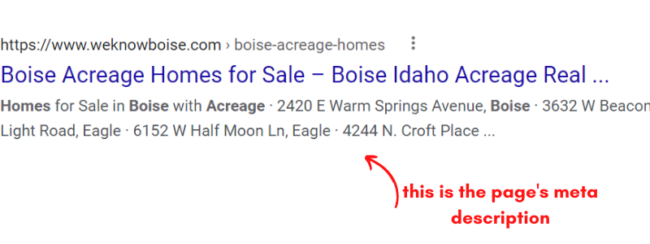
The text you find under the link in a search engine result is the meta description. Here’s an example:

It can be anything you want it to be, but it should be a short description of the page or the site. To use such valuable real estate for your company’s address is rather unwise. There are so many other keyword-rich descriptors they could’ve used here.

Organic

Typically used in the phrase “organic search results,” organic is the opposite of paid search results.

SEO

Short for “search engine optimization,’” SEO “… is the process of making your site rank as high as possible in Google when someone …” performs a search for your real estate keywords.

Learning real estate website SEO tactics can present a steep learning curve to the newbie. It can be frustrating as well because SEO is ever-changing.

SERPS

Short for “search engine results page.” It’s the page you land on after entering a search term.

Naturally, this is just the bare-bones minimum amount of definitions you can find on various aspects of SEO, but these terms are the most commonly misunderstood to new website owners.

Is there one real estate website SEO technique that is more powerful than others? Loren Baker at searchenginejournal.com claims that one of the most common answers to that question is “Well, it depends …”

Thankfully, he is a bit more willing to share an opinion. “There isn’t one golden SEO factor that outranks all the others,” he admits.

And adds that “This might be frustrating, but it’s the truth.”

Amen.

If all of this feels too overwhelming, don’t worry! LeadSites are designed to be easy to use and understand. Visit our website to schedule a demo and learn why LeadSites are the perfect tool to take your business farther.

Blog topics for real estate websites: Where to find inspiration

If you’re a client of EAP we get why you most likely aren’t blogging. After all, you get free blog posts with your website.

This doesn’t mean you shouldn’t be blogging. Although we feel that the posts you get from us are genius, they aren’t hyper-local. And that’s what it takes if you want a well-rounded SEO strategy. Heck, even if you just want to use our pre-written blogs, make sure you’re editing them to be about your local area.

blog topics for real estate websites

When we ask non-blogging agents why they don’t blog they typically give us one of three reasons:

  • It takes too much time out of my schedule.
  • It’s too expensive to pay someone to write them for me.
  • It takes too much time to see results.

When you’re looking for website traffic, these excuses just don’t cut it; real estate blogging and blog promotion is non-negotiable.

Unless seeing instant results is so important to you that you can blow a ton of money on Google ads, you simply must get that hyper-local and other share-worthy content (and the keywords that go with it) on your real estate website.

As we have previously mentioned, a blog with nothing but real estate content is boring. It also gives the impression of being overtly self-promotional when the blogs are reposted on social media.

The best real estate agent blogs offer something for everyone. Yes, this includes buyers and sellers, but also those readers interested in gardening, decorating, remodeling, DIY fix-it and more.

Best of all, when you veer away from being strictly real estate-ish you have the opportunity to show some personality and expertise in other topics. Potential clients find this engaging.

Whether you hire a writer or do them yourself, blogging is one of the best ways to increase your organic SEO.

Need blog topics for real estate websites? Here ya go!

The internet is awash with blog topics for real estate websites

blog topics for real estate websites

Conventional real estate blog-writing wisdom says that the best topics are those that answer concerns and questions from your clients. You know what we’re talking about:

  • What should I do to get my home ready to sell?
  • Are there any down payment assistance programs?
  • Should I get a home inspection before putting my house up for sale?
  • What is better? Sell first or buy first?
  • How long will it take to get my home sold?
  • How do I choose a lender?

They are common questions that should be answered. But they can also be found on a million other websites (yes, I exaggerate).

You’ll often find little-discussed but important topics on sites such as Zillow.com. The Porchlight section is where you’ll find some nuggets to inspire you.

Although it appears they haven’t added to the blog since autumn of last year, here are some blog topics for real estate websites you might want to work your magic on:

  • A 3-Step downsizing plan
  • The hidden costs of homebuying
  • A real estate lingo and term glossary
  • Simple tricks to organize your garage
  • How to negotiate the counteroffer

Head on over to redfin.com for more ideas:

  • How long does an appraisal take and what to expect?
  • How to protect your home from wildfires.
  • Minimalist home interior décor.
  • An explanation of the escrow process and the players involved.
  • Home décor ideas to induce relaxion

Find additional topic ideas at magazine.realtor, realtor.com and Better Homes & Gardens Real Estate.

Amazon

It’s often said that you can find anything on Amazon. We agree. You can even find inspiration for your blog topics for real estate websites if you know where to look.

What people are purchasing says a lot about their pain points and the solutions they’re seeking. An amazing way to figure this out is by checking out amazon.com’s best-selling product list.

For instance, right now, one of the most popular products in the Home and Kitchen category is a mosquito repellent gadget. How about a blog post on how to get rid of mosquitos or how to do battle with summer insects?

Growing sunflowers in summer gardens is quite popular and the seeds for these tall, lanky beauties are burning up the list of top 10 most popular purchases in Amazon’s Garden section. Give your readers a break from real estate with a post on how to plant and care for sunflower plants.

Pinterest

First, a word of warning: Pinterest can become a rabbit hole. There is so much to look at, to read and to ponder on the site that it’s easy to fall into that hole and re-emerge at dinner time.

Pinterest’s demographics, however, make Pinterest one of the best social media platforms for blog topics for real estate websites.

While the median age of a Pinterest user is 40, as of February of 2021, the largest pool of Pinterest users in the U.S. is comprised of adults, age 50 to 64. That, by the way, is the age range of the largest pool of home sellers in the U.S. Here are some additional stats:

  • 80% of U.S. mothers who use the internet use Pinterest.
  • 30% of U.S. Pinterest users come from suburban areas.
  • 42% of U.S. women adults (aka “decision makers”) use Pinterest.

We think it’s safe to say, then, that the content on Pinterest is of great interest to your target audience as well.

Let’s dive into some of  Pinterest’s trending topics to get blog topics for real estate websites:

  • Backyard patio trends
  • Swim parties
  • Kitchen ideas
  • Nursery ideas

Then, there is Pinterest Predicts where “Before you see it everywhere, see it here.” The folks at Pinterest have an uncanny talent for predicting tomorrow’s trends. Here is what their crystal ball says (as of this writing) that may serve as fodder for your real estate blog:

  • Japandi aesthetic (“Japanese design meets Scandinavian minimalism”)
  • Kitchen floating shelves (“130% increase in searches year over year for kitchen floating shelves decor)
  • Cloffice ideas (a cloffice is a closet or other space in the home that can be converted into a home office.)

Don’t forget where you live

Hyper-local content is what will speed up your arrival on Google’s page one of the search results faster than anything else you post.

It’s also the type of post that your social media followers will share, helping to boost your brand awareness and make you a social media darling.

We love regional magazines when searching for hyper-local blog topics for real estate websites. Denver, for instance, is home to 5280 Magazine. Here’s a sample of stories featured on the magazine’s website:

  • 6 of the hottest chicken sandwiches in Denver, ranked by spiciness.
  • Unforgettable Colorado adventures to get Dad for Father’s Day.
  • How to explore the new Colorado Springs.
  • Our 9-favorite warm-weather activities to do after work.
  • 12 of the best rooftop patios in Denver and beyond.

“… voices rooted in the sights and sounds of a place can reveal the complexity of what’s really happening in an area,” according to Danielle Jackson at longreads.com. Your community voice can also establish you as an expert on the local scene.

You’ll find a list of U.S. regional magazines online at allyoucanread.com.

Don’t overlook regional newspapers as well. We found a list of newspapers from across the country at 50states.com. Chosen at random, check out these blog topic inspirations from the Canton Observer in Michigan:

  • A Jurassic dinosaur drive-thru adventure is coming to Novi
  • Music returns to parks, gazebos, stages as community concert series start
  • M Street Baking Co. opens new shake shop at Twelve Oaks mall in Novi

Then, there are national websites that feature “the best” type blog posts in each state. Take delish.com, for instance. They’ve reviewed (among other topics) the best:

  • Grilled cheese sandwich
  • Chocolate chip cookie
  • Local convenience store
  • Place to get chicken wings
  • Barbecue joint

in all 50 states. Narrowed down to your market, these “best of” topics are immensely sharable and sure to drive traffic back to your website.

We think a very cool idea is to use the topic on social media to get your follower’s opinions. “Where’s Akron’s best grilled cheese sandwich?”

Use the eateries with the most mentions to compile your blog post and then post a link to it on social media.

Local guides are always popular, albeit a bit time-consuming to compile. Although it lacks photos (which are a MUST), here’s a guide to summer camps for kids from Lake & City Homes Realty in Madison, Wisconsin.

Here’s another from vegasfamilyevents.com.

Consider writing neighborhood guide blog posts. Although this one is quite short, it would be easy to expand by mentioning popular businesses, attractions and features (great commute, etc.).

Make the first one easy by joining your neighborhood on nextdoor.com. Check out the recommendations section for blog post fodder.

No time to research the information you’ll need to compile the guides? Researchers for hire are quite inexpensive on websites such as upwork.com and fiverr.com.

We offer up additional blog topics for real estate websites here on Easy Agent Pro.

Now that you’re armed with places to find ideas for your blog posts, all you need is someone to write them for you or the time to write them yourself. For the former, visit online hiring sites, such as upwork.com or fiverr.com.

Don’t forget the most important part of real estate blogging: share each post’s URL on social media.

Summer Real Estate Blog Topics Every Agent Should Consider

SEO. Getting sick of hearing that one? Especially in the real estate industry, it seems that all the SEO in the world won’t get the average agent to the front page of the Google search results. A coveted spot, for sure, but one that most agents will never reach by using the most popular real estate terms.

There is another way to rank higher: blogging, consistently.

As a writer, I can tell you that the hardest part of blogging, especially if you’ve been doing it for some time, is coming up with fresh topics.

A good method to use when this happens is to narrow your focus when brainstorming. What topics would be of interest to homebuyers? What are the pain points sellers are experiencing right now? What topics are the folks in my sphere of influence currently searching for?

Let’s take a look at some real estate blog topic ideas that you can use right now.

Audience: Home Sellers

Topic: “3 Things You Must Know about Selling your [name of your market] Home this Summer”

Sure, the nation is in a hot sellers’ market right now, but what is your local market like? Multiple offers? Buyers waiving contingencies? Are days on the market down significantly? Choose the three most interesting aspects of the current market and blog about them.

Remember to keep it positive. They don’t need to be scared into selling their home. Sell the benefits of putting their home on the market this summer.

Since there aren’t a whole lot of sellers in the market right now, blog posts that might get homeowners at least thinking of selling should be on your home seller topics list as well. These summer real estate blog topics include:

  • The amount of homeowner equity is at all-time highs. Many homeowners don’t realize this and for good reason. The media puts this in terms of “home price appreciation.” You won’t make that mistake. Tell it like it is. How much more money will they get if they sell right now rather than waiting? “You’re sitting on a ton of money” is far more compelling than “home price appreciation.”
  • Technology allows homeowners to sell without having people traipsing through their homes.
  • Many homeowners are worried that if they sell their current home how will they find a replacement home with the market so hot?
  • Those who don’t have that fear, want to know if they should sell first or buy first. “how to buy a house before selling yours” is a trending Google search term (spiking 160% last week) so offering an answer in a blog form is a wise move.

Other summer real estate blog topics to consider:

  • The home selling process, start to finish. Again, don’t gloom and doom this. Keep it light, and make it sound easy (because it will be with you as their listing agent, right?).
  • Explain to readers what to pay close attention to in the purchase agreement. As we all know, there’s more to an offer than price.
  • Recommended repairs to make before the home hits the market.

Summer real estate blog topics – Audience: Home Buyers

Topic: “3 Things you Must Know about Buying a Home in [name of your market] this Summer”

In plain English, explain three important aspects of the current market and what buyers must do to be successful. Keep the post conversational. For inspiration, check out this post at 5280.com and this one at wkrn.com. The latter offers homebuyers this brilliant tip for summertime 2021 house hunting:

“You can often sneak in and pick up a house that may not have 50 offers on it on a 4th of July weekend, Memorial Day, Labor Day,” Nashville broker Robert Drimmer tells WKRN’s Erica Francis.

“If you’re staying in town this summer, then keep looking. And, look during those holidays because there will be inventory on the market, and those buyers will be out of town,” he concluded.

So, that takes care of number one of the 3 things they must know about buying this summer. Here are some more to round out the list.  Feel free to steal them:

  • This is not the time to surf the web looking at houses. Most are gone the day they are listed or within days and are no longer available. For that same reason, caution against driving around to look for “for-sale” signs. Suggest that they get a buyers’ agent who will notify them of every new listing that meets their criteria as soon as it hits the market.
  • Council buyers to ensure they’re working closely with their lenders so that they’re ready to move if their offer is accepted.
  • If buyers are on the edge of their preapproval amount and wouldn’t be able to participate in a bidding war, explain how to sweeten the contract’s terms.
  • “If you sleep on it, then you likely won’t sleep in it,” Francis tells her readers. “In a competitive market like this, you must act fast.”
  • The backup offer.

Additional homebuyer-focused summer real estate blog topics to consider:

  • Are some sellers still selling virtually in your market? Educate your clients.
  • What are the most popular neighborhoods in your market and how can buyers interested in them compete?
  • “how to get ready to buy a house” is a skyrocketing search term, according to Google Trends. Use it as the title of a blog post.
  • Use “real estate” as a keyword if you serve the following markets: Montana (the term has spiked 100% over the past week); Vermont (searches for “real estate” are up 92% here); Wyoming (up 83%); Idaho (up 68% here) and Utah, also up 68%.

Summer real estate blog topics – Audience: Social media followers

Topic: Hyper-local Content

Your blog shouldn’t be populated with strictly real estate-related content. Not everyone is in the market to buy or sell right now, so mix it up. Even someone who isn’t going to buy or sell right now may know someone who is and maybe their friend on Facebook.

Community content is exceptionally shareable. Folks are typically proud of their town, so are more apt to share these posts than real estate-related content.

Check out some of these summer real estate blog topics:

  • Americans are still feeling cooped up. Which venues are open in your market? Are any festivals or other community events coming up this summer?
  • Quick reviews of local parks.
  • What is going on locally for kids? Check your local Parks and Rec department for ideas.
  • Gardening is HUGE this year. Consider posting advice on how to start a vegetable garden, plant a fruit tree, etc. Link to local nurseries to keep the posts hyper-local.
  • Americans love dining al fresco. Review the best outdoor dining spots for brunch, lunch, or dinner.
  • Day tripping is another all-American pastime and summer is ideal for it. What are some attractions out of your market that can be enjoyed in a day or over a weekend?

Blog about the best places to

  • Play golf
  • Camp out
  • Fish
  • Ride a bike
  • Hike
  • Picnic
  • Swim
  • Play tennis
  • Go antiquing
  • Dog-friendly attractions (best beach to take your dog, eateries that allow dogs, best dog parks, etc.)

Blog well and blog often and always, always, always share your content on social media.

Did these summer real estate blog topics help you plan your content schedule? Let us know!

The Key Elements of a Real Estate Squeeze Page

When a horse is thirsty, lead him to water, right?

The problem here is that you can’t make him drink, as the old saying tells us. But you can, and should, do what you can to encourage the horse to do your bidding.

The same holds true for real estate marketing. It takes encouragement and enticement to get most leads to drink from the fountain of real estate, thus becoming credible prospects.

There are lots of ways of accomplishing this, the most common is with a call-to-action (CTA).

If you have a solution to a common real estate problem or valuable information that real estate consumers seeking and a CTA to entice them, where will you lead them and how?

That’s where a landing page comes in handy. Today, we’ll dive into learning more about the landing page’s baby brother: the squeeze page.

KEY FACTORS FOR YOUR REAL ESTATE SQUEEZE PAGES

What’s the difference?

A squeeze page is a type of landing page. It’s shorter, the goal is more focused and the best use of it is to provide zero distractions so that the visitor is steered straight to the contact form.

“A squeeze page,” notes Megan Marrs at wordstream.com, “should act as an ultimatum for visitors – either take the offer or leave the page.” But an ultimatum in a kind, gentle way.

It’s the best type of landing page to use when you have a lead magnet on offer. We talked about lead magnets recently (What you Need to Know about Real Estate Lead Magnets) and reminded you how critical it is that yours is so enticing the reader can’t wait to get her hands on it.

So, she clicks on the link to find out how to get the goodies and is taken to a squeeze page. One step closer to becoming a lead.

What is the singular goal of the page for the visitor?

This is an important consideration and you’ll want to laser focus on it when building your squeeze page. More than one goal will be distracting for the visitor and the key to capturing leads with this page is to get folks to sign up for your lead magnet.

So, it has to be one, and only one goal.

If your lead magnet is a home seller’s guide, the goal of the landing page is to capture listing leads. Newsletter signup? Your goal is to gather signups for it.

Settle on one clear goal and keep it in the front of your mind when creating your real estate squeeze page.

Your singular goal with a real estate squeeze page

Your singular goal is to get the visitor’s email address. Not to tell the visitor how amazing you are, not to blast them with trite real estate sayings, but to get that contact information. That’s it.

“Squeeze pages are free of excessive content, links, and any other elements that could potentially distract users from the main goal – providing their email address,” suggests Michal Leszczynski at getresponse.com.

The real estate squeeze page

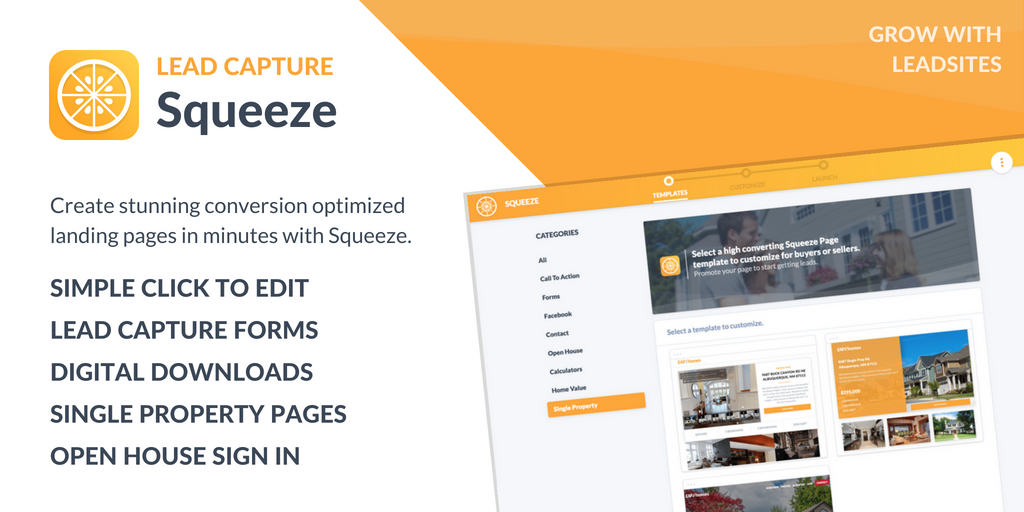
The easiest, quickest way to create a real estate squeeze page is with one of Easy Agent Pro’s templates. Check them out, here.

There are also WordPress squeeze page plugins.

Whether tweaking a template or designing your own squeeze page, there are some basics to keep in mind that will ensure you capture those leads.

Start at the top of the page

Remember, the key to success with your campaign is your lead magnet. What are you offering in exchange for the visitor’s email address? Whether it’s vital information in the form of a special report, an eBook or anything else, it must be enticing enough for visitors to want to cough up the info.

“The most common type of lead magnet is the report/guide/tip sheet where the prospect provides personal information for content that is not otherwise available,” according to Will Kenton at investopedia.com.

Again, the key to your success lies in the value of your lead magnet. Take the time to consider the average real estate consumer’s biggest problem right now and how to solve it.

Right now, one huge problem is the lack of inventory and the fact that homes in good areas and at decent prices are selling at lightning-fast speed.

We took one of Kenton’s ideas and tweaked it for the real estate agent:

“Six Foolproof Tips to Make a Winning Offer on a Home”

Folks who are going to sell and are in the process of getting the home ready for the market will next be looking for a listing agent. If your lead magnet piques their interest, they will click that button to download or otherwise receive that information.

If, on the other hand, your lead magnet offers common information that visitors can get on every other real estate website, you may as well not bother with the campaign.

The squeeze page will clinch the deal, so keep it short, distraction-proof and compelling.

  • Craft a killer headline. Jacinta Santora at optinmonster.com offers examples and we think this, from backlinko.com, is one of the best:


real estate squeeze page example 1

The headline must also let the visitor know that he or she has arrived at the right place. In other words, if you promised a seller’s guide don’t make your headline all about something else.

This doesn’t mean you need to be a Madison Avenue wiz to write the header. In fact, Emily Bauer at unbounce.com suggest that “It’s better to be clear than clever.”

Here’s another example from GQ magazine that we found at taboola.com. It’s simple, the subhead (above the headline) and the headline communicate exactly what I’ll get if I give them my email address.

We do suggest, however, that you leave off the “No Thanks” button.

real estate squeeze page example 2


Sean Bestor cites a sumo.com study that found “… straightforward headlines out-performed their creative alternatives 88% of the time.”

For example, the headline “Why Aren’t You Sending These 15 Emails?’ didn’t come close to the performance of “Free Ebook: 15 Emails Everyone Should Send.”

  • If, and only if, you have the space, include one of your best, short testimonials near the bottom. “… quotes from happy customers can prove to users that your offer is of value,” according to Marrs.
  • Create a simple yet powerful call-to-action. The above example’s is perfect. “GET THE EBOOK” or “GET THE SPECIAL REPORT,” or whatever your lead magnet happens to be.

Basic do’s and don’ts for your real estate squeeze page

Hick’s Law states that the number of choices a person has determines how long he or she will take to decide on one. The more choices, the longer it will take.

Remember this when putting together your real estate squeeze page. Give visitors only one choice: enter their email address in the opt-in box.

  • Target, target, target. This page isn’t for anyone with a pulse. If you narrowed your audience as suggested earlier, target only that audience.
  • Avoid adding outbound links with the exception of the one in your CTA.
  • Resist the urge to include a nav bar at the top of the page. It’s a distraction (remember, this page gives them only one choice).
  • Choose a compelling image.
  • Do consider adding a short but powerful sentence from a testimonial near the bottom of the squeeze page. Now, we aren’t talking testimonials from clients. Give your lead magnet to a couple of people, have them read and review it. Choose the best sentence from these reviews for your squeeze page.
  • Ensure that the page is optimized for mobile.
  • Proofread before publishing. A couple of times.
  • Ensure that your lead magnet is delivered immediately via email or download.

How do you get a horse to drink? Warm up the water, add yummy stuff to it, like apple juice, grain or soaked hay, and that horse may be enticed to drink from the trough.

Enticements.

They work on people too.

Check out this older article from Ethan Edwards at inman.com for more real estate squeeze page tips and inspiration.

What you need to know about real estate lead magnets

“Subscribe.” How many times have you been online and subjected to a pop-up with a brightly-colored button bearing that word? Very often it’s accompanied by an offer, many of which are rather lame.

For instance, would you give up your contact information to “join our email list?”

Me neither.

To generate quality leads from your website or landing page, you need to figure out which audience you want to target, what that audience wants and then provide it.

When it comes to lead magnets for real estate websites, the typical real-estate-agent-who-does-it-all thing won’t work. Niche down each campaign and narrowly target for the best results.

The why behind lead magnets for real estate websites

In a nutshell, a lead magnet is an offer from you in exchange for contact information. The offer should be for information or a service that answers a burning question or solves a current problem. The offer should be so intriguing, it incentivizes the reader to reciprocate.

In ecommerce, an enticing lead magnet (it works for me!) is “20% off if you sign up now.” That’s incentive for folks who actually came to shop and hope to find what they’re looking for because they’ll get a discount on the price.

That’s the first “why”

The second is that, hopefully, what you’re offering compels them to not only take action now but after they use or read the lead magnet.

So, another purpose of your lead magnet is to incentivize someone to take action, not only immediately, but in the future as well.

There is no incentive if the offer is common on other real estate websites. There is nothing compelling about information they can’t use, thus the importance of laser targeting your audience for each campaign.

Use your magnets to attract the right people

Just as you wouldn’t load up your CRM without segmenting each entry, nor should you create a marketing campaign that you hope will appeal to anyone with a pulse who wants to buy or sell real estate.

“If your lead magnet isn’t carefully designed to attract the right people, you’re going to find yourself with high unsubscribe rates, low open rates, and big fat bill to your email provider for subscribers that don’t really want to hear from you,” according to Jessie Lewis, at jessierlewis.com.

At least narrow down the campaign to target homebuyers, home sellers, condo buyers or condo sellers, veterans or immigrants, for instance.

An even narrower focus could be quite effective as well. Consider downtown penthouse buyers or sellers, starter home buyers, luxury home sellers, etc.

“Get clear on WHO you are talking to – age, problems, wants, needs, fears,” suggests Michelle Falzon at herbusiness.com.

“Before you create your lead magnet, try creating a survey, talking to clients, reading forums – just make sure you’re clear on who your lead magnet is for and create your content as if you were speaking specifically to that one persona,” she concludes.

Roger Dooley, at forbes.com, sums it up pretty well: “Sadly, most of the marketing emails I get are for things I have never bought and likely never will. The more off-target these emails are, the more likely I’ll unsubscribe.”

As will the potential home seller who keeps receiving content geared to homebuyers.

There is no rule, by the way, that limits you to one campaign. Along with one for the downtown penthouse buyers or sellers, run another for condo buyers or sellers, for instance.

Make sure your lead magnets are using the right keywords to rank on searches – Check out our guide here for more info.

Types of lead magnets for real estate websites

Informational lead magnets for real estate websites that we’ve seen include:

  • Homebuyer guide (the guides can be in any format, from PDF to E-book to published book)
  • Home seller guide
  • Relocation guide
  • How-to guides (staging tips, curb appeal advice and examples, what features current homebuyers are seeking)
  • City guide for newcomers
  • Neighborhood guides
  • Free staging
  • Free use of a moving truc
  • Free 3-D home tour
  • X number of hours of housecleaning, landscape cleanup or handyperson services when they list their home with you

Lead magnet formats include:

  • Checklist
  • Published book
  • E-book
  • Magazine
  • Newspaper
  • Case study
  • Video

Avoid these common mistakes when considering lead magnets for real estate websites

Mistake #1

The biggest mistake we see with lead magnets for real estate websites is that agents think it’s a set-it-and-forget-it lead gen technique. With this assumption comes a half-hineyed lead follow-up system.

So, yes, a lead magnet, if done right, will bring you leads. It’s not a magic bullet, however. It won’t magically convert them into clients and then revenue. THAT is up to you.

Here’s an example.

Ethan Edwards, in an older blog post at inman.com, tells us how he “… generated 100 real estate leads in 7 days for $50.”

In a nutshell, he created two hyper-focused lead magnet and landing page campaigns (one for buyers and one for sellers) and bought some Facebook ads to get them in front of the right audience.

He offered a seller’s and buyer’s E-book as the lead magnets.

Here are his results: “… I had 173 clicks through to my landing page and a total ad reach of 4,238 viewers. I spent $50.44, and my cost per click was 29 cents. I got 101 leads (a 58 percent conversion rate), and my cost per lead was 50 cents.”

Yes, it’s impressive, yet many agents, in the comment section, missed it and were asking the wrong question: What was your conversion rate? Or,

  • “I’d like to know how many signed contracts you get out of these leads.”
  • “How many transactions from 100 leads?”
  • “I’m curious, of those leads, how many turned in to actual business?”
  • “… how many of the leads converted to an actual sale?”

This is a common mistake with most real estate lead generation techniques. It assumes they are a magic bullet, with no further effort required by the agent. Especially that last one. Leads don’t convert themselves, agents do it.

The author didn’t answer these queries, and rightfully so. The topic of his post is about lead generation, not conversion. If I were still selling real estate and, with little effort and minimal financial outlay I am able to generate 101 leads in one week, I’ll take it.

And I’ll work my hiney off to convert these new leads into prospects and then clients.

So, for new agents, and those who may have forgotten, your GCI depends on these steps:

  • Generate leads
  • Convert leads to prospects
  • Convert prospects to clients
  • Successfully close client transactions

With the right lead magnet and landing page, the leads will come; it’s up to you to follow up consistently to convert them into business.

Mistake #2

Another common mistake we often see is the generic lead magnet.

If what you’re offering “…  doesn’t show them exactly how to fix a specific problem what’s the point of it? Mediocre advice is general; great advice is specific,” according to Ixchelle at blogbrandhustle.com.

Mistake #3

Not making your offer irresistible is a mistake we often see on agents’ lead magnet opt-in form.

For instance, homeowners who are thinking of selling have three burning questions:

  • How much is my home worth?
  • How long will it take to sell?
  • What do I need to do to get the most money for my home?

The last question leads to lots of answers, any of which might make an interesting lead magnet.

Once you’ve decided on a topic and the format to put it in, you’ll need to use the title on the opt-in form. It’s critical to make it so irresistible that they’ll cough up their contact information to get it.

For instance, “How to give your home curb appeal” may appeal to a few of your visitors.

But, “15 easy upgrades to turn on the front yard charm” is a lot more intriguing as far as lead magnets for real estate websites go.

“Home staging tips” becomes vastly more powerful when those tips are DIY. “Inexpensive staging tips that will make buyers swoon” gets that message across a lot better.

Now that you have an idea of how to use lead magnets for real estate websites, it’s time to create the opt-in form and landing page. We have you covered, so check back soon.

All the top real estate websites are using lead magnets – Here are some examples of the best websites in the industry today, and what they’re doing to get more leads.

Start Working Your Real Estate Sphere of Influence (SOI)

How many times do you have to learn that someone you helped buy a home used another agent to sell it before you decide to start targeting leads in your real estate sphere of influence?

Happens all the time, yet agents are throwing money at purchased leads when those same dollars can get more mileage by either purchasing a killer CRM or amping up the one they have, and throwing brilliant client appreciation events.

Ah, but it’s not necessarily the money for some, right?

It’s the time

Working your real estate sphere of influence takes far more time than money, at least in the beginning. And time is something busy agents are short on.

But, consider this: Agents making more than $100,000 a year told the NAR that they got nearly one-third of their business from referrals from past clients. They got 34 percent from repeat business.

Successful agents get 64% of their annual deals from their real estate sphere of influence

And, as first-time clients, they became official members of your real estate sphere of influence. If you’re like many agents, these folks fell through the cracks like the rest of the members.

Stop it!

A well-stocked CRM is the proverbial barrel full of fish and if you aren’t holding a shotgun over it, you’re working too hard chasing new business.

Fewer than one-fourth of home sellers used the agent that helped them buy their home

According to the NAR. Why? Because they forgot about him or her. That won’t happen to you, though because you’re going to take some time to ensure that you nurture both past and possible clients.

Make it easy on yourself

Make your CRM do all the heavy lifting. First, if you haven’t categorized the folks in your real estate sphere of influence, what are you waiting for? Are they potential buyers or sellers? Former clients?

Manage your sphere of influence with powerful, built-in CRM, right in your LeadSite – Learn more.

Categorizing, or “labeling” as it is sometimes known, helps you automate customized content delivery to groups of leads. It’s easy to forget the generic real estate newsletter or other content but send something of value – that they’ll actually read – and the results are far more impressive.

Then, root around in your CRM to come up with past clients who represent your oldest deals; they’re the most likely to be thinking about moving. These should be further categorized as your “hottest” leads.

Once you have your CRM up to speed, you can start planning ways to make contact with the ones who are most likely to transact in the near future. One of the easiest tasks to set for yourself is to find them on Facebook and follow them.

This way you won’t miss a chance to respond to them when they post something interesting

Real Estate Sphere of Influence - Responding

Respond you must, though, or that growing family you helped to buy a home won’t be calling you when they need a larger home.

After all, almost 90 percent of home sellers don’t use the same agent they used previously

Events for your real estate sphere of influence

When it’s time to dive deeper into your real estate sphere of influence — to really jog their memories about you — you have a number of choices:

  • Client appreciation events (even if some of the hottest leads in your real estate sphere of influence aren’t former clients, invite them anyway)
  • Seasonal activities (Kris Lindahl in Minnesota does an annual pumpkin giveaway, while Billings, Montana’s Amber Uhren held a very successful sock drive this past fall).
  • One-on-one meets (for cocktails, coffee, etc.)
  • Invite them to help you with your favorite cause. Collecting non-perishable food for your local food bank, cooking or serving food at the homeless shelter are just two ideas we’ve seen agents use.

When it comes to keeping in touch consistently, use a multi-pronged approach with your real estate sphere of influence. Email (newsletters, market updates, etc.), social media, face-to-face meetings, snail mail (just sold/just listed postcards) and whatever other marketing strategy you employ.

The point is to remain connected, consistently. This is how you build loyalty for your brand.

Ready to start growing your online marketing? Learn more about LeadSites.

Drive more leads and listings to your site with these hacks.

Looking for more ways to engage with your leads? Create a market analysis:

Focus on SOI marketing for real estate

Sure, you learned as a rookie to depend on your sphere of influence for business. Somewhere along the line, however, many agents get lured into other lead gen techniques, ignoring all those warm leads sitting in their CRMs.

Sure, some have the typical fears of salespeople, such as rejection, but many more are too busy prospecting for leads in the hopes one will turn into instant business.

If that’s you, how’s it working for you?

All the time and energy convincing a stranger to like and trust you is better spent tending to your sphere of influence, nurturing the amazing possibilities in your CRM.

Scary?

Sure, it is. Ask anyone who made the decision to cut buyers loose and focus on generating listing leads or the agent who decided to nix the single-family home market and become a condo specialist. They’ll be more than happy to tell you that niching down their business was frightening.

The same holds true for lead gen techniques. “Fear, momentum and the status quo combine to keep us stuck,” Seth Godin explains.

If free leads from something other than cold calls leading to potentially huge revenue sounds good to you, read on.

What exactly is a “sphere of influence?”

In the 1880s, the term “sphere of influence” originated as a political one:

“… the claim by a state to exclusive or predominant control over a foreign area or territory,” according to britannica.com.

Bringing up visions of colonization, it’s a pity it was chosen to represent a group of people that you know, like or even love.

Today’s accepted definition of “sphere of influence,” when it comes to sales and marketing is:

“A Sphere of Influence (SOI) business model is a strategy that focuses on attracting business to you from the people you know and the people you meet socially, as opposed to pursuing business from strangers.” (rismedia.com)

For some reason, “influence” feels like such an uncomfortable choice of words when it comes to real estate agents. Sure, you try to exert influence, or sway, a buyer to pay more for your clients’ home, but that’s negotiating.

But I digress. Your SOI, in a nutshell, is everyone you know, whether or not you’ve done business with them.

As you can imagine, the list can be frightfully long. Consider the types of people in your SOI marketing for real estate efforts:

  • Relatives
  • Friends
  • Friends of friends
  • Your parents’ friends and neighbors
  • Kids’ friends’ parents
  • Spouse’s or partner’s friends, family, and coworkers
  • Neighbors
  • Former (pre-real estate) colleagues
  • Kids’ teachers
  • Everyone to whom you send a Christmas card
  • Your doctor, dentist, gynecologist, veterinarian, eye doctor, etc.
  • Former clients
  • Service providers, such as pool cleaners, plumbers, gardeners, mail carrier
  • Folks you met and/or did business with your former career
  • Anyone you speak with on a regular basis (grocery checkout person, barista, waitperson, restaurant owner, bartender, etc.)
  • Your barber/hair stylist, manicurist, tanning salon personnel, yoga teacher, etc.

The list goes on and on and on. And, it’s growing every day.

Apparently, just by dint of knowing all these people, you have influence over them (see how creepy that word is).

A better way to think of it is that these people will at least listen to you and not hang up the phone or delete your email without reading it. And that there is half the battle.

Why it’s important to devote more time to SOI marketing for real estate

I recently read a blog post at followupboss.com that featured an interesting statistic: “85% of people don’t know how to get in touch with their Realtor.”

The writer ascribed the stat to NAR and included a link. Unfortunately, that statistic isn’t mentioned in the NAR piece so we can’t verify it.

But, if it is true, it’s a sickening truth. It explains why so many survey respondents say they will use their agent again and so few do.

It explains why the majority of real estate consumers go with the first agent they speak with

If agents spent as much time nurturing their SOI as they spend chasing after the next shiny marketing gimmick or pursuing lead gen tactics that aren’t working for them, they could end up like the team that was mentioned in that aforementioned blog post.

Apparently, the team’s coach suggested that they grow their SOI which, at that time, was just shy of 280 names. They took the advice and, within four years, their revenue jumped from nothing to $90 million.

If your CRM is short on SOI folks, start this new project by expanding it. First, wrack your brain to figure out who you’ve left out.

Then, get out and socialize (if that’s being allowed in your market). Interact with others. Get as much contact info on these people as possible and get them into your CRM.

Even if you are new to the business, or the area, you can quickly start SOI marketing for real estate. Consider:

  • Getting involved in a non-profit
  • Become active at your church, mosque, synagogue, etc.
  • Join a civic or service organization such as Lion’s Club, the Jaycees, Rotary Club
  • Volunteer
  • Join the local Chamber of Commerce and attend the mixers
  • Try to strike up a conversation while waiting in lines
  • Become a regular at a local coffee shop

Make it your goal to meet people, whenever and wherever you can.

If, on the other hand, you have the opposite problem (a huge sphere that has become unwieldy), take some time to pare it down.

  • Delete anyone whose name is only vaguely familiar
  • Delete or label as cold anyone who has moved out of the area you serve

SOI marketing for real estate – Get organized

If you haven’t done so, segment your SOI. There are no rules to this process; segment your SOI in a way that makes sense to you. Here are a few ideas we’ve heard from other agents:

  • Segment by relationship to you. For instance, family, friends, former clients, former colleagues, folks you know through your parents, kids, siblings, etc.
  • Choose who to focus your SOI marketing for real estate on by their likeliness to pull the trigger on a real estate deal the soonest. This would be your basic “hot,” “warm,” or “cold” prospect.

In the beginning, SOI marketing for real estate may be uncomfortable

If you’re anything like many other agents, there are a whole lot of people in your CRM that you haven’t had contact with in years. Maybe even decades.

Picking up that phone to make contact may bring up the same feelings you had if you ever attempted cold calls.

The fact that you actually know who you’re calling should make it easier but a lot of agents we’ve spoken with say that isn’t necessarily so. You may still ask yourself what you’ll say to break the ice. It’s even harder if you have only a cursory association with the person.

One technique we like is to make your first calls to those in your sphere that you are closest to. That will get you used to striking up a conversation and collecting as much personal data as possible.

Consider inviting those closest to you out to lunch or coffee.

Then, move on to others with whom you have a cordial, somewhat close relationship, such as past clients.

Consider direct mail for those at the cold end of the SOI spectrum; from a newsletter to a handwritten note letting them know you’re thinking of them, the first contact via direct mail, if it’s personalized, will break the ice.

Social media is another way to reach out to them. Find out where they hang out online and read through their posts. Discover what they’re interested in, what makes them laugh, etc. These are topics to keep in mind when coming up with your own social media posts.

Then, engage with them. Commenting on their posts will encourage them to return the engagement.

NAR once surveyed agents earning more than $100,000 a year. They learned that one-third of these agents’ business each year came from referrals from former clients.

Additionally, 34 percent of their business was repeat business.

This can only happen if they are consistently keeping in touch with these clients.

Something to consider, don’t you agree?

Struggling to get listings? This may just be the solution you need

What if we told you that, at least in the foreseeable future, the best way to get listings is to hang out with friends, family, pre-real estate colleagues and everyone else you know?

In other words, be more sociable and have fun.

Stop the cold calls and chasing expireds and fsbos. Put the quiver away; shooting arrows in all directions isn’t nearly as effective as what we’re going to suggest:

Focus on SOI marketing for real estate

Sure, you learned as a rookie to depend on your sphere of influence for business. Somewhere along the line, however, many agents get lured into other lead gen techniques, ignoring all those warm leads sitting in their CRMs.

Sure, some have the typical fears of salespeople, such as rejection, but many more are too busy prospecting for leads in the hopes one will turn into instant business.

If that’s you, how’s it working for you?

All the time and energy convincing a stranger to like and trust you is better spent tending to your sphere of influence, nurturing the amazing possibilities in your CRM.

Scary?

Sure, it is. Ask anyone who made the decision to cut buyers loose and focus on generating listing leads or the agent who decided to nix the single-family home market and become a condo specialist. They’ll be more than happy to tell you that niching down their business was frightening.

The same holds true for lead gen techniques. “Fear, momentum and the status quo combine to keep us stuck,” Seth Godin explains.

If free leads from something other than cold calls leading to potentially huge revenue sounds good to you, read on.

What exactly is a “sphere of influence?”

In the 1880s, the term “sphere of influence” originated as a political one:

“… the claim by a state to exclusive or predominant control over a foreign area or territory,” according to britannica.com.

Bringing up visions of colonization, it’s a pity it was chosen to represent a group of people that you know, like or even love.

Today’s accepted definition of “sphere of influence,” when it comes to sales and marketing is:

“A Sphere of Influence (SOI) business model is a strategy that focuses on attracting business to you from the people you know and the people you meet socially, as opposed to pursuing business from strangers.” (rismedia.com)

For some reason, “influence” feels like such an uncomfortable choice of words when it comes to real estate agents. Sure, you try to exert influence, or sway, a buyer to pay more for your clients’ home, but that’s negotiating.

But I digress. Your SOI, in a nutshell, is everyone you know, whether or not you’ve done business with them.

As you can imagine, the list can be frightfully long. Consider the types of people in your SOI marketing for real estate efforts:

  • Relatives
  • Friends
  • Friends of friends
  • Your parents’ friends and neighbors
  • Kids’ friends’ parents
  • Spouse’s or partner’s friends, family and coworkers
  • Neighbors
  • Former (pre-real estate) colleagues
  • Kids’ teachers
  • Everyone to whom you send a Christmas card
  • Your doctor, dentist, gynecologist, veterinarian, eye doctor, etc.
  • Former clients
  • Service providers, such a pool cleaner, plumber, gardener, mail carrier
  • Folks you met and/or did business with in your former career
  • Anyone you speak with on a regular basis (grocery checkout person, barista, wait person, restaurant owner, bartender, etc.)
  • Your barber/hair stylist, manicurist, tanning salon personnel, yoga teacher, etc.

The list goes on and on and on. And, it’s growing every day.

Apparently, just by dint of knowing all these people, you have influence over them (see how creepy that word is).

A better way to think of it is that these people will at least listen to you and not hang up the phone or delete your email without reading it. And that there is half the battle.

Why it’s important to devote more time to SOI marketing for real estate

I recently read a blog post at followupboss.com that featured an interesting statistic: “85% of people don’t know how to get in touch with their Realtor.”

The writer ascribed the stat to NAR and included a link. Unfortunately, that statistic isn’t mentioned in the NAR piece so we can’t verify it.

But, if it is true, it’s a sickening truth. It explains why so many survey respondents say they will use their agent again and so few do.

It explains why the majority of real estate consumers go with the first agent they speak with

If agents spent as much time nurturing their SOI as they spend chasing after the next shiny marketing gimmick or pursuing lead gen tactics that aren’t working for them, they could end up like the team that was mentioned in that aforementioned blog post.

Apparently, the team’s coach suggested that they grow their SOI which, at that time, was just shy of 280 names. They took the advice and, within four years, their revenue jumped from nothing to $90 million.

If your CRM is short on SOI folks, start this new project by expanding it. First, wrack your brain to figure out who you’ve left out.

Then, get out and socialize (if that’s being allowed in your market). Interact with others. Get as much contact info on these people as possible and get them into your CRM.

Even if you are new to the business, or the area, you can quickly start SOI marketing for real estate. Consider:

  • Getting involved in a non-profit
  • Become active at your church, mosque, synagogue, etc.
  • Join a civic or service organization such as Lion’s Club, the Jaycees, Rotary Club
  • Volunteer
  • Join the local Chamber of Commerce and attend the mixers
  • Try to strike up a conversation while waiting in lines
  • Become a regular at a local coffee shop

Make it your goal to meet people, whenever and wherever you can.

If, on the other hand, you have the opposite problem (a huge sphere that has become unwieldy), take some time to pare it down.

  • Delete anyone whose name is only vaguely familiar
  • Delete or label as cold anyone who has moved out of the area you serve

SOI marketing for real estate – Get organized

If you haven’t done so, segment your SOI. There are no rules to this process; segment your SOI in a way that makes sense to you. Here are a few ideas we’ve heard from other agents:

  • Segment by relationship to you. For instance, family, friends, former clients, former colleagues, folks you know through your parents, kids, siblings, etc.
  • Choose who to focus your SOI marketing for real estate on by their likeliness to pull the trigger on a real estate deal the soonest. This would be your basic “hot,” “warm,” or “cold” prospect.

In the beginning, SOI marketing for real estate may be uncomfortable

If you’re anything like many other agents, there’s a whole lot of people in your CRM that you haven’t had contact with in years. Maybe even decades.

Picking up that phone to make contact may bring up the same feelings you had if you ever attempted cold calls.

The fact that you actually know who you’re calling should make it easier but a lot of agents we’ve spoken with say that isn’t necessarily so. You may still ask yourself what you’ll say to break the ice. It’s even harder if you have only a cursory association with the person.

One technique we like is to make your first calls to those in your sphere that you are closest to. That will get you used to striking up a conversation and collecting as much personal data as possible.

Consider inviting those closest to you out to lunch or coffee.

Then, move on to others with whom you have a cordial, somewhat close relationship, such as past clients.

Consider direct mail for those at the cold end of the SOI spectrum; from a newsletter to a handwritten note letting them know you’re thinking of them, the first contact via direct mail, if it’s personalized, will break the ice.

Social media is another way to reach out to them. Find out where they hang out online and read through their posts. Discover what they’re interested in, what makes them laugh, etc. These are topics to keep in mind when coming up with your own social media posts.

Then, engage with them. Commenting on their posts will encourage them to return the engagement.

NAR once surveyed agents earning more than $100,000 a year. They learned that one-third of these agents’ business each year came from referrals from former clients.

Additionally, 34 percent of their business was repeat business.

This can only happen if they were consistently keeping in touch with these clients.

Something to consider, don’t you agree?

Educate Your Real Estate Clients To Make A Connection That Lasts

Aside from the inability to find a home in the current market, a huge swath of America’s homebuyer pool claims that the most difficult steps in buying a home are understanding the process and the paperwork (NAR 2020 Generational Trends).

Getting an understanding of the purchase process is so important to buyers that an agent’s knowledge of it is the number two most important quality that buyers seek in an agent (honesty is number one).

Ensuring that your prospects and clients have a complete understanding of the buying or selling process comes with bonuses:

  • They know what to expect every step of the way so they are more relaxed.
  • Since they’re more relaxed, the most common “freakouts” are avoided.
  • Educating them is the type of customer service that they’ll remember – which is good for your lead gen.

So, how can you help these folks to learn more about buying and selling? Let’s take a look at some of the more tried and true real estate client education methods that agents use.

Seller/Buyer workshops for real estate client education

Some agents call these events “seminars,” others refer to them as “workshops.” Whatever you choose to call them, they not only work to ensure that your prospects are educated, they’re another way to generate leads and convert prospects to clients.

Check out ways to get listing leads with seminars here on Easy Agent Pro.

The first step to workshop success is to figure out if you’ll be doing it virtual or live. Both methods have their drawbacks and benefits, especially now with the ongoing pandemic.

If your market has reopened completely and people feel confident attending events, a live workshop (preferably with refreshments or a meal served) may be your best bet.

If you opt for the virtual route, check out this Keller Williams article.

Next, decide on who you’ll be targeting with your real estate client education plan. If you’re going after buyers, consider the following:

  • First timers
  • Golf course properties (they’re gaining popularity again)
  • Vacation homes
  • Downsizers
  • Upsizers
  • Senior homebuyers
  • Veterans
  • Ranch/farm properties
  • Condo buyers
  • Luxury homebuyers

Some of the same categories can be used for determining who to target for a seller seminar. First-time sellers are particularly in need of knowledge.

Then, determine the topics you’ll cover. Budgeting, credit scores, how to prepare for the buying/selling process, down payment assistance programs, appraisals, inspections and VA/FHA loan information are just a few.

A member benefit of the NAR’s REBAC is a step-by-step walk-through of seminar setup and execution (“Home Buyer’s Seminar Guide”). Log in to find it, here.

Use a mix of old-school and digital marketing methods to lure attendees. Develop a landing page where they can sign up and then direct mail a postcard or deliver a door hanger that lists the landing page’s URL.

Don’t forget to market the workshop via your social media platforms as well.

Believe it or not, people still read

real estate client education

Although the pandemic is the biggest battle we are fighting, there’s another being waged to save small newspapers.

“The U.S. has lost roughly 2,400 newspapers in the last 15 years, about a quarter of the total,” according to Patrik Jonnson at CS Monitor.

An additional 70 have since closed, “… under the weight of the coronavirus …” claims pointer.org’s Kristen Hare.

Yet, some remain. The local paper, if you’re lucky enough to work in a market with a daily or weekly, is the perfect place to educate your prospects and clients. Oh—and to generate real estate leads.

If the paper is lacking a local real estate column, call the editor immediately. Yes, we get that you’re a real estate agent, a small business owner, and may not be a writer as well.

Hire someone. Freelance writers are available online, and often for very reasonable rates. Check out the writers at Upwork or Fiverr. Search for “real estate writer,” “journalist,” or just plain “writer.”

If you fancy yourself a pretty good writer, consider writing an eBook that dives deep into the buying or selling process. Use old blog posts as the skeleton, then flesh them out with additional detail.

Then, there’s the ever-popular real estate newsletter.

Again, you’ll find proofreaders, editors, and even book formatters on the aforementioned freelancer sites.

Host a real estate radio show

Many markets have real estate radio shows, primarily on the weekends, hosted by mortgage brokers and real estate agents. Known in the broadcast industry as “ask-the-expert shows,” they’re the ideal format for educating prospects.

In turn, you receive massive market exposure, establish yourself as an expert, and achieve brand recognition for your real estate client education efforts.

The cost may be prohibitive for new or struggling agents, but how much a station charges varies across markets, according to:

  • Size of the market (major, medium, or small)
  • The time slot you desire
  • The station’s ratings
  • Whether or not you bring your own sponsors (lenders, home inspectors, home stagers, etc.)

Air time is far less expensive on the weekends and stations in need of weekend content may give you a break.

Can’t round up sponsors? Ask the talk stations in your market if they offer brokered programming time slots.

Brokered programming is, “… time slots sold by a station to independent producers who create their own programming; the party who buys the time and produces the program to air; for example, a foreign language program on a mostly English language radio station,” according to the experts at mediatracks.com.

“For $75 to $300 an hour, theoretically anyone can play DJ, or give financial, medical or moral advice to listeners,” according to David Altaner at sun-sentinel.com.

Some stations actively seek out shows and will even train the hosts on the use of studio equipment and more. Check out KRFC in Fort Collins, Colorado, and KGPC in Oakland, California.

As for your content? Determine your audience – New buyers and sellers will have very different questions than experienced clients.

More time than money? Focus on blogging for real estate client education

real estate client education

There’s a lot more to blogging than writing. You need to promote your posts to drive traffic to your blog. So, although it’s a low-cost or even free way to educate consumers, it is time-consuming. And, it requires dedicated consistency.

Real estate client education blog topics that folks may be interested in include:

  • The mortgage process – first-time buyers especially will appreciate a walk-through of the mortgage process, from start to finish, in plain English. A list of down payment assistance programs and how to buy a home when selling (which comes first?) are examples of additional topics that most buyers and sellers will find valuable.
  • Do a series of posts—a glossary of sorts—of the most common real estate terms they’ll be hearing when they buy or sell. Examples include contingencies, seasoned funds, due diligence, and fixtures.
  • The closing process – After the financing process, closing is a mystery to most of the prospects you’ll meet. Explain who will be there, and what happens, and outline the paperwork they’ll encounter.
  • Answer common, pertinent questions, such as “Will there be another housing market crash?” “Will mortgage rates rise significantly this year?”

There are lots of ways to educate prospects and clients. Focus on avoiding jargon and using language they understand.

Check out our tips for The Best Ways To Generate Real Estate Leads

6 common sense ways to get listings FAST

Lots of demand and very little supply. The current housing market is a textbook example of the economic law of supply and demand.

Homeowners who decide to sell are the winners while buyers and real estate agents are hungry for more homes to hit the market.

Getting listing leads quickly in this market may seem impossible, but it’s not. No, it isn’t easy, but it is possible.

And, it requires a multi-pronged strategy.

First, KISS

Whether you choose direct mail, cold calling, buying ads or any other marketing method, the need to cut through the clutter of advertising that most consumers receive every day is more important than ever when looking for listing leads.

Keep to one message and simplify that message so that those with even the shortest attention spans will understand immediately:

  • What you offer
  • How it will make their life better
  • What they need to do to get started

Author Donald Miller (“Building a Story Brand”) calls this the “Grunt Test.” Is your marketing message simple enough that a caveman could, within five seconds, get the value in what you’re offering?

It’s similar to the KISS principle: Keep it Simple, Stupid.

Here’s an example of a simple real estate marketing postcard that we found at vistaprint.com.

Notice that there isn’t any personal promotion going on here. Resist the urge to clutter this marketing campaign with information about:

  • How many homes you have sold
  • Awards you’ve won
  • Your designations
  • More than one phone number to reach you

Save that information for your website.

Go after starter homes

Starter homes are not only in high-demand right now, but, as you know, they’re in short supply.

Sure, homeowner reluctance to sell has a lot to do with the shortage, but homebuilders do as well.

In 2019, “… the majority of newly constructed homes consisted of upper-tier housing costing at least $500,000,” according to fool.com’s Maurie Backman, citing a Mansion Global report.

She goes on to cite a National Association of Home Builders report that finds high lumber costs are another contributor to the starter-home shortage. Apparently, mounting lumber costs have added “$24,386 to the cost of a newly-constructed single-family home since mid-April 2020.”

That leaves existing starter homes for listing agents to pursue. Farming, via direct mail, is probably the best way to reach out to these homeowners. Start by narrowing the audience to those who’ve owned their homes for more than 10 years.

Then, create a very simple direct mail piece that highlights the equity these owners have accumulated.

Frank Naft, CoreLogic’s chief economist claims that the 9.2% bump in home prices in the fourth quarter of December 2020, compared with prices from the same period in 2019, boosted home equity.

How much? More than $200,000 “… for the average homeowner with a mortgage,” he says.


Do more schmoozing for listing leads

With the weather outside no longer frightful, and millions of Americans have had or will receive the anti-COVID jab, it may be time to consider a client appreciation event to collect those listing leads.

This one, however, will have a twist: it will be a potential client appreciation event.

The goal here is to extend your brand recognition to those potential sellers in your farming area. Hold the event outdoors, preferably in a park within your farm area. This does away with lingering pandemic fears.

Agents we’ve spoken with offer up the following ideas:

  • A barbecue
  • Movie night
  • Ice cream social
  • Block party
  • Outdoor concert
  • A day at a sporting event (this is best for your two or three most promising leads)
  • Seller seminar

Whichever you choose, serve food. Millennials, especially, attend events based on whether or not food will be served.

The invitation sent to your farm should be, again, simple yet attractive. If the event is family-friendly, let them know.

Find listing leads in your CRM

When was the last time you took a deep dive into your CRM? It’s a rich source of possibly quick business that too many agents ignore.

Since warm calls are always easier than colder calls, start with past clients and call each of them. Explain the lack of inventory and ask if they know anyone who is thinking of selling.

Then, dive deeper into old leads, especially those for whom you supplied a listing presentation and they ended up not selling. But all seller leads in your database, regardless of age, should get a phone call.

Finally, call everyone in your SOI to see if they know anyone who is thinking of selling.

End this project by ensuring that everyone you’ve spoken with is put on a drip or direct mail campaign.

Buy Google ads for listing leads

When consumers need products or services, when folks need answers, their first stop is usually Google.

This includes those looking for real estate services. The average click-through rate for Google PPC real estate ads is 3.71, which is higher than the average for all industries, according to the folks at wordstream.com.

They’ve also found that ads “… placed on the Google Display Network reach up to 90% of internet users.” Pretty impressive, right? There’s more.

Google internal studies find that “… businesses generally make an average of $2 in revenue for every $1 they spend on Google Ads.”

Is this an overnight-sensation process? Nope. But you’ll most likely see results (aka “leads”) far quicker than you would with an email, direct mail, cold calling or other marketing strategy.

Read up on the basics of Google ads for real estate agents if you aren’t familiar. Then, instead of sending visitors who click on your ad to your website’s home page, set up a dedicated, branded, high-converting landing page. This is where all of the traffic from your ads will be funneled.

Ensure the real estate landing page contains a compelling call to action and that it’s, overall, very clean and simple. The sole purpose of it is to capture the visitor’s contact information, so avoid the urge to promote yourself, to list your accomplishments and designations and anything else that distracts from the page’s purpose.

For submitting their contact information, you’ll need to give them something in return. A special report about how much home equity Americans have realized might be tempting. Or consider the following:

  • A complimentary, no obligation home evaluation
  • An e-book or report about getting a home prepared for the market
  • An e-book or report on the home selling process, start to finish
  • A local current market report, mentioning seller hot buttons, such as the prevalence of multiple offers, quick DOM, etc.

Again, what is most likely to catch a potential home seller’s attention is the home equity angle. Americans have accumulated substantial home equity and many don’t understand just how much they’re sitting on.

Set up your landing page so that visitors who submit their contact information immediately receive your valuable offer.

Consider paid social for listing leads

If Facebook ads are something you’re considering, keep in mind that the largest user demographic is age 25 to 34 (more than one third), which is not within the age range of the typical real estate seller (age 40 to 73, according to the NAR).

The second largest group (23.8%) includes users who are between the ages of 18 and 24.

Since targeting a specific audience is critical to the success of any marketing strategy, and the primary audience isn’t who you should be targeting, you may want to reconsider paying to advertise on the platform.

Or, you may want to take a gamble. After all, the audience may be very small (not only because of their age, but geography as well), but if they click on your ad, it may be worth it to you when you’re looking for listing leads.

“I have seen real estate agents burn tens of thousands of dollars per month on Facebook and Instagram ads and blame the platforms for it,” Sam Mehrbod at forbes.com said.

Like most real estate marketing methods, Facebook or other social media advertising works, if you know what you’re doing and you keep at it, consistently. Facebook isn’t quite what it used to be since they took away so much of the targeting, but what’s left is still enough to work with.

Mehrbod offers a recipe for success and, as it is with Google ads, one of the “ingredients” is a “… carefully designed landing page for the destination of the ads.”

Testing is also an important aspect of a Facebook ad campaign. “… agents can run two different ads to see which one resonates the most with their target audience,” according to Adrian Fisher at propmodo.com.

“Or, if they notice their ads aren’t performing well, they can swap out one element, such as the copy or imagery, to see which one is more effective.”

Facebook ads may or may not start bringing you leads almost right away. There are lots of variables in determining how well your ads are received by consumers.

It is, however, one more weapon to consider including in your “hunt down listing leads NOW” arsenal.

Good luck!

Still need more help generating leads? Check out these top ways to get more real estate leads


Cut in line in front of Google Ads with GLSAs for Real Estate Agents

There’s a new type of Google Ad that’s dominating local searches – And most agents haven’t even heard of it before.

They’re called Local Service Ads, and today we’re going to show you why they’re so useful and how you can set up your own Google Local Service Ads for real estate.

Back in the 1940s, the three most important criteria when evaluating property were location, location, and location. Or, so said Harold Samuel, founder of Land Securities, the UK’s largest real estate firm.

While property appraisals today take into account far more than a home’s location, the well-worn real estate tricolon still holds true.

The importance of location is not only true for brick-and-mortar retail businesses, it’s imperative to keep in mind when marketing real estate services.

There’s no doubt that we’re all familiar with PPC, such as Google Ads, but there is another offering from the search giant that might better suit agents. A more hyper-local offering, targeting local real estate consumers.

Google Local Service Ads for real estate in a nutshell

Short for Google Local Services Ads, GLSAs were born in 2015, when the Beta version was released.

They appear at the top of the page, before the PPC ads, when someone searches for services in a particular area. Desktop users will see three ads while mobile users see only two.

Here’s an example of the desktop-search results of Google Local Service Ads for real estate we obtained for the search term “el paso tx real estate agent:”

We were impressed by the stats for the agent in the middle; not only does she have 808 five-star reviews, but look at her business hours.

Seems crazy, right? Try running the search at night, and most of the ads will say, in big red letters, “CLOSED RIGHT NOW.” Not hers, though. Smart lady.

We clicked on her Google Local Service Ad and ended up here:

Here, folks can learn more about you and even contact you from this page.

Another thing we like about Google Local Service Ads for real estate is that, at least according to therealestatetrainer.com, “… 50% to 75% of the leads that come through are listing leads.”

There are other things to like about online marketing via Google Local Service Ads for real estate, but one of the best is that with GLSAs, you get to take cuts in front of the Google PPC advertisers.

What you’ll pay for Google Local Service Ads for real estate

One of the most common questions agents have before starting any new marketing method is “So, what’s this going to cost me?”

The answer? It’s up to you. You set a GLSA budget, which can be adjusted up or down at any time.

“Given that you’re charged per lead—rather than click—with Google Local Service Ads, increasing or decreasing your budget will directly impact the number of leads you generate,” according to Mark Irvine at wordstream.com.

“If you’re just starting off with Google Local Service Ads for real estate, it’s recommended that you budget for at least 20 leads per week to get the most out of your new ads,” he concludes.

The best part of this is that “You’ll never pay more for leads than your monthly max,” according to the folks at Google.

Want more info on Google Local Service Ads for real estate? Take a look at this video that goes through the entire process!

What’s with the “badges” some agents have in their ads?

As much as we may have a love/hate relationship with Google, most who don’t rely on the search engine for leads (meaning the general public) put a great deal of trust in the service.

The thinking is that if consumers trust Google, and Google trusts you, consumers will end up trusting you too. And the “Google screened badge” is awarded to trusted agents.

This trust is earned by:

  • Passing a background check
  • Providing your real estate license information
  • Providing proof of insurance

“The background check involves identity and criminal history checks like cross-checks against national sex offender and terrorist or sanctions registries in the US,” says an unnamed writer at google.com.

“At the company level, the process includes civil litigation history, like judgments and liens from federal and state courts in the US.”

Agents aren’t charged for these investigations.

Learn more about the process at support.google.com.

Not only does the badge instill trust in potential clients but we’ve noticed (in the markets we’ve checked) that the vast majority of agents advertising with GLSAs have received the badge. An ad without one would most likely cause distrust.

Getting started is a snap

Check for eligibility first. You can do that at ads.google.com. Once this is done (it only takes a minute), you will be walked through the setup process.

Or, you can use a Google setup specialist by calling 1-833-272-1444.

If you are taking the DIY route, you’ll need to choose your ad settings, such as service area. Choose your geo-targeting parameters carefully.

If you “… target a stand-alone zip code (with no city/county connected), you will only appear if a consumer is running a search for that zip code,” cautions Adam Smith at mediagistic.com.

Here’s an example: A Cheyenne, Wyoming agent decides to target the downtown area by using the ZIP code 82001. Her ad will appear in searches for “real estate agent in 82001,” and not in searches for “real estate agent in Cheyenne.”

If she had instead listed her “… service areas in the city/county dropdown format, then [her] Local Services Ad will appear in both searches: “real estate agent in 82001” and “real estate agent in Cheyenne,” according to Smith.

Another reason to list the city or neighborhood as a geo-target is that one of the ways in which Google serves up ads is by estimating the “… location of the person at the time of the search.”

As we all know, certain cities are attracting a huge number of outsiders. A Las Vegas agent would capture these newcomers to the city by choosing to target the city as well as a ZIP code.

“For example,” says an unknown writer on Google’s website, “someone in Los Angeles who searches for ‘repair toilet San Francisco’ would be able to see your ads because you specifically added “San Francisco” to your service area.”

Learn more about setting up your service areas here, and learn more about how to set up your ads with our Easy Agent Pro video on youtube.com (tutorial starts at 4:53).

New to real estate? These are the hard truths you need to hear

Hang out in any online forum for real estate agents and it doesn’t take long to feel their disdain for certain other agents.

These include the part-time agent, the clueless agent and those among their ranks who cut corners, are lazy, dishonest and generally tarnish the industry’s image.

The truth is, the real estate industry is one in which anyone has a crack at making big money and it doesn’t require a college degree for entry.

It’s exactly the situation that those who cut corners and abhor hard work seek out – and it leads to an influx of doomed new real estate agents.

“In 2014, NAR reported 87% of all new real estate agents fail after five years in the industry and only 13% make it,” according to Tom Ferry. It’s safe to say that many of those who join the churn gang each year are the disillusioned corner-cutters and get-rich-quick-with-no-effort agents.

We don’t want you to be among these unfortunate new real estate agents, to avoid that, we give you some hard truths that you may not want to hear, but must.

Money’s Tight For New Real Estate Agents

We think it’s safe to say that most new real estate agents enter the business absolutely clueless about when and how they will get their first deal.

One real estate trainer says that it takes six months to one year to hit that milestone.

The truth is, the majority of freshly-licensed real estate agents have unrealistic expectations about their new careers.

You are now a business owner. Although your license is hung with a broker, don’t expect him or her to hand off leads to you. It’s entirely up to you whether you sink or swim.

Hopefully, you have a financial cushion to depend on until you receive your first commission check. If not, be realistic enough to understand that you will be poor for a while.

Set a budget and live by it. Spend your time putting together a sphere of influence and reach out, consistently, to everyone in it.

Glue yourself to an experience agent who is amenable to mentoring you. Shadow him or her on listing presentations, during buyer consultations, door knocking and while preparing contracts and CMAs.

It’s easy to waste time as a new real estate agent, when you are self-employed and nobody is monitoring your productivity. Vow to use each spare moment to get you at least one step closer to earning a commission.

New Real Estate Agents: You’re not a celebrity

There are a handful of real estate agents who legitimately wear the “celeb” label. Maybe someday you will as well. But not now; not as a rookie.

This means that real estate consumers really aren’t intrigued by your life story. In fact, they don’t care about you as a person and they aren’t calling you because they want to be your friend.

They want someone to help them buy or sell real estate. Period.

Last year, the number-crunchers at discount broker Clever Real Estate released the results of a buyer/seller survey. One of the questions they asked consumers was “What’s the most important attribute in a real estate agent?”

Believe it or not, the personal attributes of agents didn’t make the list. Real estate buyers and sellers value knowledge and negotiation skills equally. Coming in behind those characteristics is that the agent is “well-connected” and available.

Although you may hear and read that real estate is a “relationship business,” new agents should concentrate more on the mechanics of helping consumers meet their goals.

Save the details of your personal life for your bio and focus first on closing the deal, while providing the best customer service possible.

Copycat New Real Estate Agents make everyone look lame

Consumers view agents as largely interchangeable. NAR proves this every year in their surveys; most real estate consumers hire the first agent they make contact with.

This is due to convenience, not because they’re blown away by the agent.

The common lament among the general public, in fact, is that “all real estate agents are alike.” And, although that’s an exaggeration, many agents do seem identical. Because they’re copycats.

Take an hour to cruise the net, looking at agent websites. Find each agent’s “Seller Services” section, for instance.

Notice that most offer the same “services:”

  • CMA
  • “Suggestions on how to prepare your home for sale”
  • MLS Listing
  • For Sale sign
  • Fliers
  • Open houses and broker tours

One site that we visited even promised sellers that the agent would “Assist with obtaining offers.”

Sure, you are new to the business, but you most likely know that every item on the list is standard listing agent “stuff.” There are really no true services on offer.

Any agent who doesn’t understand that consumers eyes will start crossing when they come to the third or fourth website with the same “offerings” isn’t paying attention.

How many times does the public need to see that stereotypical photo of an agent with his or her arms crossed, read the same, canned content on real estate websites and witness agents using identical, lame slogans before they consider the entire industry to be one big flock of parrots?

You are the industry’s new blood. Don’t be afraid to innovate, to stand out from other agents in town and to be truly different.

Consumers don’t care about designations

Some years back, a company interviewed homebuyers and one of the questions asked was “What does CRS stand for?”

None of them knew and most, when they found out, said that the designation didn’t impress them.

In fact, one homebuyer said that unless the letters behind an agent’s name are “MBA or PhD, I don’t really care.”

As a new agent, especially, this should be enough to discourage you from spending what little money you have on other tasks.

Consumers not only don’t know what those letters mean, but they don’t care either.

If you list market, you last

That old saying about listing agents, while true, puts the cart before the horse. To get listings requires leads and, to get leads, you need to market, both yourself and your business.

Becoming a listing agent demands that you understand more than just marketing fundamentals.

Unfortunately, real estate schools don’t turn out Elmer-don’t-sell-the-steak-sell-the-sizzle-Wheelers. Like Mr. Wheeler, however, you’ll need to teach yourself.

This is your chance to distinguish yourself as truly unique. By studying marketing techniques, you will eschew the lazy agent methods of promoting themselves and their businesses—the shopping cart and park bench ads that are the butt of jokes and the lame silly slogans attached to their brands.

Like eating an elephant, take this project one bite at a time. Choose a marketing method that you’re interested in and learn all you can about it.

LeadSites can help with this – Real estate websites that are designed with lead gen in mind, and made for agents of any skill level. To learn more or schedule a demo, click here.

For instance, if you are intrigued with social media marketing, you’ll find a wealth of information online to teach you the fundamentals. Then, move on to more advanced techniques.

You’ll find lists of free marketing information and lessons online at:

Many real estate-related services websites, such as this one, offer blog posts for agents on marketing topics.

It’s a relationship business so treat it like one

We don’t remember when it started, but for years now, agents claim that “real estate is all about relationships.”

Real estate agents aren’t sales people they say.

Many aren’t “relationship” people, either, if we believe the statistics gathered by the NAR.

Seventy-six percent of buyers claimed that they would “definitely” use or refer their agent to others. Only 34% actually did.

That more than three-quarters of those surveyed were so happy with their agent that they would use or refer their agent proves that the relationship was created.

That only 34% actually did what they said they would, shows us that the relationship didn’t last.

“Relationships aren’t static—they are living, dynamic aspects of our lives that require attention and care,” according to Karen Lawson, MD, with the University of Minnesota.

Like any relationship, the ones you will create with clients, require nurturing. And, just as you periodically check in with family and friends, so you should do with those in your sphere of influence and leads.

The veterans in the industry have a wealth of knowledge you can tap into and most that we’ve met enjoy sharing that knowledge.

If you take away little from the veterans you work with, promise yourself to live by this one:

The fortune is in the follow-up