Generating business is the “hamster wheel” of every real estate agent in the country. From the day your feet hit the ground, waving your shiny new license, until retirement, lead generation is the most critical duty in your real estate business.
Many agents that we work with choose the least expensive ways to market themselves and their services, especially during the rookie stage. That’s completely understandable.
Door knocking, direct mail, email and digital marketing all have their place in real estate. But they require time—lots and lots of time—and consistency to reap rewards.
Real estate marketing is a long game
So, how to survive in the meantime? Buying Google ads for real estate agents is one way and, although it waxes and wanes in popularity among agents, it’s worth a look if you’ve never tried it.
Google Ads is the indisputable king of paid online advertising, so it’s a good place to start for those unfamiliar with the process.
In a nutshell, the search giant employs both keywords and cookies in choosing search result pages on which to place your ad. When a user clicks on the ad, you, the advertiser, pay.
Today we take a look at Google ads for real estate agents – the pros, cons, what’s new and more.
First, a bit of history about Google ads for real estate agents
Those first couple of search results from Google, clearly labeled “Ad,” are paid for by advertisers. This advertising platform, dubbed “… the world’s first self-service online advertising product,” began life as “Google Adwords” 21 years ago.
At that time, it was a monthly service and the techies at Google managed all campaigns. It boasted 350 advertisers in its first year.
Fast forward to the summer of 2018 and Google decided to rebrand the platform, renamed it Google Ads but maintained their in-house campaign managers.
Last year, according to statista.com, the platform brought in nearly $147 billion in ad revenue for Google.
For more info on Google Ads, check out this webinar that runs through everything you need to know about Google Ads for real estate agents:
But, what can Google ads for real estate agents do for your bottom line?
According to a 2019 Hanapin Marketing study, nearly 80% of advertisers say that Google Ads have been “… beneficial for their businesses.”
A Google study found that paid ads lift brand awareness by 80%, even if the searcher doesn’t click on the ad.
Folks who visit your site via a paid ad are 50% more likely to use your services than those who find you via organic search. (unbounce.com)
Decent ROI. “Businesses make an average of $2 in revenue for every $1 they spend on Google Ads,” according to Brad Smith at wordstream.com, citing a Google study.
According to Unbounce co-founder Oli Gardner, “After setup, [Google Ads] results are almost instant. Compare this to the months it will take to achieve organic search results.
You can start with a small budget, so even a new agent can give it a whirl.
And, the downside to Google ads for real estate agents
The effort required to achieve results with Google ads for real estate agents is nothing near that required when aiming to rank in organic searches.
It does require some time on your part, however, especially at startup. You’ll need to figure out the right keywords, determine a budget for them and track your results.
The learning curve for these tasks may be time-consuming, depending on your current knowledge level.
To add even more to the time suck, you’ll need to factor in ongoing maintenance (additional keyword research, tracking, adjusting).
There are companies that are happy to take on these tasks for you. A few to consider include:
KlientBoost (“focused on small businesses with low budgets,” according to Patel)
While it doesn’t cost anything to set up Google Ads, the aforementioned companies do charge for their services. However, if done right, they may just pay for themselves.
Finally, keeping abreast of Google Ads updates is critical. For instance, in early March, 2021, Google announced the release of two new features of the Google Ads mobile app.
Meant to “… help you monitor and improve performance in real time,” the app offers the ability to set up custom notifications.
Google also rolled out a handy feature that will notify you “… if there’s a significant performance change, and an explanation describing why the change occurred. You may also see a recommendation to help you resolve the issue.”
Pay attention to Google’s in-account notifications that are labeled with a blue icon. This is where you’ll learn about updates. Email notifications may also offer some info on updates, most especially in the newsletter, so opt-in to accept these emails.
Learn more about recent Google Ads updates at adpresso.com.
Getting started with Google ads for real estate agents
The best walkthrough we’ve found for getting started with Google Ads comes from Google. You can find it here.
There are several others that are quite informative- We’ve even written a guide specifically for agents using Google Ads here.
Here’s your in-a-nutshell description of the first step to take if you want to get started with Google Ads.
First, you’ll want to choose your search terms. To do this, think like a real estate consumer. Agents tend to call single-family residences, “homes,” while most consumers use the word “houses.”
So, “houses for sale in Surprise, AZ” is better than “homes for sale in Surprise, AZ.”
Although those in the industry tend to use the term “real estate” frequently, the general public doesn’t.
To get a feel for which terms are used the most by consumers searching on Google, log into your Google Ads account. Click on “tools and settings” and then “Keyword Planner” and, finally, “Discover New Keywords.”
Coming up with keywords for your ad plan may take some time. Once you have figured them out, the rest of the process is relatively straightforward. Learn how here:
I’ll be selling my house soon. I have a listing agent standing by and I’m just putting the finishing touches on getting the house ready.
I interviewed five listing agents. One of the first questions I asked each agent I interviewed was who they used for listing photos.
Only one of them used a pro; three used their smartphones and one agent used a “Canon digital SLR” to shoot photos of his listings himself.
That’s a $2,500 camera yet the photos in his listing presentation looked like my 3-year-old niece took them. I wasn’t surprised, really. I’d spent weeks checking comps online to get a feel for how much my home is worth. I couldn’t believe the number of blurry, dark, unprofessional photos I ran across.
Do I need to mention that I made a point of not interviewing any of those listing agents?
I wanted a pro, not someone who penny-pinched and cut corners.
Here it is, 2021. If an agent can’t afford to hire a professional real estate photographer, he or she should either offer the seller a discounted commission (because what is on offer is not “full service”) or become a buyers’ agent.
Sounds harsh, I know, but it’s nonetheless true. Homeowners depend on their listing agents to protect every last penny they’ve invested in their homes.
Then, consider the hypocrisy of urging sellers to increase the home’s curb appeal, to clean, declutter and stage—all to create a compelling first impression. What good does all that work do if the first image most potential buyers will see looks something like this?
Why quality listing photos matter
“… every single second of the day, every day of the week, there’s a person somewhere in the world buying a new pair of beSwooshed sneakers …” according to Jake Woolf at gq.com.
How successful would Nike be if Phil Knight insisted on taking his own advertising and marketing photos?
Is advertising and marketing of a pair of sneakers more worthy of drop-dead gorgeous photography than a client’s largest financial investment?
Ocular tracking studies show that, when viewing a listing online, buyers “overwhelmingly” look at the photos first (Journal of Real Estate Research). They then move on to the description. Only 40% of them read the agent’s remarks.
But, back to that photo. When viewers like what they see, they will move on to the next photo of the home. If not, they begin perusing the rest of the page or click off the page.
Other studies show that online listings accompanied by professionally-shot photos not only receive 61% more views than homes photographed by an amateur, but they sell for more as well. Often, they sell for substantially more (between $934 and $18,819), according to a Redfin study.
Listing photos matter because “You have to grab people’s attention within two seconds,” according to the lead researcher in the study, Professor Michael Seiler.
Photos snapped by an amateur on an iPhone simply cannot and do not meet that two second test.
Still not convinced?
Real estate agents wear a lot of hats in running their small businesses. Delegation isn’t a process that comes easy to them. Especially when it comes to saving money, agents stubbornly resist hiring help.
Even if you do own the latest, greatest premium camera, if you’re not a pro, you lack the skills and knowledge required to take compelling listing photos.
A professional brings much to the table, including the ability to capture color and light, exposure control, composition. Then there are the post-production skills the pro brings to the project.
Finally, consider what those fuzzy, dark, amateur listing photos say about your brand and the services you offer. They scream that “Here’s an agent who cuts corners!” and cares little about his or her clients’ success.
Just as owning a scalpel doesn’t make one a brain surgeon, owning the latest SLR camera won’t make one a professional real estate photographer.
Money, money, money
“A Real estate photographer costs too much” is an oft-heard lament in online agent forums.
The Redfin study, however, shows us that homeowners whose listing agent’s use professional photos to market their homes make more at closing than owners of listings with crummy photos.
If the homeowner nets more, so do the listing and selling agent. The professionally-shot photos, therefore, pretty much pay for themselves.
Although real estate photographer fees vary from region-to-region, we’ve rounded up some prices we’ve seen quoted on various websites.
“A basic real estate photography shoot from a professional real estate photographer generally costs anywhere between $110 and $300 per shoot for photos only (no video),” according to Jim Harmer at improvephotography.com.
Harmer goes on to say that this price typically covers the photog’s transportation costs and “… 25-50 photos.”
“In my local market, there are real estate photographers who charge anywhere from $100 to $500,” according to Natalia Robert at experphotography.com.
“And this is for photos only. Rates go up for things such as twilight photos or video tours. Larger-than-usual homes also mean higher rates,” she concludes.
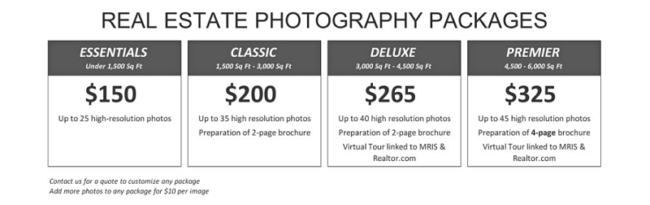
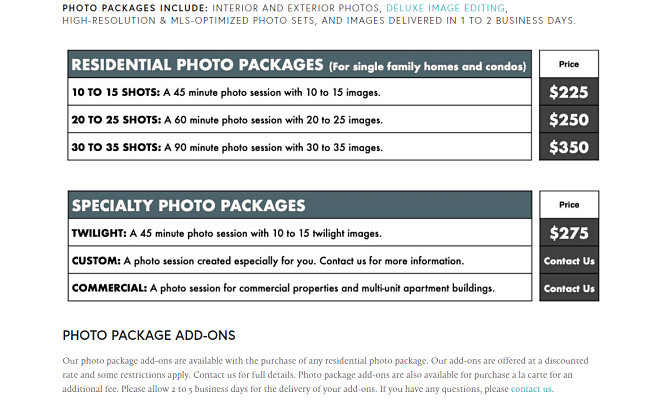
Many real estate photographers charge by the type of services the agent needs. Robert Miller in Northern Virginia, for example, offers bundled packages:
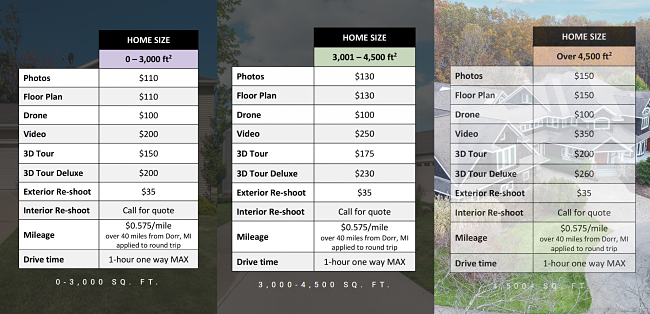
West Michigan real estate photographer Scott Wycoff, on the other hand, offers real estate agents ala-carte pricing:
Others base their fees on the number of photos required, such as Pro Property Shots in Los Angeles:
While price is important to many struggling agents, quality is as well. Listings that catch attention, also catch additional clients. Your listing presentations, with photos snapped by a professional photographer, will stand out among those of other agents.
Good, quality photography in your marketing pieces adds a professional edge to your business that those agents who cut corners just don’t have.
How to hire a real estate photographer
A good first step in finding your new real estate photographer is to cull through the latest MLS listings to find those with amazing photos. If the photographer is credited, look online for his or her website. If not, call the listing agent.
Naturally, agents might be reluctant to share their vendors, but it’s worth a shot.
If that doesn’t work, check for real estate photogs with good reviews on Yelp.com. Then, run a Google search for the same.
By now, you’ll have a nice-sized list of candidates to interview. Before the interviews, however, check their websites for a portfolio of work performed for past clients. Make notes about each photographer as to what you like and don’t like about their photos.
During the interview, ask some of the same questions you would hope that real estate consumers ask agents:
May I view some of your recent work?
May I interview your last three clients?
What, exactly, does your fee include?
Do you charge a licensing fee and, if so, how much?
Will the photographer retain the copyrights?
Ask about the post production process (editing, etc.) and how much of the process is included in the real estate photographer’s fee.
What other services does the photographer offer? Video tours, 3-D walkthroughs and drone photography are offered by most full-service photographers. If these services are of interest to you, ensure the photographer offers them and ask for prices.
Finally, perform your due diligence and call references. Your photographer is someone that, hopefully, you will work closely with on future listings and other marketing projects.
Ask the agents who used the one you’re considering:
Is the photographer reliable?
Is he or she punctual?
Is he or she honest?
Is he or she amiable and easy to work with?
Does he or she project a professional image?
Remember, this person will be in your clients’ homes and is a reflection of your brand.
The need to pull out all the stops when marketing a home for sale isn’t as necessary in a hot seller’s market as it is when homes for sale have lots of competition.
It is, however, always the listing agent’s duty to ensure the seller gets every last penny possible.
New York City agent Steven Gottlieb boils it all down: “Good photos can turn online views into showings, but conversely, bad photos can dissuade potential buyers from giving a great house a second thought,”
At realestate.usnews.com, he cautions home sellers to “Leave it to the experts” by hiring an agent. The same caution can be offered to those agents:
If you aren’t a professional photographer, leave your marketing photos to the experts.
Ready to use your photographs as a lead gen source? Here’s how:
If you’re struggling with understanding IDX, you aren’t alone. For many, learning how to set up IDX on websites, understand IDX website cost or know the difference between IDX vs RETS can feel like a lesson you simply don’t have time for. Maybe you’re a busy agent who just doesn’t understand the features of a great IDX website. Or maybe you’re a new agent asking what is IDX period.
No matter the questions you have about IDX Integration with your real estate website, we’ve got the answers. Oh, and for examples of the best IDX real estate websites, complete with pictures, be sure to check out the bottom of this article. Let’s begin!
IDX Websites For Agents – The Basics
We’ve been talking about IDX for a long time, but IDX is far older than any of us.
The first use of the term “multiple listing” dates back to 1907. As you can imagine, the service was nothing like it is today. Listings were advertised, in person, to other members of the Board of Realtors® “… gathered at the Board offices.” (NAR)
The evolutionary steps to today’s tech-driven system included listings printed in huge directories, much like the phone directories of old, distributed among members. To this day, veterans tell stories of lugging the tome around in their cars and laboriously combing though it when conducting showings.
Still the repository for real estate listings, technology has changed everything else. One of these changes is IDX.
We receive so many questions about IDX that we’ve decided to put together a basic explainer for you. From why it was created to how it works and how to make it work for you, you’ll find what you need right here.
What is IDX?
For many agents, “what is IDX” seems like a “well, duh” kind of question. For many others, however, it’s a bit like using electricity.
We know it works, but maybe not how it actually gets from wherever it comes from to the outlets in our homes and offices.
We just take for granted that it’s there when we need it.
So, what is IDX? Internet Data Exchange (IDX), at its most basic, describes a method for real estate agents to share MLS listings on their real estate websites.
According to Emile L’Eplattenier at theclose.com, IDX is “the technology and individual agreements between your MLS and individual agent and brokerage websites that allows them to display MLS listings online.”
The service dates back to the early 2000s. Prior to that, MLS listings were available only to members of the local association.
To view the inventory of homes for sale, buyers couldn’t just go online to Zillow or Redfin (they didn’t exist), they had to consult the keepers-of-the-listings: real estate agents.
What is IDX vs What is RETS
Ok, so we’ve answered the “What is IDX” question, but now we have to talk about RETS.
IDX is but one method of transferring MLS data to your website. Real Estate Transaction Standard (RETS) is another. The end game is the same: both get listings from the MLS to your website.
RETS began in 1999 “… as a collaborative effort between the National Association of REALTORS® (NAR) and a number of industry technology leaders who saw the potential for making it easier to access MLS information and move it from one place to another,” according to the NAR.
The main difference between IDX and RETS lies in the method of data transfer. The most significant difference for agents is that RETS is customizable and offers better SEO.
Additionally, agents have control over how often RETS transfers are updated, which is lacking with IDX.
RETS, on the other hand, is more expensive than IDX, which is a concern for many agents.
Easy Agent PRO websites now offer RETS in specific locations, and those available locations are growing all the time. To find out if you live in one of these areas, schedule a demo with our sales team today!
What’s new in IDX?
Flash forward more than two decades and IDX websites are no longer strictly within the purview of wealthy agents and brokerages.
And, of course, with its popularity and easy availability come rules. Although individual associations create rules which may vary, you can find NAR’s Internet Data Exchange Policy at nar.realtor.
We think one of the best advances in IDX technology to come along is the ability to integrate IDX with a CRM, bringing lead capture to a new level.
How to set up IDX on websites
The easiest and best way to DIY the use of IDX on a real estate website is by using a WordPress site. This allows you to dabble in DIY IDX intergration.
If you’re starting IDX integration from scratch, you’ll need to do the following:
Purchase a domain name. Choosing a domain name is easy, it’s finding one that’s still available that may drive you down the rabbit hole. Concentrate on keeping the domain name as short as possible, avoid the use of hyphens, don’t use your own name and keep it local.
Install WordPress on your domain. To do this, go to the CPanel in your web hosting account. If you still need help, you’ll find a tutorial at wpbeginner.com.
Choose and purchase an IDX plugin. Take your time with this step, choosing a layout you like, ensuring it offers the customization and features you want and need. Some of the most popular include Showcase IDX and WPL Pro.
Tutorials for IDX integration and building your own WP IDX real estate website can be found online. We like this one from Emile L’Eplattenier at theclose.com.
We get it, though – Not everyone has the time or resources to build an amazing IDX website from scratch. Enter LeadSites, the all-in-one real estate website from Easy Agent PRO.
LeadSites deliver comprehensive IDX experiences that guarantee your visitors will get exactly what they’re looking for when they search for homes. Better yet, LeadSites are easy to use and highly customizable, allowing you to create truly unique and innovative experiences with your website’s IDX.
What makes a great IDX website?
Whether you build it yourself or have it done for you, it’s important to understand the elements of an effective IDX website.
“Laying out the site in a way that makes searching for homes easy and quick is a must,” according to Lukas Termini, Easy Agent Pro’s marketing manager.
He goes on to supply a list of features to consider when building or buying your real estate IDX website. Some of these include:
Ability to integrate your IDX with a CRM
The ability to search for properties on a map
Polygon searches
The ability for visitors to save and email favorite listings
A sleek, modern look and feel
Ease of incorporating calls-to-action
Frequency of MLS data updates
Facebook cataloging
In this video, we show you how to use IDX searches to generate leads and build out a Facebook ad meant to work with this strategy. Take a look:
Examples of some of the best IDX Real Estate Websites
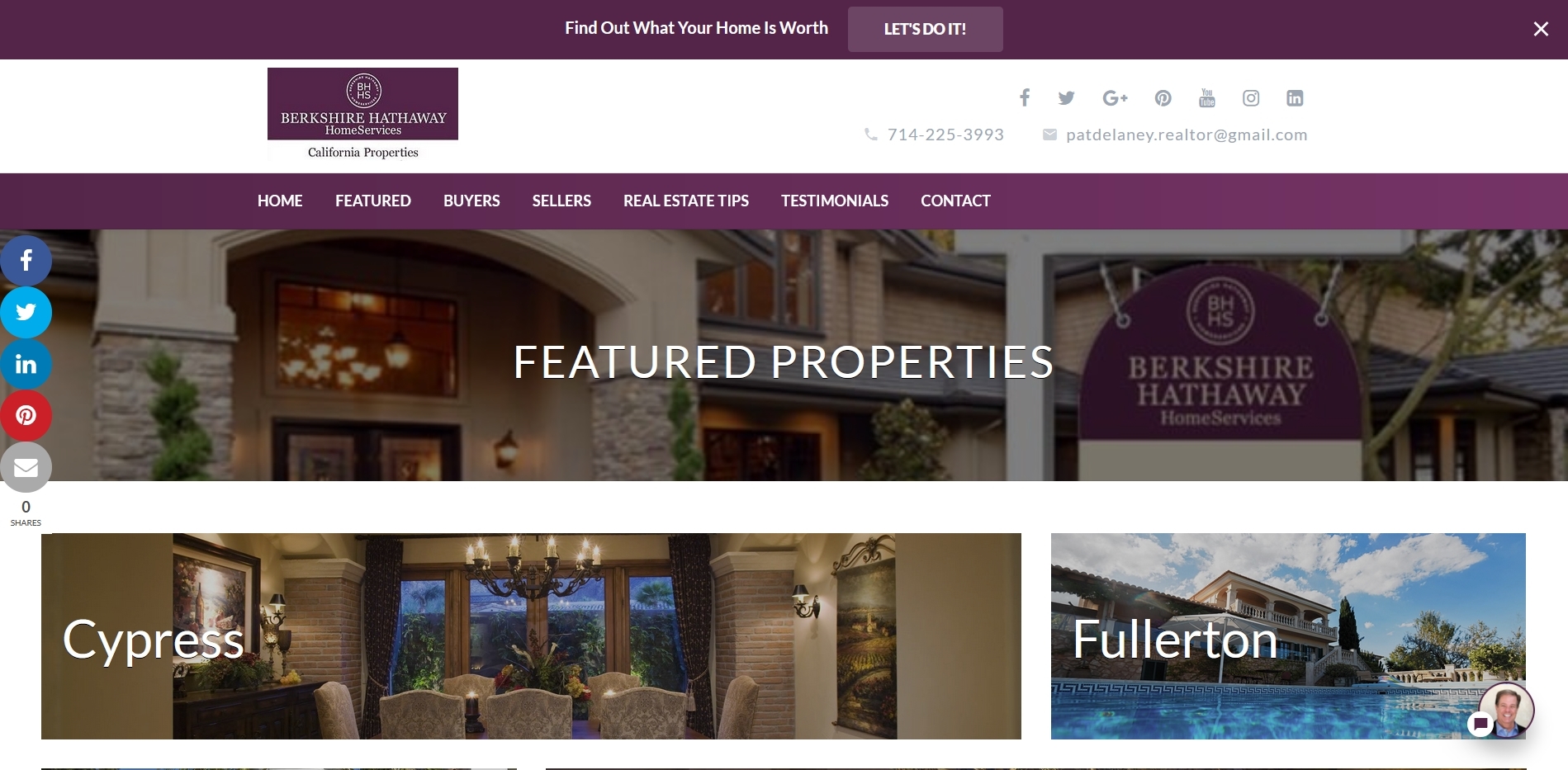
Let’s take a look at some inspirational IDX agent websites.
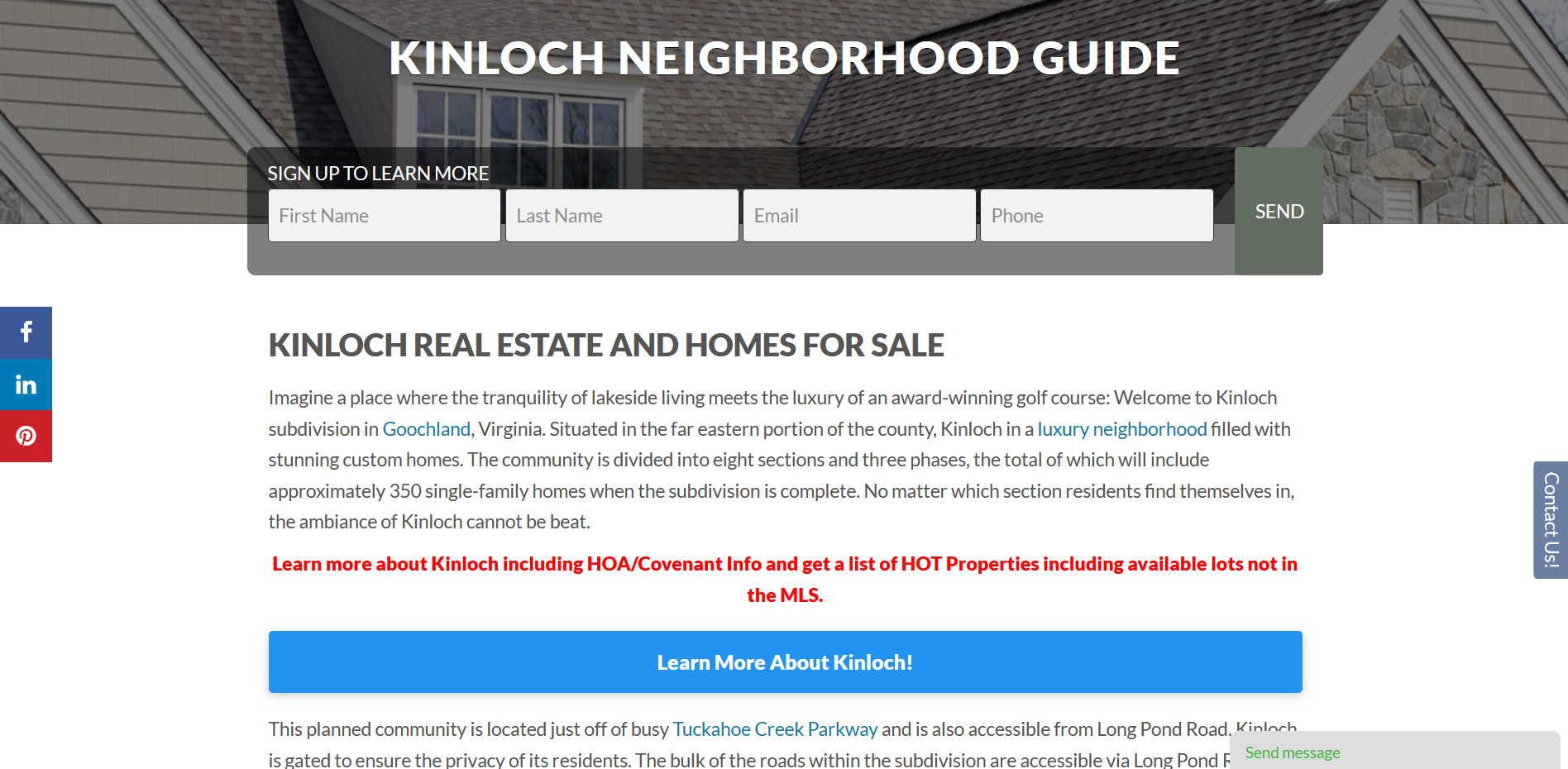
Another take on a neighborhood page from Virginia agent Daniel Keeton – Notice how he teases the visitor with info about not only the neighborhood HOA, but also lots not otherwise found in the MLS?
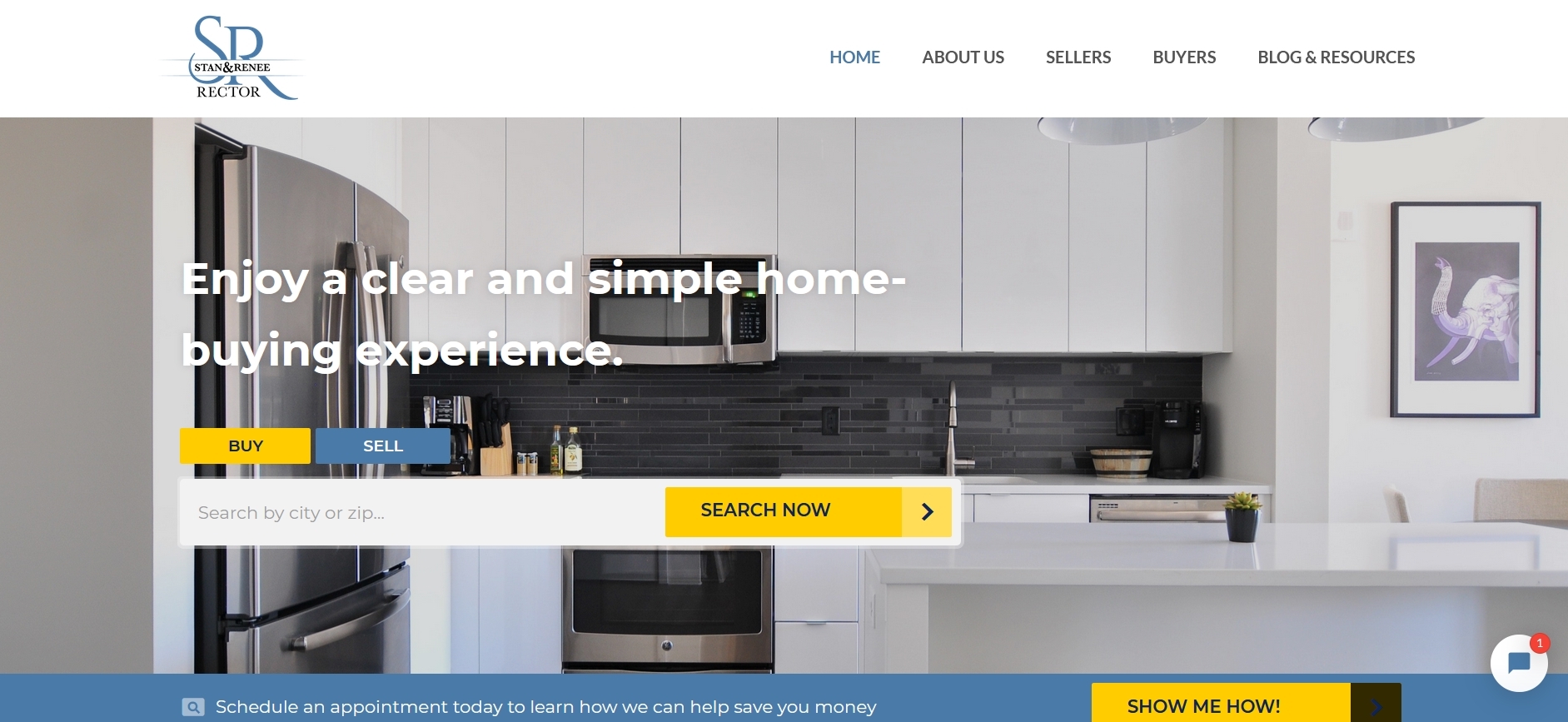
We love the clean, modern look of Simi Valley, California agent Stan Rector’s IDX website
Hopefully the examples above helped shine a light on how IDX can be a game changer for your real estate website!
I won’t spend $15 on a bottle of liquid stevia at Amazon.com without checking customer reviews.
It would be an understatement, then, that it blows my mind that a guy wanting to sell his house (his HOUSE, for pity’s sake) picks the first agent that comes along.
After all these decades, real estate consumers still find the pool of agents in their town interchangeable. “You’re all alike” is a statement that deserves a slap in polite society, yet people think nothing of using it to describe real estate agents.
So, how does a knowledgeable, hard-working, awesome customer-service-providing agent combat this?
By getting your clients to do it for you, via real estate testimonials (or, reviews as they are more commonly known).
For a digital marketing platform that makes it easy to gather and display your best testimonials, learn more about LeadSites.
Good real estate testimonials are critical
With the proliferation of online review sites, the “oh-I’ll-just-pick-the-first-agent-that-comes- along” tendency will hopefully change. We know from studies that it’s started.
BrightLocal.com, for instance, finds that 89 percent of consumers age 35 to 54 (which includes the average age of buyers and sellers) read reviews for businesses.
Granted, most of them read reviews for hotels, restaurants and doctors. Only about 15 percent of those surveyed claimed to have read reviews for real estate agents.
But each time a new review site goes online and as millennials age, expect that percentage to climb.
You can bet your competitors who use testimonials on websites and in marketing materials understand their power. You should to.
Do real estate testimonials the right way
“You can even include a little “Thank You” gift card for each positive review posted – a good way to incentivize clients at a low cost to you!” says a guy whose website site offers “real estate agent training.”
Another advice giver tells agents to send an email to clients stating the following: “Happy with my service? Leave me a review on _______ with a direct link to your review site of choice.” She then goes on to also advise giving a gift in exchange for a testimonial.
Here’s another: “Motivate Clients to Leave Feedback” followed by a list of things to bribe them with.
The first problem with all of this advice is this: Would you trust real estate testimonials from someone who was incentivized, motivated or otherwise bribed to leave it?
For instance, for a long time Amazon.com didn’t reveal which reviewers were incentivized. Over the past couple of years, however, they’ve been complying with the law and we can now see who was paid or otherwise compensated for their reviews.
I skip right over those, don’t you?
Second is that the aforementioned advice to real estate agents is in opposition to both the terms and conditions of many review sites AND federal law.
And they put teeth behind the warning. Back in 2015 they popped AmeriFreight, a car shipment broker, for posting customer reviews on its website while “failing to disclose that the reviewers were compensated with discounts and incentives.”
And, they’ve since dragged numerous other businesses to court for the same infraction. It’s a great-big hefty fine if you’re caught, plus years of having to report your marketing methods to the court.
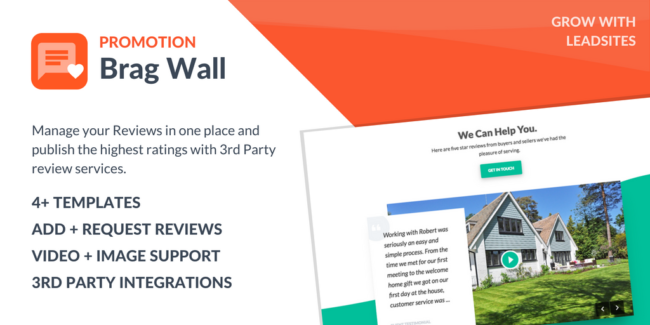
Real estate testimonials done right – See how Brag Wall makes gathering and sharing reviews easy.
The various review sites have their own set of rules, in addition to federal law:
Google – The search giant prohibits using reviews as advertising vehicles. Don’t post your email addy, phone number, links to your social media pages or to your website in the reviews.
Google also prohibits discouraging negative reviews or soliciting positive reviews from your clients, offering money in exchange for reviews and soliciting reviews in bulk.
Yelp — Outright forbids asking clients for a Yelp review. “Business owners should not ask customers to write reviews.” They also warn “Don’t ever offer freebies, discounts, or payment in exchange for reviews.” Learn more about Yelp’s terms here.
Zillow – It cracks me up to read Zillow reviews. Apparently, every single real estate consumer had an absolutely brilliant experience with their agent because anything less than five stars for agents is practically unheard of.
Would you trust this site’s reviews?
About as much as you trust their Zestimates, right?
At any rate, Zillow accepts reviews from anyone with a heartbeat, solicited or unsolicited.
Other things to consider about real estate testimonials
Like most online content, testimonials are only as good as their recency. If you aren’t consistently posting fresh reviews, you may lose business to the agent who does.
Bright Local finds that the number of consumers who only “take into account reviews written within the past two weeks” skyrocketed from 18 percent in 2017 to 40 percent in 2018.
An unsigned testimonial, or one signed with first and last initial, has the potential to create distrust in the viewer. Don’t use them.
Always ask permission from a former client to post their review but never ask him or her to give up intellectual property rights to the content in the review. Oh, and get that permission in writing (or via email) and keep a copy in the client’s file.
“If you see a good testimonial for your product on another site, don’t just copy and paste it onto your own website,” warns legal professional Leah Hamilton at NeilPatel.com.
“Most review sites have a clause in their Terms of Service stating that user-generated content (such as reviews or testimonials) is owned by the user and licensed to the website.” Instead, she recommends linking to the site’s page where the real estate testimonials appear.
Now that you understand real estate testimonial best practices, learn how to set up a Brag Wall on your Easy Agent Pro website.
Easily get your best reviews to your leads with LeadSites. Here’s how it works.
Want more leads? Here are 16 tips that get more traffic to your website.
Having trouble earning your leads’ trust? Here’s why:
Website Hacks For Your Real Estate Testimonials
What if we told you that all you need to do is tackle one task and you’ll realize a threefold return for your effort? Adding a real estate testimonial (aka social proof) to your website and marketing materials is the task. The return?
Your real estate testimonial enables consumers to judge your credibility as a real estate authority
It helps potential clients get to know you
Social proof instills trust
As a bonus, if done right, it may even help with SEO.
Today, in our continuing series on website hacks (homepage, about me), we’re working on a page on your real estate website that will, if done right, do most of the heavy lifting when it comes to converting leads: your real estate testimonial page.
Want a harder working real estate website? Check out LeadSites, and get started for just $1.
Social proof is the magic elixir of lead conversion
Gone are the days when simply driving a luxury car will show potential clients how successful you are. Agents’ self-proclamations as specialists or top producers also fall on deaf ears.
Consumers in general and real estate consumers in particular are a cynical bunch. They take little that a company says at face value and many demand proof of its claims. And they want to hear it from those they trust: people who have used the services.
Display social proof with Brag Wall and organize all of your reviews in one place – Learn More
Social proof isn’t new, it’s a well-worn phenomenon that now has a name. It describes our reliance on others’ opinions as a shortcut to making our own.
“Advertisers don’t have to persuade us that a product is good, they only need to say others think so,” claims author Rob Henderson at psychologytoday.com.
“Most of us do not have time to increase our knowledge of all merchandise and research every advertised item to measure its usefulness,” he continues.
“Instead, we rely on signals like popularity. If everyone else is buying something, the reasoning goes, there is a good chance the item is worth our attention.”
In a Mintel survey, most of the 2,000 participants claimed that online reviews were the yardstick they used to determine which services they’ll utilize and products they’ll buy.
“Do you read online customer reviews to determine whether a local business is a good business?” was one question in a survey conducted by the researchers at BrightLocal, a review monitoring and SEO tools firm.
A staggering 92 percent answered “yes,” with more than one-third stating that they read them “regularly.”
More than half of these respondents said that the number of stars a business receives is the most important part of a review with “quantity of reviews” and “recency of reviews” placing second and third in importance, respectively.
The majority claim that a business must have between three and five stars to merit their consideration.
The numbers don’t lie: if you truly want to build trust with your leads and convert them to clients, the testimonial page on your website is the place to start.
Which real estate testimonial to use?
It’s tempting to throw up every, single testimonial you receive, but it’s not wise. It’s important to read each one carefully to determine the value it will bring to the reader.
A REALTOR® Magazine consumer survey found that agent testimonials “must contain hard information and not bloviate,” according to the magazine’s Graham Wood. “The panelists were strongly critical of agents who posted testimonials that appeared overly self-serving,” he concluded.
Graham mentioned that panelists viewed one testimonial that credited the agent’s “smart marketing efforts” for selling his home in 19 days for asking price.
Viewers liked this testimonial, with one panelist saying that “The time-on-market figure lent the testimonial particular credibility, considering many online agent reviews are less detailed and sound automated.”
5 Real estate testimonial page best practices
1. Get that CTA in there
Aside from posting testimonials on it, the next aspect of this page that is critical is that it links to a contact page. Easy Agent Pro’s LeadSites link to a scheduling page, making this step a no-brainer for our clients.
2. Cut down on the clutter
The page should also be visually appealing. Cluttered, confused-looking pages will have visitors hitting the back button. Again, we hate to brag, but EAP’s LeadSites’ testimonials page is visually gorgeous.
If you’re designing your own, you won’t need to spend a huge amount of time on it – just enough just enough to let people know which page they’ve landed on and to make the testimonials easy to read.
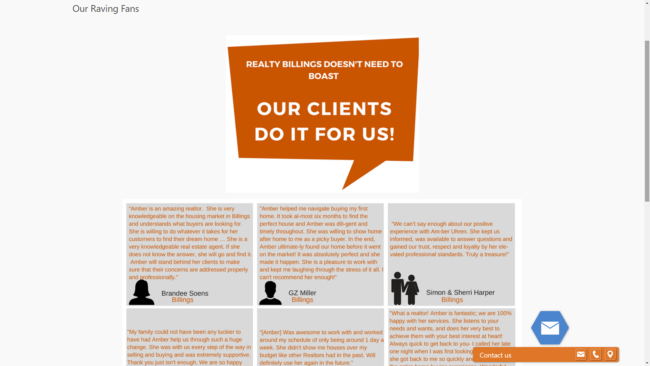
Although we’d like to see the real names of clients, Realty Billings does offer up a clean, easy-to-read testimonials section on their website.
4. Go for quality over quantity when considering real estate testimonials
Not all seemingly “good” testimonials are worthy of placement on the testimonials page. Skip posting the one-liners (We Love Jane Doe!”) and use only those that highlight the value you bring to the transaction.
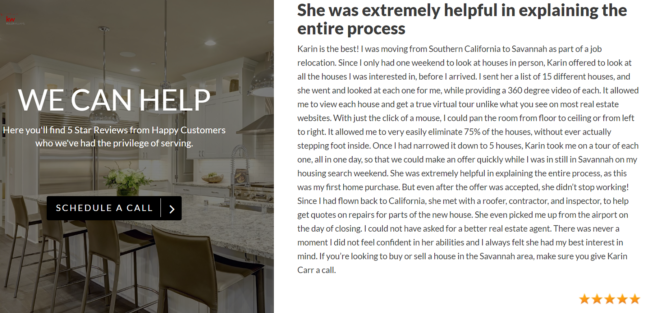
Keller Williams agent Karin Carr has a knack for choosing the best of the best when it comes to which testimonials she’ll use on her site.
Not only are these testimonials extremely detailed, you agents can pick up some brilliant customer service tips by reading them.
A quality real estate testimonial will “counter actual objections, not just praise your product or counter non-existent objections,” warns Copy Hacker co-founder Joanna Wiebe.
The best reviews also address what consumers consider most important, according to reputation and brand management firm ReviewInc:
Reliability
Expertise
Professionalism
If you solicit testimonials from clients, structure your list of questions to elicit the quality responses you need to post to your testimonials page.
4. Don’t use real estate testimonials from anonymous users or those using initials or screen names
Anonymous reviews are worthless and, apparently, even Google thinks so. The general public distrusts anonymous reviews (“Google User”) or those from people using initials or screen names.
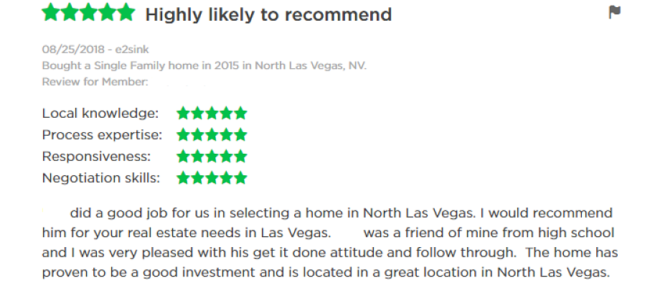
Not only is this Zillow reviewer anonymous, he or she is a “friend” of the agent. Studies show that a reviewer’s subjectivity renders a review useless.
5. Consider including client photos with your real estate testimonials
“Testimonials with photos were significantly more effective at generating recall than testimonials with no photos,” according to Shanelle Mullin at conversionxl.com.
Since people trust other people more than they trust you, adding a photo of the person who left the review adds veracity and helps build trust.
Finally, don’t forget that “recency” is important to those who rely on online reviews to help make decisions. Dump the old ones and keep adding fresh, new testimonials.
Tip:
Use care when soliciting real estate testimonials. Yelp expressly forbids asking for reviews and may ban you if they learn that you actively solicited a Yelp review. Google forbids the exchange of something of value or services in return for a review.
Get the hardest working website in Real Estate – Learn more
Although attributed to the Chinese, it was a 15th century Italian lawyer (Hippolytus de Marsiliis) who invented a certain type of water torture.
The torture subject was strapped to a board and water was very slowly dripped, often for weeks, on his forehead.
Often, the victim went insane before giving the torturers the information they sought.
Drip email marketing for real estate is, in a way, comparable. If not done right, recipients feel tortured by your constant drips into their email inbox. They may not go insane, but they will most likely either stop opening your emails or unsubscribe to them.
In short, a drip email campaign is a marketing method in which marketing emails are “dripped” consistently to your leads and prospects over a period of days, weeks or even months.
It takes time to develop an effective strategy for drip email marketing for real estate and if you, like most new agents, lack current clients, time is a commodity you can’t afford.
There’s a kinder, gentler and easier way to nurture the leads you’re able to generate: regular old email marketing, without the “drip.”
The difference between basic email marketing and drip marketing is the timing. You aren’t going to smother your recipients with drops of water every few days.
You’ll be able to “… provide value without inundating …” the recipients, Sendbloom’s David Sneider tells Ryan Buckley of hubspot.com.
Why use email marketing for real estate?
Productive agents are busy, busy people. Any halfway-decent marketing method that is low-cost and pretty much hands-off is intriguing to them.
Ask Google how many touches it takes to convert a sales lead and you’ll get a number of different opinions. On the low end, for top producers, it supposedly takes five touches or contacts.
On the high end? Thirteen is the lucky number.
Regardless of the discrepancies in the answers you’ll find, nobody says that you’ll convert after one contact. Sure, it happens, but not often.
Real estate marketing is a long game and patience and consistency are the keys needed to win the game.
So, you’ll need to reach out to your first real estate email campaign recipients at least once a month. All while learning the ropes, looking for clients and getting your name out there.
The ability to automate an email campaign is a definite benefit for real estate agents, especially new agents who have so much to accomplish on any given day.
You do have a CRM, right?
It is the warehouse where you’ll store all of your contacts, so if you don’t have one, get one. Learn more about real estate CRMs here.
Then think about planning a real estate email campaign.
The other tool you’ll need right away is automation software, if your CRM doesn’t come with it.
Mailchimp — Plans start at $0 per month. Agents appreciate the drag-and-drop design platform. LeadSite integration too.
GetResponse — Like Mailchimp and some of the others, GetResponse offers a drag-and drop platform and tons of templates. You can try it free for 30 days. After that, prices start as low as $15 per month.
Aweber — Offers drag-and-drop email creation, a decent template library and more. There’s no monthly fee if you sign up for the free program, which allows you the services for up to 500 subscriptions. This is ideal for the new agent.
All of these services vary in offerings, but ensure the one you choose has the templates you need and the ability to track your campaigns’ results.
Develop your strategy for email marketing for real estate
If you’re a new agent, the simpler you make your first campaign, the easier it will be for you to track and tweak results.
Choose your audience carefully. Most new agents start working with buyers in the beginning. But, “buyers” is still a broad target.
Narrow it down, at least for now, to a smaller niche market of buyers. Here are some ideas:
Buyers who are currently renting
Condo buyers
Starter home buyers
Ranch buyers
Golf course home buyers
Downtown buyers
If you’re knowledgeable and passionate about something, say horses, consider horse ranch buyers. An avid golfer? Golf course homes might be a great niche for you. Veterans may want to work with other veterans.
Not only does narrowing the audience help simplify this first campaign, you won’t be wasting time and money contacting consumers who have no need for, or interest in, your services.
Determine how often you’ll send emails. A good starting point for the new agent is to send one a month.
Now the fun part
Time to get creative and figure out what you’ll be sending each month. A newsletter is the popular and best choice of email marketing for real estate.
Newsletters, if done right, bring value to the recipient while establishing the agent’s knowledge. They accomplish the business triad of “know, like and trust.”
Your content will help folks get to know you and, hopefully, like you. The consistency with which you contact them will go far in helping you to build trust with them.
But, first, let’s design your email newsletter and create a template of it that can be easily edited each month.
This is where the above-referenced email companies come in handy. Some have rather large template libraries with drag-and-drop capabilities, making it a snap to create and edit your newsletter.
Other companies that offer real estate email newsletter templates include:
Ensure that the template of your email marketing for real estate contains your branding, contact information, a link to the social media platform you use the most and your DRE license number (if required in your state).
The body of your email will be your newsletter or a preview-link to its content. Ensure the preview includes a yummy, irresistible photo or two.
About that content: it is imperative to always, always, always keep your target audience top-of-mind.
For instance, don’t include content about home staging to your homebuying audience. Do send:
Tips on budgeting to buy a home
Information on down payment assistance programs
Lists of common mistakes buyers make
How to compromise on wish list items as a couple
How to compete in a hot sellers’ market
Then, sprinkle in some general interest pieces, such as local restaurant reviews, quick real estate market updates, neighborhood reviews (with photos), client success stories, etc.
Where will you get content for your email marketing?
DIY
Link to others’ content
Hire a writer
Fancy yourself a wordsmith? If you have the time, go for it; write your own newsletter content.
Do yourself a favor, however, and when you finish a piece, set it aside for a day. Then, go back and read it over, looking for grammatical errors, spelling flubs and to ensure that the flow is spot on.
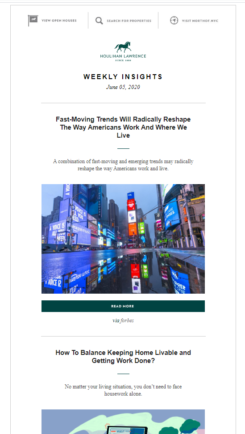
Let’s face it, though. Your time right now is best spent trying to load up your sales funnel, not writing content. You have other options. Take a tip from Houlihan Lawrence’s Linda Kermanshahchi (Scarsdale, NY) and link to others’ content.
There are typically 4 to 5 articles in Kermanshahchi’s newsletter, curated from around the web with a link to the original. Notice that she also gives credit to the site that hosts the original.
If you prefer your content custom-written, hire a writer. Content writers abound across the internet. What you need, however, is a real-estate writer. Otherwise, you may end up sounding like a dunce in your newsletters.
For example, one agent’s blog writer called a plat map a “plant map.” Said agent didn’t catch the mistake and there it was on his website for all to see. Under his byline.
Another agent’s email marketing for real estate featured advice for home sellers in which it told readers to never hire the agent they worked with before. Yes, seriously.
I about slapped my monitor, though, when I read the article that claimed that it’s buyer’s agents who “… pay for any damages found during the final walkthrough.”
If you must hire a writer with zero real estate experience, proof every word of every piece before paying for it.
Welcome to the real estate industry, rookie. The road ahead isn’t smooth and you have a lot to learn. Kicking email marketing for real estate to the top of your “to do” list is a good first step.
Then, stick with it, because, as Denzel Washington cautions, “To achieve your goals you must have discipline and consistency.”
Branding sucks. It’s probably one of the most challenging aspects of starting any business, including a real estate biz.
Coming up with your unique selling proposition, brand values, colors, logo, and tagline – who has the time and energy for all of that given the number of things an agent does in a typical day?
This is why too many agents either lack a brand identity for their real estate business or have half-heartedly gone about building one. Most have what one marketer refers to as “nonsense branding.”
It’s really rather sad. After all, branding is supposed to help you stand out, right?
The reality is that as long as real estate agents refuse to delegate to experts the marketing aspects of their business that they aren’t good at, there will be embarrassing listing descriptions, really bad blog posts and they’ll use lame real estate slogan ideas.
While answering the question “Can a Tagline Help Communicate More About your Brand?” the folks at Franke+Fiorella, brand identity designers, claim that “Your tagline should educate and reinforce what’s unique about your brand.
And if you can do it on an emotional, impactful level, all the better.”
But, wouldn’t the space you use for the tagline be better filled with a kick-hiney testimonial? Or, as the folks at KendallCopywriting.co.uk ask: “Why give people riddles when you can give them answers?”
Then there’s the fact that with the explosion in mobile devices used to access the internet, your marketing space is much smaller than it used to be. Are you going to fill that dinky spot with your opinion of your services (which means nothing to consumers) or with a client’s words, singing your praises?
A brilliant testimonial will do everything Franke+Fiorella hopes your tagline will do, only better.
It will educate and reinforce your brand. And, because it comes from someone who has actually used your services, it’s more believable than some made-up slogan that may not even convey what you hope it does.
However, if you feel you simply must have a tagline, let’s dig into ways to come up with one that doesn’t suck.
3 Reasons to Avoid Real Estate Slogan Generators
When marketing your real estate business, you want to be sure that your slogan is catchy and memorable. However, it can be tempting to take the easy way out and use a slogan generator. While these tools can help generate ideas, there are a few reasons why you should avoid using them for your final slogan.
1. Generated Slogans Can Be Clichéd
Because slogan generators rely on inputting keywords and phrases, the resulting slogans can often be clichéd or overused. If you want your slogan to stand out from the rest, it’s important to come up with something original that accurately reflects your brand.
2. They Can Be Expensive
While some free slogan generators are available online, many more robust tools can be quite expensive. If you’re on a tight budget, it’s important to consider whether the cost of the generator is worth it for the quality of the slogans it produces.
3. You Might Not Have Full Control
When you use a slogan generator, you’re typically given limited control over the final product. This means that you might be unable to make changes or tweak the slogan to fit your needs better. If you want complete control over your slogan, it’s best to create it yourself.
If you’re looking for a great slogan for your business, it’s best to avoid the temptation of the generator and come up with something original on your own. With creativity and thoughtfulness, you can create a phrase that perfectly represents your company and sets you apart from the rest.
What your realtor taglines should do
Realtor taglines aren’t meant as a vehicle to do cute stuff with your real estate business or to promote your hobby. It doesn’t matter that your last name is “House,” or that sailing is your passion. Some of the worst real estate taglines are plays on the agent’s names or allusions to their hobbies. “Allow me to sail you into homeownership?” Come on.
Done right, a tagline “can help a company communicate its purpose, difference, and value.” Since taglines should be short, replace the word “and” with “or” in that sentence and Gary Slack nailed it at B2BMarketing.net.
You can’t do all three, so pick the one that you feel is the most important to convey when you’re looking for ideas. Hopefully, you’ll choose “difference,” because it is truly one of every agent’s most sought-after qualities.
To stand out in a sea of other cellular service companies, Verizon set itself apart by being the one with the clearest reception: “Can You Hear Me Now?”
Now, compare that to “Everything I Touch Turns To Sold,” “I’m never too busy for your referrals!” and “Coming soon to a closing near you!”
See what I mean? Lame, lamer and lamest.
Differentiating yourself and your real estate business is important, but it’s not easy. Especially if you do things the same way everyone else in your market does them. If, however, you do something different, then your tagline should convey that.
For instance, you provide full service to your listing clients. You don’t just mention staging, you pay for it. You pay for a pre-sale home inspection. You may even hire a handyman to fix stuff for your client or a house cleaning company to get it ready for the market.
What you do different is that you provide “Full Service, not Lip Service.” Yeah, you can have that one for your collection of slogans.
Let’s talk about the best real estate slogans
Real estate slogans… The right one can be so hard to find, and oh-so-crucial for your real estate business. Your brand is a foundational part of your business, but it’s more than just a few words in a slogan. The best real estate taglines present a picture of a local authority, a market expert that can help people with one of their largest lifetime transactions. Nothing provides this better than a good real estate website – one that works for you – a LeadSite.
When it comes to branding or social media marketing, real estate slogans matter. Your real estate tagline is the message you want your potential clients to remember when they see your website. That means these real estate branding slogans ultimately end up representing a lot more than you’d initially think.
In fact, we’ve seen clients who use our LeadSites generate as much as twice the amount of leads just by having quality real estate taglines.
Here are the things to consider when picking real estate branding slogans:
The Basic Guidelines To Consider When Crafting Your Real Estate Slogan:
Identification: Your real estate branding slogans have to match your brand and your logo. These three things should work together to help separate you from the crowd.
Memorable: The best real estate slogans last for years and have a musical memorability to them.
Beneficial: Keep it all about your potential clients. Your clients are the same way. Keep your real estate slogan all about them and you’ll keep them around longer.
Differentiation: Real estate is a crowded market. Be sure to look at what others are doing around you and then be different from them.
Now that we have the basics covered, let’s talk about actual real estate branding. The key here is to find something that works for you.
For example, our Leadsites are built to convert your website traffic into more leads for your business. And part of how we do this is by branding you as a helpful real estate agent through an auto blogger that automatically posts helpful blogs twice a week.
But more than that:
The websites tie your slogan, logo, and brand together into one package. This makes a memorial experience that helps you stand out in the ‘sea of white’ that is the internet.
Branding Tips: Get Your Realtor Taglines Right!
Seth Godin – How To Win At Business:
In this video, Seth teaches some fundamentals on how to stand outside the box when marketing. His stories are great and should inspire you to find a creative angle for your real estate slogan:
An Overview Of Branding:
Additional Resources For Real Estate Taglines:
5 Tips For Writing Your Slogan: This article by INC Magazine focuses on five tips (or benefits) to consider when building your real estate taglines. It’s worth a read to make sure you are implementing a real estate slogan that will actually resonate with your readers.
10 Clever and Effective Series of Advertisements: There are tons of great examples in this article that highlight the effectiveness of branding and could help you in your search for the perfect real estate slogan.
landlordtips.com has some great advice for working with a digital marketer for your real estate business
25 Real estate slogan examples for your real estate business
Since my sincerest hope for your real estate taglines is that they aren’t boring and that they’re different from everyone else’s, I refuse to regurgitate the stuff from the various and vacuous online lists.
OK, so some of these ideas are tongue-in-cheek, but, hey, they might work, if differentiating yourself is your aim.
I’m Really Good at What I Do
Because sticking a sign in the yard isn’t enough
Something wonderful is about to happen
When Average isn’t Good Enough
Real Estate Made Simple
Home Selling Made Simple
Home Buying Made Simple
It’s Not Full Service if you have to Pay for Everything
Lucky You — Your Search for a Real Estate Agent Just got a Lot Easier
I Return Phone Calls
Hope Doesn’t Sell Homes. Marketing Does
Forget the Rest, You’ve Found the Best
Let’s go Look at Houses
My Past Clients Say it Best
Simply Accomplished
I’m Fun to Work With
The Only Proactive Realtor in Town
Real Estate, redefined
Home Selling, redefined
We put the ‘Real’ in Real Estate
I’m Different
Because Not all Real Estate Agents are Alike
Taking your Home from Staged to Sold
Ask me about my Brilliant Marketing Plan
How can I Help?
Remember, a tagline or slogan won’t help anyone decide whether or not to use your services, but it may help them remember you.
Cliches to avoid when working on your REALTOR taglines
We get it, it’s tough to break away from the crowd. Sadly, when agents do come up with a fresh, innovative way to market him or herself, it is immediately copied.
First, there’s one copycat, then another and, if the differentiating tactic is cheap enough and easy enough the copycats multiply like bunnies.
Then, because everyone else is doing it, the tactic becomes ineffective and no longer innovative
In fact, the general public makes fun of it. From agents using their vehicles as video broadcast studios to the ubiquitous headshots on their business cards, there’s a lot to ridicule. I mean, nothing screams “unique!” like having your dash-cam video show up with 300 similar ones online.
Most of all, the cookie-cutter-agent myth is perpetuated.
Promotional music videos
It takes a very brave (or deluded) soul to attempt to copy the more brilliant real estate promotional videos. Unless you’re loaded with talent and money, this is a practice that few can get away with.
If you’ve tried it and you aren’t getting rave reviews from anyone other than your mama and those you work with, realize it’s not doing you any good and you should probably dump it.
If you can’t sing like Des Moines agent Meghan Hill Mitchum (or hire someone to sing for you), reconsider the Adele parody video you’re so keen on doing.
If you can’t pull off the attitude like L.A. agents Cherrie Brown, Zach McReynolds and Sara Spalione, ditch that rap video idea.
“I want to make one but don’t know where to start. Is there an alternative to hiring a video production company?” asks an agent online.
No, not if you want to avoid looking lame
The same holds true for those Hollywood-style listing videos. If you don’t have the budget, stick with the crowd and make them straightforward – after all, listing videos don’t stay alive forever (unless your clients overpriced the home), or unless you happen to be Brian Keith Lewis whose videos are watched over and over.
By the way, if you want to cop someone else’s ideas, check out more of Lewis’ listing videos.
Agent photos on biz cards
Unless you are Eric Lavey, whose face is apparently his brand, your face has no business being plastered all over your business card and marketing materials.
Yet, despite all the talk of the importance of branding, agent headshots still take center stage on the one marketing material they hand out most often.
“ … it’s a business model that hasn’t changed in a century to keep with the times,”
bemoans a consumer in an online forum about lame real estate agent headshots with accompanying cheesy real estate slogans (but more on those in a minute).
There are arguments for and against. St. Paul broker Teresa Boardman presents some interesting thoughts on the topic at Inman.com.
We rather like the way The ONION treats the debate in “I Wasn’t Going to Buy This House Until I Saw The Realtor’s Headshot On The Sign.” Author Sam Cone even manages to work in the cringe-worthy agent tagline “You’re my No. 1 priority!”
“I guess what I’m saying is that it’s just such a relief when professionals take the time to demonstrate a true respect for my intelligence,” he says.
Before ordering your next batch of photo-embellished business cards, check this out: the Google search term “lame real estate agent photos” returns about 5,220,000 results. In many cases, adding these photos to your cards is a mistake.
Then, if you must go through with it, use a professionally snapped, updated photo, leave the weird hat and/or companion animal at home and consider putting your headshot on the backside of the card and reserve the front for the professional-branded stuff.
Ok, let’s get back to those real estate slogans
Why do so many agents not know that so many real estate taglines, so prolific decades ago, are viewed by today’s real estate consumer as smarmy? That there are websites devoted to poking fun at them?
Like closing gifts, it’s something only those in the real estate industry feel they need to do to attract and keep clients. (And much like slogans, we have a guide for closing gifts too)
Real estate slogans can be a shortcut around providing amazing customer service
So, what are agents finding when they enter “real estate slogans and taglines” into the magical Google search box?
You don’t want to know.
“To Buy or Sell Call Mel!” was actually chosen by a writer at fitsmallbusiness.com as a “fun, memorable and straight to the point” tagline. “What’s not to love?” the author asks.
We don’t even know where to start to answer that question.
Another site tells us that you need real estate slogans because it’s not good to “make your customer base work to find out who you are and what you do. Tell them loudly and clearly and start building trust and loyalty at first contact.”
Wait.
Don’t agents’ business cards and websites typically have the name of their brokerage emblazoned across them? And, don’t the vast majority of real estate brokerages have the word “realty” or “real estate” in them? And, don’t most agents who are members of the NAR put the word “REALTOR” after or below their name? Clients want to know how you’re going to help them buy or sell, not that you can come up with a catchy slogan.
It’s safe to say then, that agents are pretty good at identifying themselves as such and that real estate slogans typically do nothing toward that end.
But, we’ll play
Imagine you are a real estate consumer trying to nail down who you will hire to represent you in a real estate transaction. Will “Everything I touch turns to SOLD” instill trust and loyalty or will “A Local Expert” be the tagline that seals the deal for you?
“They are awful and the reason why people think agents are idiots and like used car salesmen,” claims one agent in the comments section at fitsmallbusiness.com.
Avoid sounding like an idiot or used car salesman and hire a company that specializes in branding to help you come up with one.
If it’s cheap and easy, it’ll be cheesy (someday)
If you’re tempted to copy another agent’s marketing technique, understand that it isn’t going to make you stand out from the crowd unless few others are doing it. And, you can count on others picking it up if it’s inexpensive and easy (like the aforementioned dash-cam videos).
On the flip side, the more expensive or labor intensive a real estate marketing method, the less the chance it will be copied. For instance, branded real estate-oriented newspapers sent to a geographic farm can get pricey, so if you decide to go this route, it’s doubtful others in your market will copy you.
A ghost-written, agent-branded real estate book (not an e-book – that’s too cheap and easy) to hand out to buyers or sellers offers the same rip-off protection.
But, in the end, the cheapest, most effective marketing vehicle is word-of-mouth. And you’ll get that by providing your experience, knowledge and a dash of charisma to all you do business with. In other words, plain, ol’-fashioned excellent customer service.
Looking for some great examples of real estate branding done right? In this special webinar, we explore how some EAP clients branded their businesses in creative and unique ways:
Congratulations on that new listing! And those photos that your pro photographer snapped are gorgeous. Also looks like you put a lot of thought into writing the listing description.
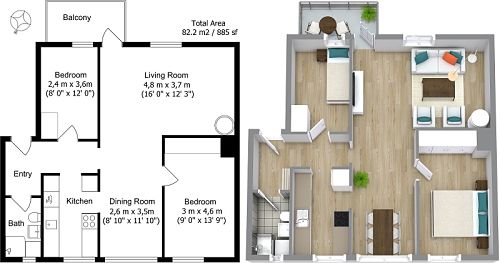
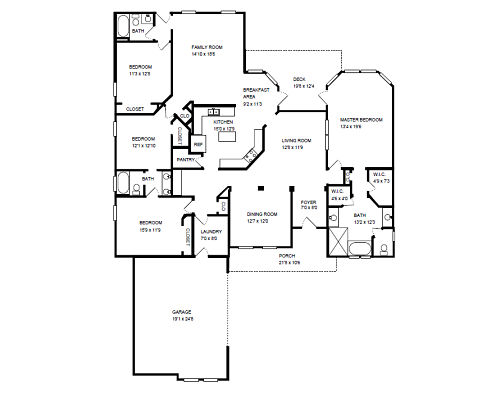
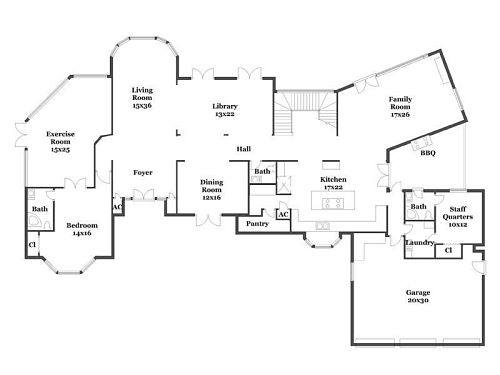
It’s a pity that you hit the “submit’ button before you uploaded a floor plan. But you don’t use floor plans in your listings, do you? Most agents don’t, and those who do want to thank you for not using them.
That’s because their listing will get more 52% more click-throughs than yours, according to Rightmove
These agents also know that floor plans of listings are beginning to catch on with buyers. One in 10 buyers told Rightmove, the UK’s largest property portal, that they wouldn’t even look at a home for sale if they hadn’t seen a floor plan first.
These agents know this because they pay attention to real estate trends. And, for the past few years, the importance of including a floor plan with a listing has been inching its way up the consumer-popularity chart.
NAR’s latest Generational Trends Report says that the third most important feature of an agent’s website (behind photos and the listing description) is a floor plan. It ranked third last year as well.
It’s 2021, folks. We’re in a world-wide pandemic that’s turned the way you do business upside down. Remote viewings shouldn’t be the entirety of what you offer homebuyers and sellers.
Consider including floor plans with your listings. The process isn’t as expensive and time consuming as you might assume.
Besides, buyers want them.
Let’s take a look at some 2021 real estate floor plan software reviews.
When looking into 2021 real estate floor plan software reviews, the OG of real estate agent floorplans, Matterport, is typically what comes to mind first.
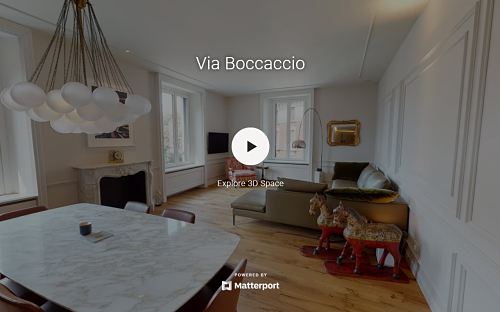
Matterport’s 3D interactive floor plan offers clients what they truly crave: the ability to “walk through” a home and view what they want to view, not what the videographer wants them to see.
Founded in 2011, the brains behind Matterport “… spent over two years in pure R&D mode before being ready to launch” what they envisioned would be some pretty “… amazing immersive experiences,” according to Matt Bell, co-founder of Matterport
Since then, they’ve continued innovating and even offer their 3D tech for iPhones.
According to the company’s website, using Matterport interactive floor plans in your real estate listings will result in:
A 4-9% higher sales price
DOM decrease of up to 31%
In their listing presentations, they “… always leave Matterport until the end,” according to So-Cal real estate superstars Matthew and Josh Altman (of “Million Dollar Listing fame).
“Because it’s almost like having your grand-slam hitter come in when bases are loaded. And, for us, that’s what it is; it’s our grand-slam hitter,” notes Josh.
Along with the price of the plan, you’ll need to purchase a 360 camera. Learn more about that process at matterport.com.
Agent reviews are all over the map. One Las Vegas agent claims that although Matterport’s “… virtual tours are the gold standard when advertising properties online … The price of the equipment and storage is expensive.”
Read additional 2021 real estate floor plan software reviews online at g2.com.
Around since 2007, you may have known RoomSketcher’s software as “Home Designer.” While “The tool is still the same … our new name emphasizes our focus on creating both the best floor plan tool, as well as the best home design tool, on the market,” according to the company’s website.
With RoomSketcher you have options:
Draw the floor plans yourself using the app
Order them from RoomSketcher’s Floor Plan Services
Hire a freelancer to draw them for you
With a drag and drop interface, it couldn’t be simpler.
Then, dress up the space, if you like, by adding the listing’s paint colors and even furniture. A good choice for your vacant listings.
Finally, choose between 2D and 3D.
On the company’s website you’ll learn that “Our real estate floor plans are high-resolution and optimized for print or web. Print or download them in multiple scales and formats such as JPG, PNG and PDF.”
Prices start at $49.99 a year for the VIP package or step up to the Pro plan for $99.99 a year. If you’ll be creating more than 100 floor plans a year, go for the Hi-Volume plan. You’ll need to contact the company for the price of this one.
The folks at Floorplanner wish to, respectfully, take issue with the old “Momily” that “Nothing in life is free.”
They offer, among other plans, a free plan, without the bells and whistles of the paid options, naturally.
Looking for prices on the website, however, is challenging. They offer “levels” of service and, depending on the level, you’ll be charged a certain number of “credits.”
These credits, in turn, are available by the bundle, for a one-time fee. Or, buy a subscription to get “… a recurring bundle of credits monthly or yearly.”
The software is browser-based, your designs can be 2D or 3D and there are tutorials, both video and text, to help you get the hang of using Floorplanner.
Yup, your friendly neighborhood Home Depot offers floor plans.
Through its “Measuring Service,” the process is easy:
Create an account
Log in
Enter the property’s address
Enter your contact info
Select an appointment date
Home Depot will then send a technician to your listing, who will measure it and then email you the completed floor plan within two business days.
It’s a pay-as-you go thing, so you won’t need to pay to sign-up or annual fees.
The price per floor plan is reasonable so if you aren’t a volume listing agent, this could work for you.
On the pricing page we entered the ZIP code for Tucson, Arizona and the U.S. median home size of 2,301 square feet. The price for a floor plan is $119.00. In fact, the price is the same for homes up to 3,000 square feet.
The larger the home, the higher the price, topping out at $739 for a home with 15,001 to 16,000 square feet.
If the 2021 real estate floor plan software reviews we’ve seen so far haven’t quite sold you, this next one just might.
Here’s one that might appeal to the ultra-busy agent who already uses a photographer for listings. Fire him/her and consider going with PlanOmatic.
Based out of Denver, Colorado, and operating nationwide, PlanOmatic offers a different service than the aforementioned companies. This includes:
Professional photography of your listings
Floor plans
The service has “hundreds of photographers across the US” on their payroll, according to the website. The process seems simple enough. The agent places an order and receives an appointment to meet with a local, pro photographer.
The photographer snaps listing and marketing photos of the property “and/or measure[s] the dimensions of the space.”
PlanOmatic promises to deliver the finished product “… in under 2 business days.”
Sounds easy, right? That’s the whole idea behind the service, PlanOmatic CEO Kori Covrigaru told Byron Lazine at inman.com.
“Our two-year goal is to make ordering photography as easy as it is ordering something from Amazon and getting it to your house in two hours.”
Don’t bother clicking on “see full pricing” on PlanOmatic’s website because it doesn’t reward you for your diligence. Instead, you’re taken to a page where you’ll need to register and then enter the information about a listing.
What they do say is that the price of a floor plan tacked onto a photography order is $100.
Bonus 2021 real estate floor plan software reviews
New agents and those on tight budgets might want to check out the following floor plan apps and software:
Sweet Home 3D‒Free, open-source app designed for the interior designer that will work for agents needing a simple floor plan. Windows, macOS, Solaris and Linux friendly.
CubiCasa‒Although it’s not free, if you don’t take a lot of listings, CubiCasa might make sense for you. Avalable for iOS and Android, the room-scanning app makes it a snap to take measurements. Just point and click.
Your first scan is free. After that you’ll pay-as-you-go, at $34.90 per scan.
Fiverr‒Hire a freelancer to create your floor plan (just remember to label it “not to scale”). The site features some very talented freelancers with reasonable fees.
Sure, we’re still in a heavy-duty sellers’ market and homes in good areas, in good condition, are practically selling themselves.
But, we’re also in a pandemic and many consumers have valid concerns about allowing strangers to wander through their homes.
Offering a floor plan, especially one with a 3D walk-through, is yet another way to help buyers make their decision on homes to view without endangering themselves and homeowners.
Need more help with your listings? Take a look at this video for some tips for marketing your listing on Facebook!
Just how full of leads and prospects does your CRM have to get before you finally decide to concentrate on conversion?
Hey, if you got into real estate to become a full-time lead generator, that’s cool. Not much money in it, but have at it.
If, on the other hand, your sales funnel isn’t converting, but you want to learn how to convert a real estate prospect into a client, read on.
How to convert a real estate prospect into a client – Snake oil doesn’t work
There are far too many agents who think that the snake-oil peddling coach, book or podcast will lead them to prospect conversion heaven. Sure, there are a lot of great coaches, how-to books and podcasts out there.
But, there’s no super-secret script or dialog. A magic bullet to close prospects just doesn’t exist.
Perhaps this is because real estate sales is a long game. The truth is, there is no one thing that leads to conversion; it takes a combination of personal qualities, habits, knowledge and more.
How confident are you in your knowledge?
“Customers are more likely to trust sales people who show confidence in themselves and what they are selling,” according to the experts with Business Queensland.
Knowing your business, inside and out, and knowing your “product” also helps you sell the benefits:
Of working with you
Of buying this home
Of selling a home, right now
The southern California agent I once interviewed who took the time to visit every new listing, whether he had a buyer or not, exemplifies getting to know the product.
The new agent who tagged along with a mentor for a solid year ended up with more real estate knowledge than many seasoned agents. That is what knowing your business is all about.
The listing agent who was presented with a problem that might bear on a home’s market value, and came up with a solution in seconds, showed an impressive amount of confidence and knowledge.
By the way, this listing agent so impressed that homeowner that she referred him to her mother.
An older woman with health problems (COVID-19’s favorite victim), she had valid concerns about showing her home. In addition, she fosters homeless pets and had five dogs and two cats.
She had decided that the best option was to sell her home to an investor. While interviewing investors, her daughter convinced her to speak with her agent as well.
The options he offered her were unique and specific to her situation. She used him to list her home and walked away with far more money than any investor offered.
Think about challenges that you and other agents have encountered and their possible solutions. Think creatively.
Get out in the market and view listings in your typical target clients’ price range. When someone asks about the home at 123 Main St. you can offer details, confidently.
Believe me, this is impressive.
When you can answer every question a prospect throws at you, when you can offer solutions to their problems, you’re one step closer to understanding how to convert a real estate prospect into a client.
How to convert a real estate prospect into a client – Trust is a biggie
As you can imagine, confidence is a trust-builder. However, the opportunity to show off this confidence to a prospect may not appear. So, how else can you build trust?
Testimonials.
There is just no substitute for a glowing review of your services, especially if it highlights your knowledge of all things real estate.
Think again about possible challenges that may need to be changed when deciding how to convert a real estate prospect into a client:
The need to sell a home before buying
Closing date challenges
Showing challenges
Equity challenges
Problems with the home, neighborhood, etc.
Testimonials that address common challenges and how you dealt with them are like gold.
Those that attest to your trustworthiness are equally as valuable.
Use them on your website, in your email signature, on your business card and every direct mail piece you send to your prospects.
“A potential client [or lead, in this case] must trust you in order to be fully-qualified” as a prospect, according to Jeb Brooks of the Brooks Group, a corporate sales training and sales management training company.
Learn more about how to get glowing testimonials for your website here.
Time is not on your side
NAR studies show that most real estate consumers sign up with the first agent that calls them back. I know, it’s pretty sad.
But it is a lesson for agents who are studying how to convert a real estate prospect into a client: be the first guy or gal to return calls.
“The average first call response time of all companies that responded by phone was 40 hours and 56 minutes,”
How about five minutes? Studies show that’s the sweet spot. Respond within five minutes if you want to begin to convert that real estate prospect.
“Measure your response times in seconds and minutes, not hours and days,” cautions Dan Sincavage, co-founder of Tenfold.
“Don’t even consider scheduling first touches beyond a couple of hours,” he adds.
That lightning-fast first touch and an ongoing contact campaign will help convert prospects the rest of the way: into full-fledged clients.
Your competition will most likely send a text or email to thank the prospect or lead for their call.
Not you. You’ll be delivering or sending a follow-up package to begin immediately building trust. Items to include when considering how to convert a real estate prospect into a client through followup:
Cover letter thanking the prospect for calling.
Your resume, or a brief outline of your experience, production statistics and awards.
An abbreviated CMA for listing prospects.
An invitation to join you on social media.
Your website’s URL, your contact information and lots of testimonials.
Then, put the prospect on your hot list and nurture, nurture, nurture. The best part is this can all be automated!
When it comes to figuring out how to convert a real estate prospect into a client, understanding your CRM inside and out is key.
If your CRM is a mess, it’s time to fix it. The most important fix, right now, is labeling your prospects.
Forget leads for right now and concentrate solely on your prospects. After all, “a prospect is the possibility that something fabulous will happen,” according to vocabulary.com.
Segment them according to their likelihood to transact in the near future. Use “warm,” “warmer” and “hot” if that works for you. As long as it lets you know which prospects are lower in the funnel, any label is ok.
In the market for a new CRM? Read our recent reviews here.
Once you’ve decided to focus on warm-to-hot prospects and segmented your database, it’s time to develop a winning touch campaign that will do the heavy conversion lifting.
Haven’t a clue where to come up with such a workhorse and how to get it started? Take a cue from Keller Williams’ “33 Touch Campaign For Real Estate Agents.” It’s their recommended tactic to “… stay in touch with your database over the course of one year,” according to Michael at revrealestateschool.com.
Based on techniques outlined by Gary Keller in his book “The Millionaire Real Estate Agent,” you’ll find an outline of the process by following the aforementioned Rev Real Estate School link.
Or, create your own campaign by combining a number of different methods. Direct mail is particularly effective right now, so rotate direct mail newsletters, market reports and a quarterly CMA with email and telephone calls.
When you plant a seed, does it immediately spring from the soil, in full bloom? Of course not.
By the same token, do we dig up seeds to ensure that they’re germinating? Nope. For some reason we have faith that the seed will sprout.
We also have faith that if we nurture the seedling, it will grow and we’ll realize a return for all the time we spent on it.
Yet, when it comes to how to convert a real estate prospect into a client, so many agents tend to give up after a short nurturing period; the results weren’t immediate.
“The average incubation period of an internet lead is 6 to 24 months,” according to coach Kevin Ward. Understand that he has the definition of lead and prospect reversed so what he is actually referring to in this sentence is “prospect.”
Knowing this timeline should give you the patience to hang on, with faith, that many of them will convert to clients.
Don’t go big on lousy prospects when learning how to convert a real estate prospect into a client
It’s easy to stuff everyone you meet who can fog a mirror into your lead database. But, is it a good idea?
Lousy leads make lousy prospects and they’re huge time wasters. When it comes to converting prospects to clients, “… your success is determined by [the quality of] your leads,” according to Chinese-Canadian business magnate Dan Lok.
Often, the quality of a lead is determined by how it was generated. Thus, the difference in quality between a warm and a cold lead.
Which is why we suggested that, for now at least, ignore those cold leads and prospects in your CRM and concentrate on the warm to hot ones.
“Converting prospects into customers doesn’t happen by accident,” according to Lok.
It takes more than canned scripts, dialogs or templates when you’re trying to figure out how to convert a real estate prospect into a client. It takes a strategy. It takes confidence, persistence and faith .
Need help deciding on the right CRM for your real estate business? These 2021 Real estate CRM reviews will help get you on the path to a more successful year!
Customer Relationship Management: it’s among every real estate agent’s most important duties. So important, in fact, that a CRM should be a mandatory tool for all new agents.
Each person that you deal with in your business, whether a client, a lead or someone in your sphere, brings with them a ton of associated data. Remembering birth dates, a dog’s name, kids’ names, career, hobbies and more helps build rapport, nurtures existing relationships and leads.
The larger your sphere becomes, the harder it gets to remember when you last spoke with someone, what you talked about, what your next move should be to push that person through the funnel.
Agents get this, which is most likely why one of the most commonly asked questions in online real estate agent forums and Facebook groups is “What is the best real estate CRM?”
And the most common answer is “What do you need it to do?”
This is because we don’t all use a CRM the same way. Sure, the overall goal is client relationship management, but agents meet that goal using their preferred metrics.
So, today we offer up a list of some of the most popular 2021 Real estate CRM reviews to help you shop for the best one for you.
As far as 2021 Real estate CRM reviews go, RealtyJuggler checks off most of the boxes.
With 4 out of 5 stars at Google Reviews, a pretty decent ranking from the Better Business Bureau and a 90-day free trial, Realty Juggler may just be the ideal solution for new or struggling agents.
Even after the trial expires, the price is $179 a year, or less than $15 per month. You may spend more than that at Starbucks each month.
According to the company website, RealtyJuggler was created almost 17 years ago by a Washington DC agent and a software engineer. Their sole aim was to come up with a CRM that offered ease of use to the “average agent.”
In fact, their three core principals include:
Full-featured
Easy-To-Use
Friendly Support
RealtyJuggler’s CRM is cloud-based, mulit-user friendly and real estate-specific. Features include:
If you’re looking for more than just contact management, you’ll be happy to know that Wise Agent offers automation solutions, transaction management, newsletters, drip marketing campaigns and “time management tools,” according to the company’s website.
“The software integrates with anything. So, you can easily incorporate Wise Agent with tools and software that you’re currently using,” according to Lars Lofgren at quicksprout.com.
From the reviews we’ve read, Wise Agent’s CRM offering is simple, affordable and reliably delivers the basics. “There’s nothing I don’t like! The system works as intended and is easy to use,” one agent offers up to g2.com.
An agent in a Facebook group claims that “If you are just looking for a very basic CRM that will do most of what you need, Wise Agent cannot be beat.”
Try it free for 14 days or jump right in and purchase a plan. They start at $29 a month or $299 per year, which represents a savings of 14% over the monthly payment plan.
Follow Up Boss is yet another real estate CRM that has raving fans.
“In the past, I would say to new agents that you should be able to get a deal within 6 months. Now with Follow Up Boss, most are getting something under contract within 6 weeks!” Gary Ashton, Ashton Real Estate Group in Nashville.
Aside from a robust CRM, the software offers marketing help, reporting and “200+ lead providers” and “31+ integrations.”
It’s those integrations that are a big factor in many agents’ decision to buy. “I use Follow Up Boss too and love it. It’s so easy to use and connects to Gmail, Mailchimp and much more,” according to one agent in an agent-focused Facebook group.
Check out additional reviews and some screen shots of the software in action at g2.com.
Solo agents will spend $69 per month for the Follow Up Boss CRM. Teams are looking at $499 a month for up to 10 users and larger teams (15 to 30 agents) will pay $1,000 per month.
Try it free for two weeks. See the details online at followupboss.com.
This self-described “Intelligent CRM for the real estate industry” may not be a complete solution for some agents, but for others “…they blow other CRMs out of the water,” according to an agent in a Facebook group.
Lofgren chose Contactually as his choice of the “Best Overall Real Estate CRM.” He especially likes the ease of segmentation, which is critical for laser-targeting your marketing efforts.
Reviewers also appreciate the company’s high level of customer support. “Much better than [that of] similar programs I’ve used in the past,” according to an agent in a Facebook group.
This is a SaaS-based CRM with a “… layer of intelligence over everything,” notes the overview at g2.com.
If you love the product after a 2-week free trial you can purchase the Professional plan at $69 a month or the Accelerator (see the description here) at $119 a month.
Is LionDesk “The only CRM you’ll ever need?” Naturally, the company thinks so but the CRM has a ton of fans to back up their claim.
Among them is theclose.com’s Emile L’Eplattenier who says that “LionDesk is the real estate CRM version of a great screwdriver: It does one thing really well, it’s affordable, and it’s essential for doing your job properly.”
Aside from managing contacts, LionDesk’s most popular features include:
Transaction management
Integrated video emails and texting
Scheduled Emails & Texts
3rd Party Lead Imports
Drip Campaigns
Auto Responders
Tracking
Facebook lead gen
This list is just a sampling of the software’s many features.
Got your attention? LionDesk is currently offering a free 30-day trial. Should you decide this is the CRM solution you need, you’ll pay:
Buffini & Company’s CRM is among the highest rated by agents. “In LOVE with ReferralMaker. It connects to Facebook, keeps me on track with my clients and prospecting,” notes one agent.
There are lots of tools for both solo agents and teams. In fact, the software is so loaded with features that one agent reviewer complained that some of them “… aren’t needed/it’s too much for some agents to use.”
Buffini’s website is advertising a free 30-day trial and a price of $20 per month. Not sure how long this will last, so if you’re interested in purchasing ReferralMaker, make the move now.
Easy Agent PRO’s real estate website platform, LeadSites, actually comes with a built in CRM which is perfect for small teams. The platform comes equipped with drip campaigns, text/SMS campaigns, lead management, shared content library, deal tracking and more.
Leads CRM comes with pre-written templates for drip campaigns, making it easier than ever to quickly create and share your message with the world.
The biggest advantage to using Leads CRM in conjunction with your LeadSite is that the tool is constantly being upgraded and improved upon; This CRM is built from the ground up to be compatible with LeadSites, and users can submit feedback right from their websites for features and improvements they want to see on the platform.
You can read more about Leads CRM here, and learn all about LeadSites and the many features that come with it here.
EAP alumn Chris Tenerowicz details the CRM in action here in one of his live webinars – Take a look:
2021 Real estate CRM reviews for the lead generation focused agent
We all know the value of staying top-of-mind with past and (hopefully) future clients. The folks at CINC promise to get you there and keep you there.
“Agents using this software typically increase lead generation by up to 30% while decreasing the cost per lead by 20% year over year,” according to Lofgren.
He goes on to claim that CINC software “… generates 3+ million leads per year, which results in 177,000+ homes sold.”
Impressive numbers.
CINC offers several CRMs and Cinc Pro Agent is what you want if you’re a solo agent. Cinc Pro is specifically designed for teams.
Try as we might, we couldn’t find prices on the company website. Nor was there an offering of a free trial.
Because CINC lacks some common CRM features, it is definitely something you want to try before you buy.
The company website claims that Realvolve is the “Residential real estate CRM for teams and serious agents.” Yet, they later state that its CRM has an “emphasis on teams.”
Do with that what you will.
2021 Real estate CRM reviews for this one are all over the map, from those who rave about it: “The real estate CRM I waited 20 years for!” to the nay-sayers: “While my team loves it, it’s meh for me.”
The software’s most popular features include:
Email automation
User-friendly
Commission and split tracking
Transaction management
Realvolve offers a 14-day free trial (sign up here). If you decide to go for it, there are several plans from which to choose (the first listed is the amount you’ll pay if you sign up for a monthly plan, the second is the amount you’ll pay if you pay annually):
Pro: $59/$49
Pro Plus: $285/$238
Team: $470/$392
They also offer a plan for large teams but you must call to get the price.
Still not sure which CRM is right for you? This video goes over the pros and cons you should expect with different types of CRMs:
Did these 2021 Real estate CRM reviews help you pick the perfect CRM for your business? Check out these tips to get the rest of your website ready for the new year!
Ready to learn how to get foreclosure listings? In this quick read, we’ll go over everything you need to know!
Economists are, for the most part, predicting a red-hot year for real estate in 2021.
This comes as “More than 3.3 million U.S. homeowners will be on the hook for delinquent payments when mortgage forbearance ends,” according to Daryl Fairweather, chief economist of Redfin.
She goes on to predict that while this may result in a “wave of foreclosures,” most will be able to avoid it.
Michael R. Strain, director of economic policy studies at the American Enterprise Institute, notes that, as of August, more than 10% “… of the eight million single-family mortgages backed by the Federal Housing Administration were delinquent by more than three months.” (bloomberg.com)
In February, pre-CARES Act, 10,438 FHA loans were in foreclosure. In August, after the Act was passed, only 352 foreclosures were started.
CARES is about to expire, thus the expected “wave of foreclosures.”
Whether it’s a tsunami-strength wave or a ripple, these homeowners will be looking for help. Position yourself to be the one person in your market they can turn to – Here’s how to get foreclosure listings.
Location, location, location
As in all things real estate-related, location is paramount when deciding whether to spend your limited and valuable time on how to get foreclosure listings.
Some markets will naturally only experience a trickle of foreclosures while others will be harder hit. Check out this chart at redfin.com to see if yours is forecast to be among the latter.
Cities that are home to the highest percentage of “Homeowners Very or Somewhat Likely to Foreclose in the next two months,” for instance, include:
Atlanta
Chicago
Phoenix
Following close behind, however, we find Las Vegas, Providence and Los Angeles.
Since the article was published on December 7, these figures apply to December and January, while “… most forbearances will not terminate until April or May 2021,” notes Bryan Neft at jdsupra.com.
OK, so you wanna know how to get foreclosure listings
If you’ve been in the business for more than a minute you no doubt recall 2008. It seemed as if every real estate agent on the planet, overnight, became a “foreclosure specialist” or a “short sale expert.”
Regardless of their lack of training, they irresponsibly took on clients who were either upside down in their mortgages or so distressed they were about to lose their homes.
Horror stories filled the news about homeowners who hired an agent who didn’t know the first thing about distressed property sales. Homes they thought were saved were lost.
Don’t be like those agents. Learn about how to get foreclosure listings, obviously, but also how to properly help a client in need. Brush up on what you need to brush up on. Be the guy or gal that actually helps distressed property owners.
This starts with knowing the foreclosure process. Yes, it’s a baby step, but we hopefully learned from the Great Recession, is that some agents are sorely lacking in the fundamentals.
Foreclosure: the process in a nutshell
The foreclosure process is lengthy, which is good news for homeowners. It starts when mortgage payments go unpaid. One missed payment and the lender will send a notice to please make the payment. Two missed payments will result in a nasty gram from the lender.
Absent a worldwide pandemic with widespread unemployment and the government stepping in to halt foreclosures, a homeowner can miss four payments before the lender gets really serious.
Lender’s policies vary, however, so this isn’t a fast and hard rule, according to Craig Anthony at investopedia.com.
Default: At 30 days late, the homeowner is generally considered to be in default, but still able to work with the lender to remedy the situation. His or her credit score, however, will take a nasty hit.
The lender sends a Demand Letter after the second missed payment. If the borrower keeps skipping payments, the lender will send a Notice of Default (NOD), typically when the borrower is 90-days delinquent. The notice is recorded at the county recorder’s office and off goes the loan to the foreclosure department.
Reinstatement period: Now, the reinstatement period begins. The homeowner has 90 days to bring the loan current.
Notice of Trustee’s Sale: If the borrower hasn’t brought the loan current within 90 days of receipt of the NOD, “… a notice of trustee sale will be recorded in the county where the property is located,” notes Jean Folger at investopedia.com. The lender also has to publish the notice in the newspaper for three weeks, along with the date of the sale and where it will be held.
Trustee’s Sale: The home will be put up for sale at auction. If it doesn’t sell, it becomes a REO (real estate owned), or bank-owned property. REOs present another opportunity for agents to become involved in distressed property sales.
Again, the process is location-dependent. States vary in foreclosure requirments for lenders.
There’s more to learn regarding how to get foreclosure listings
We strongly encourage any agent who has never listed or sold a pre-foreclosure home to find a mentor. Hopefully, there’s an agent in your office who specializes in dealing with distressed properties.
Ask the agent if you can shadow him or her for a few weeks. Mentorship is one of the best ways of learning in real estate.
Depending on the foreclosure industry specialty you choose, you’ll need to brush up on or learn more about it. You’ll need to know how it’s changed since the recession, who the major players are and how to contact them.
Consider specializing in one of the following:
Pre-foreclosure listings
HUD homes
REO listings
Learn all you can about the specialty you choose and work on getting leads and clients. It takes time, but after the first couple of deals, you’ll have it down.
Finding homeowners who need your help
When the lender files the NOD, it is also recorded with the county. These notices are public records and you can search for them, for free. It’s a tedious process and one that is easily handed off to a staff member.
It may even be worth it to hire someone temporarily to do the research for you. Depending on your region, you’ll be looking for a Notice of Sale, Lis Pendens or Notice of Default, according to Florida broker Allison Bethell, at fitsmallbusiness.com.
She also mentions two online directories to which you can pay for pre-foreclosure leads, REDX and foreclosure.com.
Naturally, you’ll run up against competition for these leads, especially from investors. Bethell suggests that the public records search is likely the method with the least competition when looking for how to get foreclosure listings.
Work with HUD
Working with HUD foreclosures may be the best way to get your feet wet when you’re brainstorming how to get foreclosure listings. These homes were purchased with a government-backed loans, such as FHA and VA.
You’ll need to file some forms with HUD to become a HUD-registered agent, among them a broker’s application.
“If you are interested in becoming a listing broker you must contact the Asset Manager in your region to receive information,” note the experts at hud.gov.
“You can locate contact information for the Asset Managers on the HUD Homestore,” they continue.
How to get REO listings
Agents who are successful getting REO listings understand that this can be a lucrative niche. It’s not easy to get started and it may take some time. But, again, the payoff is well worth the time and effort.
If you won’t be working with a mentor to learn the ins and outs of getting started, your climb to success will be even slower.
Here are a few of the basics:
Build a team. This step is a must-do before you contact asset managers. At the very least, your team should include:
A trash-out company
Cleaning crew
Landscape crew
Handyman or woman
Licensed general contractor
2. Next, compile a killer resume which should include your bio and your sales history.
3. Gather contact information for banks and asset management companies
4. Apply to all of them
“So, you’re gonna send in your resume via hard mail, email and then follow up with a phone call,” according to Steve Daria, Florida broker and investor, at youtube.com.
He goes on to claim that “… this is where 95% of your competition is gonna stop,” sitting back and waiting to be contacted.
Daria suggests calling asset managers once a week. Ask them if they need any BPOs (Broker’s Price Opinion) in your area. Offer to do these for free if it will help you get your foot in the door.
Your aim is twofold:
Build rapport
Stay top-of-mind
Sound familiar? Building rapport with potential clients is key to getting their business. Following up with them and with past-clients is where the “fortune” is in real estate.
In the aforementioned video, Daria gives suggestions on what to say to asset managers once you’ve built rapport with them. Fast forward to 3:48 to find out.
He also offers a reasonably-priced course, teaching agents how to get REO listings which may be worth your time if you want to jumpstart the process.
Real estate agents who specialize in certain niches have advantages over the generalists. It’s easier to brand yourself when you specialize, it’s easier to focus your marketing efforts and, often, it’s more lucrative to serve a specific segment of the market.
“The commission for working with foreclosures can be more lucrative than standard real estate transactions,” according to Lindsey Thompson at chron.com.
“HUD homes pay 5 percent commission, and VA homes pay 6 percent commission. Typically, the agent does not have to split that commission with another agent.”
Need more help getting leads? Here’s how you can target homebuyers through Facebook ads (It’s not what you think!)
The difference between fearlessness and bravery is that “… fearlessness is a state of being and bravery is a choice,” according to Tanner Christensen at creativesomething.net.
“… you can’t control your fear response. Bravery, however, is the choice to act despite the fear.”
Real estate can be a scary business for some. It’s an act of faith, really, to work your hiney off with no guarantee of a paycheck. Although acts of faith shouldn’t, they often induce fear.
Keep in mind, then, that just joining the ranks of the self-employed shows a certain amount of bravery. It shows that you have faith in yourself and that you see a positive outcome.
Then, the ca-ca hits the fan. Who knows why and where or who whittles away at that conviction, but whittled it becomes.
This past year has been filled with enough fear, don’t you agree? Think back to the “you” when the notion to get your real estate license first struck. “You can do this,” you told yourself. “Others are doing it, so can I.”
Hang on to that memory because we want to help you turbocharge that confidence into actionable real estate marketing methods for 2021.
Learn what you don’t know, but should
One of the best ways to boost confidence and thereby allay much of the fear of doing something different is through knowledge.
What is it that you need to learn more about?
Marketing your business, online and/or offline: You’ll need to break those topics into smaller chunks because there’s a whole lot to learn about each. Start off with learning all you can about SEO, social media marketing, PPC, direct mail statistics, etc. Choose one to master, then move on to the next. Check out this helpful guide from Josh Keeton that goes over the ABC’s of content marketing:
Finance: If you’re new to the business you especially need to focus on this topic. Learn about the various types of loans, the different GSEs and what they offer. Get completely familiar with the mortgage process, from start to finish.
Construction basics: According to the NAR, 60% of homebuyers want their agent to be knowledgeable enough to point out faults in homes.
Get to know home construction standards and regulations in your market, the permits required of homeowners when doing work on the home, construction materials used when local homes were built and today’s materials, the ins and outs of wells and septic systems, common architectural styles in your market.
If you have no idea what the appraiser or inspector is talking about, brushing up on commonly used construction terms might be a good idea.
These are just a few ideas to get you thinking.
A note of caution: It’s easy to find information about all of these topics and more online. We urge you to consider the source and only take your information from reputable ones, like our own blog.
Wildly creative real estate marketing methods for 2021
Debates rage online as to whether one can be creative without fear. There are those who believe that to be truly creative requires an “… act of turning into your fear and pushing past it,” according to Christensen.
So, what does this have to do with assisting consumers with buying and selling homes? Let’s look at some examples.
A couple of years ago when a friend wanted to sell her her Las Vegas home, I sat in on the listing agent interviews. Yeah, it was interesting, to say the least.
The home was lovely but there was one problem that concerned her: she had converted two small bedrooms into a large suite. The home went from four bedrooms to three in a neighborhood where four bedrooms were the norm.
When asked what they thought, two of the three agents she interviewed met her question with blank stares and stammering which eventually led to, quite frankly, some B.S. answers.
Agent number three was the winner, though. From the top of his head, he rattled off several solutions, some more challenging than others.
First, as you know renovations like this aren’t uncommon. Homeowners are fond of converting garages into bedrooms and, yes, removing a bedroom altogether.
Why, then, did two real estate agents have such a hard time thinking up a solution?
In my opinion, it was fear. They were afraid that if they told her the truth, or that she didn’t like their solutions, they wouldn’t get the listing.
The third agent, however, was fearless; he included some pretty creative, yet challenging fixes to his list. He bravely put them on the table.
Sure, the obvious fear from the other two agents provoked sympathy. I distinctly recall the clammy hands, the rise in heartrate and the incessant chatter in my oh-so-fearful brain while on the way to listing appointments.
The good news is that fear can be overcome, and you’ll want to overcome it when you’re planning your real estate marketing methods for 2021. “… bravery is a choice, it is also a skill,” notes Christensen.
“How can you practice bravery? Find a small task that will generate those fears and self-doubt and repetitively push past them,” he said.
I, for one, don’t care for his suggested solution (“Take a cold shower for 30 days.”)
When it comes to creativity in real estate, the elephant in the room is marketing. It also happens to be the one aspect of their business that stymies and paralyzes so many agents, apparently.
This is why your business card photos have you all striking the same poses. Websites all promise the same “services.”
Copy-cat-ism runs deep in real estate. It’s why the public thinks that you are “all alike.”
It took one agent’s idea to video herself while driving around to create a real estate phenomenon. Soon, it seemed like every agent on the planet was posting videos of themselves while driving. There is even one YouTube video about “Realtors in Cars Getting Coffee,” Episode 1 and Episode 2.
One real estate group decided that a clever song parody video would make them appear more relatable to the general public. It was wildly successful. Then, tons of other agents decided to copy them.
One agent decided to purchase a moving truck to help his clients move. Now, that idea is pretty common.
The above list is prioritized by how popular the idea became. The truth is, the cheaper a marketing idea is, the more popular it will become among real estate agents.
Afraid to move away from the pack, to be different, to act on creative impulses and spend money doing so is scary. But those who defeat the fear typically find great success.
Need some motivation for real estate marketing methods for 2021? Turn off your phone’s camera while in the car, close the door while at the office. Get motivated:
The king of overcoming fear, you can’t go wrong by reading, viewing or listening to Tony Robbins. Check out “10 steps to overcoming fear” at tonyrobbins.com. Listen to “Fear will destroy you or drive you,” Robbins’ third most popular podcast. Watch “My SECRET to Getting Out of a Fear Mode” at Youtube.com.
Read “Success Is An Inside Job: Stop Playing Small – Overcome Fear of Success – Live Your Potential,” by Judith F. Chusid and available at amazon.com.
If your fears of becoming more creative in marketing your business stem from a lack of self-confidence, that, too, can be overcome. Watch “How to Overcome Your Fear of Rejection,” Brian Tracy at youtube.com.
Does the fear of being judged keep you from stepping away from common, often trite, real estate marketing methods for 2021? Check out “Stop Worrying About Being Judged,” a youtube.com video from Julia Kristina, registered clinical counsellor in Vancouver, Canada.
Listen to In The Lead – A real estate podcast produced by EAP’s own Chris McHale and Eugene Allen. They cover the latest industry trends and tips for marketing yourself as an agent, every week.
Did you know that you can actually use criticism to improve your message and delivery of your real estate marketing methods for 2021? There’s proof right here in the real estate industry in Kris Lindahl, Minnesota broker and super-agent.
Lindahl decided to create a billboard unlike any other real estate billboard on the planet.
And people snarked.
Businesses snarked and the local newspaper joined in.
In fact, the Star Tribune’s Chris Riemenschneider calls Lindahl “… the nice-guy Realtor behind the 600 annoying billboards.”
Riemenschneider adds that Lindahl is also on”… buses and trains, and even airplane banners … Simply put, many people are sick of seeing him.”
Annoyed? Sick of seeing him? When asked why they hired Lindahl or a member of his team, clients more often than not mention the billboards.
Do you think he had some fear around the idea when he came up with it? I imagine he did.
How does he handle the naysayers, the insulters, the haters? “I responded gracefully to everything that I heard. I didn’t let my emotions get out of whack, one time” Lindahl says in an episode of his “Behind the Billboard” podcast.
“I got crushed by a lot of people .. but I’m ok with that … “ he continues. “… when you have someone that’s trying to kill your dreams … is that your fault? Or is it theirs?”
I’ve known Kris since he got his license. Kind, unassuming, devoted to family and generous to a fault, he doesn’t have an ounce of fear when it comes to creatively marketing his real estate business. If you’re a copy-cat, this is the agent to mimic.
Whatever you do, if your current ideas aren’t working, be sure to change up your real estate marketing methods for 2021. Get wildly creative by overcoming your fears of rejection, of standing out from the herd of other agents or the fear that you’ll look lame.
Whether you have real estate marketing methods for 2021 waiting in the wings, or you’re just starting your brainstorming session today, LeadSites can help you make your 2021 marketing a success.
Looking for the perfect real estate website keywords? You’ve come to the right guide.
Seriously, when you think about what’s most important to your real estate business, you are not a “real estate agent,” even though that’s what consumers consider you.
Sure, you drive clients around or you give tons of listing presentations. But you wouldn’t have those duties without leads.
You are, in reality, a lead generator.
Whether you’re good at it or suck at it doesn’t change the fact that lead generation is your most important duty, at least if you hope to last in the business.
So, why not excel at choosing the perfect real estate website keywords?
And, since we’re all about saving money, why not wring every last lead you can out of free lead gen techniques?
Showing up in organic internet searches takes some effort, but it beats paying for leads, don’t you agree?
Since we have a lot of new agents among our clients, we’ll start with the baby steps.
What are real estate website keywords?
Joshua Hardwick, head of content at ahref.com, offers up a definition: “Keywords are the words and phrases that people type into search engines to find what they’re looking for.”
Notice that he says “…words and phrases.” While a keyword can most certainly be one word, consumers understand the lousy results they’ll be offered if they stick to one-word searches.
Type in “t-shirt” for instance and see what Google gives you. FAR too many choices when I’m looking for a “women’s t-shirt with long sleeves.”
Unfortunately, that search term returns too many results for “shirts.”
“Women’s tee with long sleeves” gives me a Goldilocks moment – it’s just right.
The tee shop owner who uses this keyword (and others) is optimizing her pages for SEO, or search engine optimization. Optimized pages are more likely to get noticed by Google’s spiders and, hopefully, found valuable enough to rank higher in search results.
Why is that important?
“The first organic result in Google Search has an average click-through rate of 28.5%,”
Either Google is really good at serving up the “just right” result for searchers or searchers are too lazy to scroll to the other results on page one.
“Average CTR [click-through rate] falls sharply after position one, the study finds, with the second and third positions having a 15% and 11% click-through rate respectively,” Southern continues.
If your website shows up as number 10 on page one there is only an “abysmal” 2.5% CTR, notes Southern.
While 2.5% may be abysmal, it’s a whole lot better than it would be if your site was ranked on page three.
That’s where the agents who don’t bother optimizing their sites end up, hidden among the “dead bodies.”
So, how do you come up with real estate website keywords?
They recommend that you “Write down the main categories of your business, and then write down the terms or phrases that might fall under each of those categories.”
In other words, use phrases that a consumer might use when searching for an agent, homes for sale or just general real estate information.
best real estate agent
2 bedroom homes for sale
buying a house with a septic system
Keep your aim solely on what a visitor might be looking for, because “… what you want to rank for and what your audience actually wants are often two wildly different things,” cautions Britney Muller and the staff at moz.com.
“Focusing on your audience and then using keyword data to hone those insights will make for much more successful campaigns than focusing on arbitrary keywords,” they note.
You most likely have a general idea of what real estate consumers are searching for online. But a “general idea” isn’t enough when you want to laser-target certain real estate consumers, such as condo owners, sellers, landlords or folks in the market for acreage.
If you still need help coming up with keywords, check out Ubersuggest at neilpatel.com.
Once you have a list of keywords, it’s time to prioritize them and one of the best ways to do this is to find those that your competition isn’t doing particularly well with.
There are several online keyword checkers, most will ask you for your credit card number before sharing the goodies.
Alexa.com offers a free service but to get all the advanced features, you’ll need to pay. Enter your URL into the search box and, for free, learn about:
A list of what the site considers your competitors.
Keyword Gaps (“keywords driving traffic to competitors, but not to this site.”)
“Easy-to-Rank Keywords” Keywords with lots of searches that are within your “site’s competitive power.”
“Buyer Keywords.” These are “…keywords that show a high purchase intent.
Alexa.com is a good place to get a basic list of keywords and to figure out where you might gain a competitive SEO edge.
Note: Just because your competitor is ranking for real estate website keywords doesn’t mean they shouldn’t be on your list. Take a look at how he or she is using it – the content. If you can create a better piece of content (longer, more info-packed, better organized, etc.) go for it.
Check out these 10 tips to help you rank in local search results – and optimize your content for ANY market:
Generic vs. local vs. hyperlocal real estate website keywords
Yes, it would be amazing for your business to show up as the number one organic result for the terms “real estate,” “real estate agent” or “how to sell a house.”
Unless you’re Zillow or one of the other page one hogs, it’s not gonna happen.
That’s not bad news, however. If you sell real estate in Cowansburg, Pennsylvania you don’t need or want visitors looking for real estate in Anaheim, California.
I entered “real estate agent” into Google’s Keyword Search tool to come up with a short list of generic real estate keywords getting tons of searches.
Some of the results were useless because they weren’t even local to the U.S. (such as “property agent,” used in Hong Kong, among other regions, and “estate agent,” a very British term).
There were some, however, that would give me a good start:
realtors near me
real estate agents near me
top real estate agents
find a realtor
selling agent
There were even some real estate keywords specific to brokerages, such as:
keller williams agents
remax realtor
howard hanna agents
redfin agents
berkshire hathaway agents
Remember, these keywords are a “good start,” but, because they are overly competitive, they need tweaking.
The first place to tweak is by making the keyword phrase local:
realtors in las vegas
real estate agents in las vegas
top real estate agents in las vegas
find a realtor in las vegas
selling agent in las vegas
That’s not enough, however. Find additional ways to make your real estate website keywords hyper-local:
realtors near the strip in las vegas
highrise condo realtors in las vegas
summerlin real estate agents in las vegas
top southern highlands real estate agents in las vegas
find a tournament hills realtor in las vegas
seven hills selling agent in las vegas
Neighborhood pages are ideal for loading up with your real estate website keywords:
ocean view condos in kona for sale
cheap homes for sale in kailua kona
kona coffee villas for sale
kona sea ridge condos for sale
sell my kaulana at kona condo
3 bedroom house for sale in kailua kona
You get the idea, right?
Now use those real estate website keywords
The pros at moz.com call for diversification when determining how and where to use your real estate website keywords.
“It’s important to note that entire websites don’t rank for keywords — pages do”
We see agents attempting to get their home pages to rank for tons of keywords and while this is a worthy goal, it probably isn’t working.
Muller notes that your site will most likely “… receive more organic traffic to pages other than the homepage, which is why it’s so important to diversify your website’s pages by optimizing each for uniquely valuable keywords.”
This means you’ll need to create (or have a professional real estate writer create) content for the site. Not just content for content’s sake, though; it needs to be valuable content if you hope to rank for your chosen real estate website keywords.
Tip:
If you do hire a writer to create content for your site, ensure he or she actually knows your industry and the buying and selling process before you trust them with your real estate website keywords.
“In-depth, niche industry knowledge can mean the difference between ‘good enough’ and ‘groundbreaking’ when it comes to” … your local content strategy,” according to moz.com’s State of Local SEO Industry Report, 2020.
And remember, “knowing your audience and catering to their unique needs is more vital than ever,” in 2021, according to the Moz report.
Get started on creating compelling content that tells them what to consider when buying a home with a septic tank and/or well, waterfront property or an HOA.
Get those neighborhood pages optimized and add lots of yummy photos of the places you write about.