All posts by Shannon

Easy Home Staging Tips For 2021

Wanna hear something weird?

According to buyers’ agents, “Staging the living room was found to be most important for buyers.” (NAR)

Ready for more weirdness?

Forty-two percent of buyers’ agents claim that the master bedroom is second in importance when it comes to staging.

The kitchen, which I think most of us consider the most important, was third at 35%.

Even stranger is the number of buyers’ agents who feel staging “has an effect on most buyers’ view of the home.” Only 40%.

Maybe the respondents were a batch of rookie agents?

Most of us get how important staging is to the seller’s bottom line. Statistics are all over the map but I’ve yet to see one that claims no additional value in staging a home for sale.

Here’s 29 of the best home staging tips that your clients need to know:

Staged homes sell 73% faster (Real Estate Staging Association)

Home Staging Tips For 2021

Ok, so that’s not exactly an unbiased source. Let’s see what agents have to say:

In a survey of more than “… 900 top real estate agents across the country,” homelight.com found that:

  • Nearly 70% claim that staged homes sell for more.
  • More than half of these agents say that “… staging increases a home’s value from anywhere between 1% to 10%.”

If you don’t offer free staging, or stage the home yourself (hey, nearly 30% of listing agents do, according to the NAR), at least give your homeowner clients some brilliant ideas so they know how to stage and do it on the cheap.

First, get buy-in

Explain to your clients that staging is a marketing technique and may be among the most important used in home sales.

It makes MLS listing photos, often a buyer’s first impression of a home, powerfully irresistible.

Staging gives the perception of a well-cared-for home, it makes a home look cleaner and it helps buyers connect a lifestyle to a house.

Explain to your listing clients exactly what you do to market homes for sale and put staging on that list.

Let them know that, while photography is off-site marketing, staging is on-site marketing and just as critical (maybe even more).

Lay out the goals of staging in your home staging for 2021

Explaining staging objectives is an additional way to get buy-in from your listing clients–especially those with challenging homes or décor choices.

Many stagers claim that creating “universal appeal” is the number one goal in staging. A good listing agent knows that not only is that not true, it is impossible to achieve.

A savvy listing agent has determined, as closely as possible, who the likely buyer is for a home. Sometimes, that’s easy. A home in the town’s best school district, for instance, is most likely going to appeal to families with school-aged children.

A penthouse condo may appeal to families, but it’s not as likely.

Once the likely buyer is determined, staging to that buyer is imperative to a quick and lucrative sale.

Other staging goals include:

Making the home appear as light and bright as possible

Dark rooms and closets feel cramped and dreary. Natural light is best but if a home lacks a lot of it, use light fixtures, lamps, mirrors and anything else that helps light it up and reflect light.

Home Staging Tips For 2021

Accentuate the positive and distract from the negative 

One way to accentuate the positive is to” make it easier to see, without distractions, writes Kristie Barnett, expert in residential color, staging and decoration, at tennessean.com.

For example, if your client has amazing kitchen countertops, “… accentuate them by clearing them of all clutter and anything that distracts buyers from this positive selling point.”

On the flip side, use staging to distract from the negative aspects of a space. Lack a fireplace? Barnett suggests creating a “…focal point for that space. If the view is nice, a large window may be your best bet for a focal point.

Small closets? Remove oversized winter clothing, boots, blankets to make them appear roomier.

Depersonalize

Agents, thanks to certain home stagers, assume that this edict means sellers should remove “Excessive personal items like photos, collections, personal awards, electronics and collectibles.”

A very well-known home stager says that these items “… will make it difficult for buyers to see past your personal style and may deter a sale.”

Think about it: what is considered “personal?” Photos? Electronics? Hogwash.

A toothbrush. A hairbrush. A box of tampons. Shaving paraphernalia. Now those are personal items according to a study by Andrea Angott, Ph.D. (psychology), postdoctoral associate in the Fuqua School of Business at Duke University.

So personal, in fact, that on a scale of one to seven, personal items left in plain sight in the bathroom proves to be the number one blunder of home sellers (that and leaving the toilet lid up, imo).

Even a used bar of soap can be a turnoff, according to Dr. Angott.

“I got this sense that the theory coming through in these answers is that people don’t want to feel that the house they’re buying is lived-in — that other human beings are shaving and brushing their teeth in it,” she told chicagotribune.com’s Mary Umberger.

“They don’t want to imagine that other people are inhabiting the place we want to buy,” Angott concludes.

Advertising each room’s purpose                                                 

“Many spaces lack a defined identity and will have potential buyers puzzled at the functionality of the area.” Adam Rostocki, owner of a home staging consultancy business in New York and author of the eBook, “Learn Home Staging.”

This means taking the bassinet out of the office, toys out of the kitchen and workout equipment out of the master bedroom.

Cleaning and organizing – the basics of home staging

Home Staging Tips For 2021

I think most of us have purchased a used item at one point in our lives. Maybe a car, an appliance or, yes, a home.

It’s amazing that we still see MLS listing photos of messy, cluttered homes. We’ve seen unmade beds, toy-strewn living rooms, kitchen and bathroom counters with so much stuff on them you can’t see the countertops.

And toilets with the lids up.

This is the listing agent’s fault. It truly is and it’s a pity that the homeowner who is paying them thousands of dollars didn’t take the time to counsel them on how important listing photos are.

Think about your buyer clients’ reactions when they walk into a clean home as opposed to a dirty home. The difference is night and day, right?

Even eBay sellers clean up their merch before posting it for sale. Explain this to your selling clients when going over your home staging.

Organization of what’s left in a home after removing oversized furniture, electronics, collectibles and the like is the next basic step in staging.

The main goal when considering the best home staging tips should be to make the rooms look larger, closets and cupboards roomier

Here are a few more ideas to incoporate into your staging:

  • Remove at least half of whatever is stored in the home’s closets.
  • Organize the rest so that the closet appears roomy and tidy.
  • Change light bulbs in walk-in closets to make the interior light and bright.
  • Paint the interior of the closet if needed.
  • Do the same for the kitchen pantry, if the home has one.
  • Ditto for kitchen and bathroom cupboards. These are especially important, as you know, to homebuyers. Give them the impression that there is more than enough room for all of their kitchen and bathroom “stuff.”

Is your client on a budget? Check out these cheap tips to save you time AND money.

Let’s go room-by-room when considering home staging

We all know how easy it is to become so accustomed to something that we no longer notice it. If you’ve ever lived near train tracks or an airport you are familiar with this phenomenon.

The flipside is true as well. I once lived on a hill, overlooking the cutest town in California (imo) and the Pacific Ocean. Within a year of living there I completely forgot about the magnificent view.

So, yes, it’s easy to live with grimy baseboards, dirty light fixtures and torn window screens. They become invisible to us.

It’s up to you to tour your listings and jot down the small things that your client may no longer notice.

As you go room-by-room, inspect the following:

  • Are there cobwebs near the ceilings?
  • Is the overhead light/ceiling fan clean?
  • Ensure that all the lightbulbs in the rooms work.
  • Are the blinds dusty? Do the drapes need dry cleaning?
  • Are the window screens in good condition?
  • Are the windows clean?
  • How’s the paint? Are the walls dirty?
  • Do the baseboards need caulking, painting or replacing?
  • Check the flooring. Make notes about condition and cleanliness and your recommendations.

That all-important first impression

Yes, it’s a bit odd to save this one for last in our list of the best home staging tips, because making a compelling first impression is critical to getting buyers to tour your listings.

Every buyers’ agent understands the importance of curb appeal. I clearly remember driving up to homes back in the day and the buyer asking me to drive on. The exterior did nothing to invite them into the home.

Impress this upon your listing clients. No, they don’t need to re-landscape (hopefully) the entire front yard. A few small changes, however, can make all the difference.

  • Fresh mulch in the planting beds
  • Pruned trees and shrubs
  • A mowed lawn
  • Pops of color from potted plants lining the walkway or on the porch
  • A fresh coat of paint on the front door and mailbox
  • New house number plaque

But, wait–there’s one more first impression to hurdle.

The entry way. It’s scary how many sellers ignore this critical area of the home.

Stand in the foyer and look around. Does what you see, hear and smell beckon you further into the home? If not, check out these Pinterest boards for ideas to share with your listing clients:

“The national average home staging cost is $1,228,” according to research performed by homeadvisor.com.

The “typical range” is between $519 to $1,959. Naturally, this amount is significantly more for the luxury home.

Convince your clients that it’s a small price to pay to sell the home quickly and for top dollar.


Is your website attracting traffic? Here are 10 tips to help you rank in local search results:

We’re not done yet – Here are 38 dirt-cheap home staging ideas to help you sell your homes for more

Crafting a better brand: Real estate taglines

Branding. It’s one of those business concepts thrown around like beads at Mardi Gras.

There’s almost always an urgency attached to the word; something like “Branding is critical to success,” or “Branding Is More Important Than Ever Before.”

And, the urgency is valid, especially for large corporations. Goodwill is considered among a corporation’s intangible assets and brand reputation is one of the pillars of goodwill.

The powers-that-be at RE/MAX, for instance, figure their brand reputation is worth $159 million and change.

 So, yeah, branding is important. But what exactly is it?

Your brand as a real estate agent is personal. It conveys your “image.”

I recently read a brilliant description of personal branding from Ryan Rhoten, founder of CareerBrand.

“… chances are, the first interaction you will have with someone will be online, not in person,” he begins.

“Unfortunately, when this happens, you won’t know it because you weren’t even present. You could very well have been asleep.”

He goes on to explain that the online “meeting” is the same as the in-person meeting in that your visitor forms a perception of you, almost immediately. This perception “… will determine what they feel, think and say about you when you’re not around.”

And, because you aren’t there, the perception will be largely based on your branding.

Branding elements are meant to appeal subtly, when taken as a whole. Some of these elements include:

  • Color
  • Typography
  • Images
  • Logo
  • Website design
  • Voice (professional, friendly, conversational, informative, etc.)
  • Tagline/Slogan

As in all marketing endeavors, you’ll want to craft a brand that resonates with your target audience. And, no, “anyone with a pulse” isn’t an acceptable target audience.

The more specific you are about the person you’re targeting, the easier it is to come up with appropriate branding.

Start small by crafting a real estate slogan (or not)

Did you know that one of the most-searched keyword phrases from agents has to do with real estate taglines?

Real estate agents use the word “slogan” when, in reality, they are referring to taglines. Yes, there is a difference, according to marketers.

“A tagline represents your brand,” according to Katy French at Column Five Media.

“A slogan represents a specific product or ad campaign,” she concludes.

Note: We are using both terms to apply to what you most likely call a “real estate slogan.”

Here it is, almost 2021, and real estate agents are still looking for the holy grail of real estate taglines. How many times has a real estate client told you they chose you because you have a kick-butt tagline?

Probably the same number that chose you because of that cool, arms-crossed pose in your business card’s photo.

I thought real estate taglines were lame when I was selling property back in the Jurassic age and my feelings haven’t changed. But, since so many agents feel the need to come up with one, let’s see what we can do to eliminate the lame factor.

Purpose, difference or value

I once read that the best real estate taglines communicate “purpose, difference and value.” The biggest mistake anyone can make is to give that mandate to a real estate agent.

Can you imagine how long the slogans would be?

“My purpose is to serve your real estate needs as a buyer or seller here in King’s Landing and the surrounding areas of Winterfell, Flea Bottom and the Red Keep. I do that by providing excellent customer service and value, such as free dragon-fire-caused insurance and cleanup.”

Yikes.

Do yourself a favor and choose one of the three to focus on with your slogan.

Don’t choose “difference” if you don’t offer clients something that nobody else in your market is offering. Everyone offers a “complimentary analysis of your home’s value.” Everyone offers “advice.”

If you offer complimentary handyman services, free staging or free moving assistance, and nobody else does, you’ve got yourself the makings of a slogan.

Don’t despair, however, if you don’t. Consider concentrating on customer service. “… if other companies sell the same products as your company does, let them; instead, sell the public on trust and customer care,” advises Dave Smith at Inc.com.

“Like a Good Neighbor, State Farm is There” is an apt illustration of this at work. Immediately, an insurance company is transformed from a monolithic corporation to a neighborhood “Joe.”

The company’s “community-first value proposition … sets it apart from the huge, bureaucratic feel of most insurance companies,” according to Lindsay Kolowich Cox at Hubspot.com. “And it quickly establishes a close relationship with the consumer,” she adds.

Additional considerations for crafting real estate taglines

Here are a few things to consider when picking real estate taglines:

  • Don’t be self-centered. Yes, it’s cool that your name rhymes with a bunch of other words or that you love to race cars. But, “Call Rebecca Dome for your New Home” or “Racing you into Home Ownership” are beyond lame and tell potential clients nothing about you.
  • Consider using a line from your best testimonial instead of a slogan.
  • Dare to be different. You are not a “housesold” word nor does everything you touch turn to sold.

Now that we have the basics covered, let’s talk about actual real estate branding slogan ideas. The key here is to find something that works for you.

For more ideas on branding, check out these actual agent case studies.

Real estate taglines: Ideas and examples

One of our favorite real estate taglines belongs to a relative newcomer to the industry, Compass.

real estate slogan example 1

Not only does it evoke images of finding a home, but it helps, subtly, to reinforce the company’s name.

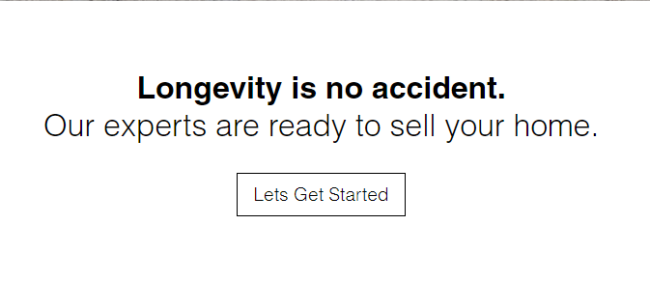
One of the worst, in our opinion, comes from a Los Angeles brokerage, Nourmand & Associates: “Longevity is no Accident.”

real estate slogan example 2

Huh? It appears that the company is touting its tenure in the real estate industry, but it does nothing to speak to the needs of the home seller. Unless one assumes that home sellers actually care how long a brokerage has been in business.

Still stuck?

If you’re stuck for slogan ideas, try looking outside of the real estate industry. Here are some that the top brands use that might get your creative juices flowing:

L’Oréal: “Because You’re Worth It.” 

real estate slogan example

This is so perfect. Aren’t ALL real estate consumers worth your services? Play with the slogan–see if you can rework it.

BMW: “The Ultimate Driving Machine”

real estate slogan example

Could you possibly be “the ultimate real estate machine?”

Panasonic – “A Better Life, A Better World”

real estate slogan example

While we think it’s rather lofty, and it really has nothing to do with electronics or appliances, it can be reworked into a suitable real estate slogan. “A better way to buy or sell a home.”

If I were a real estate consumer, I’d want to know more about this “better way.”

Additional resources to help you come up with a real estate slogan idea

  • Adobe Spark offers some excellent tips on tying your slogan in with your branding. Scroll down below the examples to find them.
  • “Taglines for your Business” at score.org offers things to consider when crafting a real estate tagline.
  • Katy French at columnfivemedia.com offers a brilliant walkthrough of taglines in “How to Write a Great Tagline (According to Science).”

If you’d rather get more in-depth help with your tagline and branding in general, check out these books at Amazon.com:

REALTOR BRANDING: Marketing Yourself for REAL ESTATE SUCCESS, by Irina Kim Sang. This book has a five-star rating.

BrandFace for Real Estate Professionals UPDATED: Be the Face of Your Business & a Star in Your Industry, by Tonya Eberhart and Michael Carr

What to Post: How to Create Engaging Social Media Content that Builds Your Brand and Gets Results (for Real Estate), by Chelsea Peitz (Peitz also offers tips on social real estate on Instagram @chelsea.peitz)

A word of caution: you’ll find slogan generators and tagline generators online. Don’t waste your time. I tried them out for you, using “writer” as the main word I wanted in my slogan. Here are some of the weird and often downright creepy results:

  • Go to Heaven with Writer
  • Splash Writer all Over
  • Do it with Writer

Um, I don’t think so.

By the way, we offer up some real estate taglines that don’t suck, here. We dare you to use one!

The disadvantages of a tagline

55, female, college educated and a homeowner.

That is the description of the typical REALTOR®, according to NAR.

Surprised? Blame the media. Cruise around the internet looking for articles on real estate and check out the accompanying photos.

If it features a model who is supposed to be a real estate agent, he is either young and handsome like Serhant, or young and female.

The folks at daveramsey.com think you look like this

real estate slogan example

Wrong, wrong, wrong, realtor.com. The client in this photo is more representative of the average real estate agent.

real estate slogan example

USnews.com has this image of a real estate agent

real estate slogan example

Now, if this type of blatant stereotyping was happening to any other demographic, there would be a huge outcry. But the status of the older woman dominating real estate goes completely buried and there’s not a peep.

Ok. Off the soapbox.

Although women in their 50s have rich and varied backgrounds, there comes a time when we tend to get stuck at a certain point in that background. Happens to men, too, of course, but I’m addressing the ladies right now.

I know, myself, that I often run certain terms, lingo, jargon, etc. by my daughters. “Is this still cool?” Or, “Do younger people still say this?”

You get the idea, right? We tend to lose our coolness and typically, that’s ok. Those older Americans who think that they haven’t lost it end up embarrassing themselves and, as a professional, that’s the last thing you need to do.

Thus, the many (too many) lame real estate taglines, from both male and female agents. They’re a topic of ridicule on daytime TV, in blog posts and more.

So, before you kvetch over the need for a real estate tagline, ask yourself if you really, truly need one.

There is an alternative and it’s not only trendier, but will get your point across in a manner that real estate consumers crave: authentic.

And you can’t get any more authentic than by using the words of one of your clients to describe your purpose, difference or value. Your words mean nothing to them in this age of the review.

Dig up your best testimonials and find a quick and brilliant line. For instance, we found some online at various agent websites and tweaked them a bit:

“Fast, friendly and careful attention to details,” or “Sold in 2 weeks & closing was a dream,” Sandi Pressley, Albuquerque broker.

“Responsive, incredibly detail oriented, and an expert in the local market,” or “Liane made the process seamless and easy,” Liane Wong, Tucson agent’s Yelp reviews.

“Patrick walked me through the entire process, explained everything, was always easy to get a hold of and quick to respond,” or “I would definitely work with Patrick again and recommend him to anyone looking to buy or sell a home,” Patrick Gillan, Fort Wayne, IN agent’s Yelp reviews.

Not only will a testimonial in place of a slogan speak to your potential clients curiosity about you, it educates and reinforces your brand. It’s more believable, because it comes from someone who has used your services.

And we highly doubt anyone will call you “cheesy” or “lame” for using one.

Need more ideas before you get started? Check out our 50+ sure-fire ways to craft a better brand!


How to choose a real estate website builder

The folks at realtrends.com are about to release their annual real estate website builder rankings. Those rankings, regardless of the company compiling them, are always a fun read.

Realtrend’s criteria for a kick-hiney real estate website includes “best design.” In fact, they’re looking for “show-stopping websites.”

Not the “best-designed website to increase organic SEO.”

Not the “best-designed to capture leads.”

Nope.

It’s the prettiness factor that proves a real estate website builder “… has what it takes.”

We beg to differ with them. Pretty is as pretty does and the “best” real estate websites actually work for their agent-owners.

They do this by ranking in organic searches, by helping to convert leads, educate visitors about the buying and selling process and by informing them about the area and its attractions.

And they do it while not annoying the visitor, making them search for the information they need, by loading at lightning-fast speeds and more.

And the very best real estate agent websites do a lot of the heavy lifting in lead generation so that you no longer have to buy leads.

There’s an old Duke Ellington-composed song that says it all: “It Don’t Mean a Thing (If It Ain’t Got That Swing).”

Download the free guide! 5 Real Estate Landing Pages To Make Now:


5 Landing Pages To Make NOW

Download our quick guide to build these landing pages FREE.


 The best real estate websites are not only pretty, they “got that swing”

No, it’s not pick-on-RealTrends day here at Easy Agent Pro. The site is packed with valuable information. Their writers do, however, sometimes miss the mark, especially when referencing the in’s and out’s of how to choose your real estate website builder.

Another blog post, “What to Consider when Choosing a Website Vendor,” is a case in point. Testimonials, contract length and pricing are what the author considers three “critical” aspects of choosing a real estate website vendor.

Yes, those are important considerations– if they’re of concern to you. Many agents don’t care about pricing if the website brings in leads.

Many aren’t concerned with contract length either. And, testimonials?

Isn’t reading reviews before you purchase most anything nowadays a no-brainer?

The “swing” doesn’t include any of those. A real estate website builder that has it:

  • Features responsive design (don’t yawn–we’ll explain, in plain English)
  • Is attractive in its simplicity
  • Converts visitors, or leads, into prospects
  • Attracts organic search engine traffic
  • Gets you through the entire process
  • Is user-focused

Let’s take a look at each aspect of a real estate website builder in more detail. Then, feel free to use the information when shopping for a real estate website builder.

The best real estate website builder provides responsive design

real estate website builder - responsive design

This is one of those phrases that makes eyes glaze over.

What it refers to is a website that adapts its “… content based on the browser space available. This allows consistency between what a site shows on a desktop and what it shows on a handheld device,” according to Mads Soegaard at interaction-design.org.

Think of a real estate website with responsive design as “mobile-friendly.”

Why is this important? Responsive websites load quicker on mobile devices. And, since 77% of digital minutes are consumed via mobile devices, responsiveness is critical.

Furthermore, 73% of homebuyers use a mobile device as their chief source of information in home searches according to NAR’s “Real Estate in a Digital Age” report.

 Attractive in its simplicity

Think “clean” when it comes to a real estate agent’s website layout. Don’t let anything detract from your branding, from your CTAs and from the user’s experience (fluff won’t be read anyway).

Leave a lot of white space, use short sentences and paragraphs and take advantage of bulleted and numbered lists.

Ensure that the websites on offer from a particular vendor “… are simple and clean with easy-to-navigate buttons and tabs,” suggests the pros at quicksprout.com.

Simplicity is key, they say, because sites “… with simple designs have higher conversion rates.”

It’s gotta convert

Let’s read that again: “… simple designs have higher conversion rates.”

And, again, the home page should be the simplest of all.

We know how tempting it is for agents to tell visitors right off the bat that they’re the best agent on the planet and why.

But cluttering up the home page by listing all of your services, your resume, designations, awards and endless ways to contact you makes the page look far too busy.

That, in turn, alienates visitors and you lose those valuable 50 milliseconds that you have to make a good first impression.

Know what’s important to your visitors and jettison the rest, again, at least on the site’s homepage. You can’t convert visitors who split the second they land on your site.

So, what’s important to them? Here are the no-brainers:

  • Buyers are looking for an agent, listings and knowledge about the buying and mortgage process.
  • Sellers are looking for an agent and knowledge about the selling process. They, too, may be looking at listings to find their next home.

They want to find this information easily, so don’t make them guess where it is on your site.

The “above the fold” portion of your homepage should include the name of the market you serve. Sadly, we see few agents doing this.

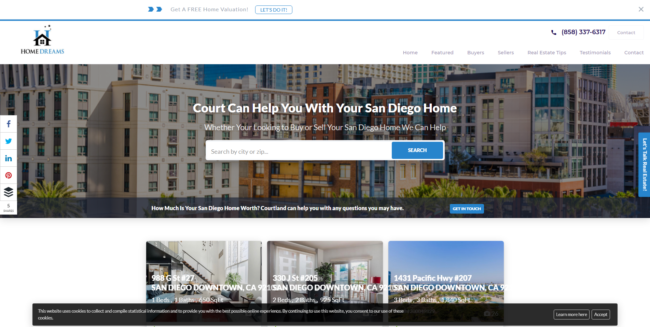
If I were looking for a home in San Diego, I’d like to know immediately that Google didn’t send me on a wild goose chase and land me on the site of a Santa Monica agent.

San Diego agent Courtland Young nails it.

real estate website builder example 1

So, now I know that I’m on a local real estate agent’s website. What else would and should immediately catch my eye – to help me decide to hit the back button or scroll down?

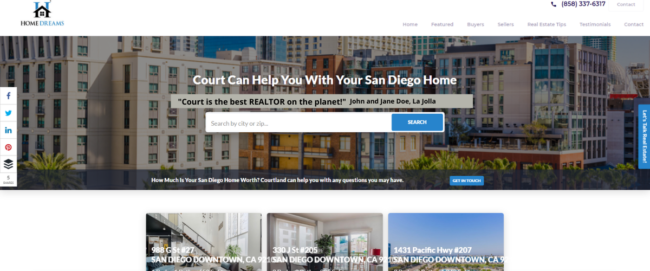
Something that tells me that Court is the best agent in town and, therefore, the best for me. A testimonial will do just that.

We see two spots for a testimonial. The first is just above the search box and the second is the text just before the “Get in Touch” button. Sort of like this:

real estate website builder example 2

Now, what else are they looking for? If I’m looking for listings, I don’t even have to scroll down Court’s page to know that they’re at my fingertips.

This doesn’t mean you should switch to a carbon copy of his website, though.

What it means is that you don’t force visitors to guess the location of the information they seek. Ensure that the website’s vendor provides clear navigation to buying, selling and information about you (with plenty of testimonials).

And ensure that the site is easy for you to edit the way you want. And with a LeadSite, both tasks are a snap.

Attracts organic search engine traffic

If you currently buy leads, how’s that working for you?

If you aren’t buying from a reputable source and you haven’t maximized the power of free lead generating sources, such as your website, you’re wasting money.

“In our experience, website-generated leads convert significantly better than a cold, purchased lead,” according to Lukas Termini, our marketing manager here at Easy Agent Pro.

So, how do you turn your real estate website into an even bigger lead-generating monster? Start by performing small changes to several pages on your site.

Localize the free blog posts you receive twice a week from EAP. It only takes minutes to add local search terms. Here’s an example from a recent post about appraisal problems in hot markets:

Fiery real estate markets such as what we’re experiencing are a dream come true for sellers, unless prices are rising so fast that the market can’t keep up.

Stick the name of your market in that post to boost its SEO value.

Fiery real estate markets such as what we’re experiencing here in Vallejo

For even more value, link the name of the city to its page in your site. These types of links are called “internal links” and each of your blog posts should contain at least one.

Why?

Internal links “… give Google an idea of the structure of your website,” according to Meike Hendriks, a digital marketer on the Yoast SEO team.

“So using the right internal linking strategy can boost your SEO,” she continues. Learn more about internal linking and how you can use it to boost your site’s visibility in organic searches at Yoast.com.

Every post includes numerous opportunities for you to localize them, even those we write for your sphere. Take a post on landscaping and add to it:

Check out the trees for sale in Memphis at Dabney Nursery, 5576 Hacks Cross Rd. and Dan West Garden Center, 4763 Poplar Ave.

Then, work on your neighborhood pages by adding local photos and alt tags to go with them.

Right about now you’re wondering what happened to helping me find the right real estate website builder.

Regardless of the real estate website company you choose, your site will need to be localized.

A real estate website builder should get you through the entire process

real estate website builder - finish line

“A lot of agents struggle with finding the time to work on their own sites, which is why having a site that can take some of the work out of the process can be so important,” according to Termini.

Compare vendors on whether or not they offer the “goodies” to help make your work day easier:

  • Template-based pages that make adding and deleting information a snap
  • Help building landing pages
  • Twice weekly auto-blog content
  • CRM integration that will help you convert website visitors into leads
  • A slew of apps to help with everything from lead capture and management to boosting SEO and increasing website traffic.

The best real estate website builder maximizes an agent’s brand and optimizes his or her online activities with one simple goal in mind: To help you get more leads, sell more houses, and improve your professional and personal brand.

Ready to get started with a new website? Here are the most important first steps for when you do:

We broke down the most important things the top 10 real estate websites are doing to stay ahead in the business – Take a look

November real estate news

Did your city make the list?

On October 20, the folks at wallethub.com released their study of “… more than 1,200 U.S. cities with populations between 25,000 and 100,000.”

They compared these small cities using what they feel indicates
livability.” Stuff like restaurants per capita, housing costs, crime rate and more.

Depending on where your real estate market falls on the list is either brilliant marketing fodder or something to ignore.

The study finds that Santa Barbara, CA is the small city with the highest housing costs and South Lake, TX with the lowest.

The five best small cities to live in:

  • Sammamish, WA
  • Lexington, MA
  • Carmel, IN
  • Needham, MA
  • Sugar Land, TX

The five worst small cities to live in:

  • Camden, NJ
  • Hot Springs, AR
  • North Miami, FL
  • Florence, SC
  • Lauderdale Lakes, FL

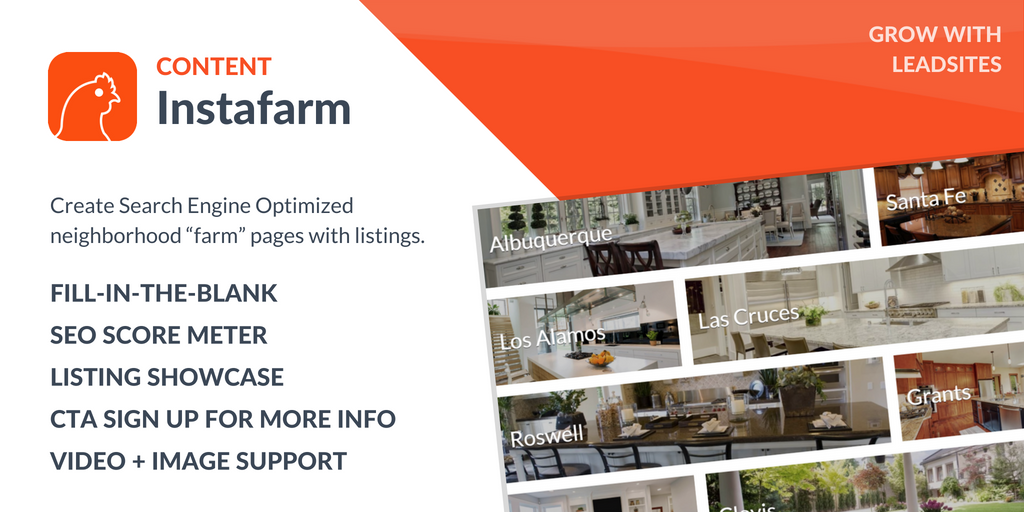
Instafarm

“If you can’t explain it simply …”

If you’ve been in the real estate industry for some time, you no doubt recall the Great Recession, when the housing market went sideways.

Overnight, real estate agents became “short sale experts” during a time when few even knew what the term meant.

It may be “déjà vu all over again,” at least according to some industry insiders. Luke Babich, at realtrends.com, claims that because lenders capitalize mortgage payment deferrals, “… adding these amounts to the balance owed,” home equity gets whittled down and “… could push troubled families into short selling.”

He adds that if the foreclosure rate spikes, when these homes hit the market they may drag down home prices.

His suggestion? Brush up on the foreclosure and short sale process by taking the classes (it’s actually a one-day session you can do online” leading to NAR’s short sale and foreclosure designation.

Or, you could just DIY it. There’s enough information online to help you out.

Position “… yourself as a distressed property specialist,” he suggests.

But only if you understand the process, we add.

Or, as Albert Einstein once claimed, “If you can’t explain it simply, you don’t understand it.”


 The “absolutely insane” demand for homes

November is the time when many people who hope to buy a home decide that they’ll not be able to buy until next year.

These buyers “… expect to do so going into 2021,” Glenn Kelman, Redfin’s CEO, recently told CNBC.

He expects the frenzy to remain in the market “… into 2021, at least.”

Since 2021 is only about two months away, we decided to look deeper into housing market forecasts.

Over at money.com, Brenda Richardson spoke with nine real estate industry experts and they all seem to agree that the frenzy will remain through the end of the year, at least.

Realtor.com’s chief economist, Danielle Hale describes the current market as “… undoubtedly a make-up period for the lost spring buying season,” and that pent-up demand “… will run its course.”

Despite that, she says, if mortgage rates remain low and millennials remain interested, we should sail through calm waters in early 2021.


Commercial agents: Here are the top 10 real estate markets for 2021

I learned a new real estate term this week: “18-hour cities.” I’d never heard it before, but then again, I worked in residential real estate so maybe that’s why.

James Chen, at Investopedia.com, describes 18-hour cities as “… mid-size cities with attractive amenities, higher-than-average population growth, and a lower cost of living and cost of doing business than the biggest urban areas.”

A joint study by PwC and the Urban Land Institute finds the following cities will continue to be the ones to watch in 2021.

  1. Raleigh/Durham, N.C.
  2. Austin, Texas
  3. Nashville, Tenn.
  4. Dallas/Fort Worth, Texas
  5. Charlotte, N.C.
  6. Tampa/St. Petersburg, Fla.
  7. Salt Lake City, Utah
  8. Washington D.C./North Va.
  9. Boston, Mass.
  10. Long Island, N.Y.

Happy Thanksgiving!

Check out these real estate holiday card templates for your holiday lead gen efforts

It’s not too late to grab some year-end real estate leads

Short on real estate leads? Now might be the time to consider Facebook contests and campaigns.


Start with Halloween

Halloween, like many events, will be different this year. Most of the folks in my NextDoor.com neighborhood responded to a poll about trick-or-treating saying their kids won’t be participating this year.


And, they are desperate for alternatives.

The easiest alternative is to buy a bunch of candy and bags and do a reverse trick-or-treat to those in your sphere who have kids. Don’t forget to stick a business card in each bag in case they aren’t home when you arrive.

Other alternatives exist, and they all involve social media. You’ll need to work quick but they aren’t too difficult to set up and you can start today.

First, decide on a title for your contest, such as “Best Costume.” This can even be broken down into age groups, such as “Best Costume, Kids infant to 5 years old, Best Costume, Kids age 6 to 12,” etc. Or you can use the type of costume: scariest, cutest, etc.

If you don’t like the costume idea, consider Best Pumpkin Carving, Scariest Pumpkin or Most Creative Pumpkin.

Next, you’ll need to come up with a prize or prizes if your contest has multiple categories.

The prize will depend on the contest. If it’s a kids’ costume contest, go online and find gift certificates or cards for toy stores (or give an Amazon, Target or Walmart gift card).

Check out sites where tweens love to shop and offer a gift card:

Don’t be cheap. The more compelling the prize, the more engagement your contest will receive.

If you’re short on cash, consider teaming up with a local business, offering exposure and promotion in return for a prize donation:

  • Bakeries
  • Cupcake shops
  • Candy stores
  • Toy stores
  • Local attractions (ask for free passes to use as a prize)

Need some inspiration? Check out Minnesota broker Kris Lindahl’s two Halloween contests on Facebook (here and here), where he offers “… two different ways you can win big!”

While you’re there, notice the engagement from his followers. Not only are tons of people getting in on the contest, there is a respectable number of “shares” for the post as well – and that’s what you need to build brand recognition.

Contest alternative: Why not start a campaign to collect items for a local charity? For instance, do you know what most charities that cater to the homeless need most every fall and winter?

Socks. They are the least-donated item and, therefore, the most needed.

Find a shelter in your area and let them know what you’ll be doing. Then, create some graphics to share on Social media (Canva.com is free and easy to use). You can find ready-made, free graphics at Happysocktober.com.

A Montana agent we know places collection barrels at her office and also spreads them around town at various merchant locations. You can even offer to pick them up if they fill out a request form. That form, by the way, will be on a dedicated landing page on your website.

Don’t have the energy to ramp up your real estate leads gen by Halloween?

The same idea can be used for a Thanksgiving contest, but there are other topics as well from which to choose:

  • A drawing for a free Thanksgiving dinner for a specified number of people (the catering department at Whole Foods Market and, quite often, other markets and restaurants offer complete holiday meals for pickup or, you might want to pick it up and deliver to the winner).
  • A drawing for a large gift card for a local supermarket to help them buy what they need for Thanksgiving.
  • Consider a photo upload giveaway. Ask followers to upload a photo of their family with their Thanksgiving feast.
  • “Best Non-Traditional Thanksgiving Dish”
  • “Best Thanksgiving Decorations”

Thanksgiving real estate leads

You can also switch up the topics for Christmas:

  • Best outdoor holiday decorations
  • Most unique holiday tree
  • Ask for photos of their holiday cookies

Mind the rules

After reading through tons of Facebook contests, we’re shocked that Facebook has rules. We couldn’t find even one that adheres to them.

“Personal timelines and friend connections must not be used to administer promotions (e.g. “share on your timeline to enter” or “share on your friend’s timeline to get additional entries” and “tag your friends in this post to enter” are not permitted).”

Facebook also requires a disclaimer stating that they aren’t in any way connected with the contest or giveaway for your real estate leads. Consider adding something like this:

“This promotion is in no way sponsored, endorsed or administered by or associated with Facebook.”

Dana Kilroy, at shortstack.com, has created a blog post and infographic detailing Facebook’s rules. She also offers a brilliant suggestion:

“Don’t run your contest on Facebook!”

She suggests running it from your website (with a landing page) and promoting it on Facebook and tells you how in another post that you can find here.

It’s not too late to get closer to your 2020 real estate leads goal.


Need more ideas? Here are 49 Facebook posts for real estate professionals

2 websites to make friends (and maybe pick up real estate leads)

Let’s get this out of the way upfront: there are social media sites that are ok with real estate agents actively promoting their businesses. Think Facebook and Instagram.

Then, there are others, such as NextDoor.com and the two discussed below, that may ban you when you self-promote or solicit.

Think of Facebook prospecting as “active” and prospecting real estate leads on NextDoor as “passive.”

They’re both worth doing.

While active prospecting involves selling yourself and your services blatantly, passive prospecting entails sitting back, reading, contributing valuable information, engaging with others and waiting for someone to say the magic words: “Does anyone know a good real estate agent in [name of city].

If you like hanging out on social media, getting to know new people and contributing knowledge, passive prospecting for real estate leads is something you’ll enjoy.

No, it won’t take the place of your active online prospecting strategies, but you may just pick up a couple clients a year. And who can’t use a few extra commission checks?

BiggerPockets.com

Biggerpockets.com

If you haven’t considered working with real estate investors, you’re missing out on a huge pool of buyers/sellers and a lucrative niche for real estate leads.

“BiggerPockets is a complete resource for anyone looking to succeed in real estate investing,” according to the About Us page on the site.

They boast 1,897,604 active users (“and counting”), most of whom are real estate investors. They offer forums that you can view by the latest posts, trending topics or just browse.

Right there at the top of the list of forum topics is a reminder that “Advertisements, solicitations, and self-promotional posts are only allowed in the Marketplace Forum.”

One of the topics I noticed today you may find interesting: What’s One Quality You Look for in a Real Estate Agent?

Read through the responses, especially those from real estate agents. With the exception of the agents from Chicago and Memphis, THIS is how to show your knowledge without the eye-roll inducing, overt self-promotion agents are notorious for.

While perusing the forums, I also found a post from an investor who asks “… does anyone have any recommendations for a real estate agent and property manager in the Las Vegas area?”

Out of eight responders, two were from real estate agents. Actually, those two were from the same agent.

That question, about agents in any city, posted on Facebook would be overflowing with agents waving their hands and shouting “Me! Me! Pick me!”

Competition for real estate leads at BiggerPockets is quite slim and, if you understand investing strategies, this should be your new hangout.

City-Data.com

citydata.com

According to an administrator at City-Data, the most common reason that consumers visit the site is because they are (or are considering) relocating.

Warning:

Before joining, please read the site’s Terms of Service (TOS). Agents are not allowed to initiate contact with members (aside from other agents), and there is no solicitation or promotion allowed in the forums.

They’re pretty strict on these points and the other members will hold you accountable if you violate the TOS.

“Some play by the TOS and stay, some leave when they realize they can’t solicit, and some are asked to leave because they do solicit,” warns one agent in the professionals forum.

In fact, the agent members of the Real Estate Professionals forum seem to be highly territorial, so tread lightly if you decide to join that particular forum. At least as a newbey.

The state-specific forums allow you to refine your search to specific cities and topics within those cities. This is where you’ll most likely find folks seeking information about your town, homes there, etc. Remember – be helpful, not salesy.

And, if you like the site and decide its worth your time to hang out there, you’ll find a ton of other forums. They deal with everything from automotive, gardening and relationships to sports and “Unexplained Mysteries and Paranormal.”

Yes, it is a slow process to get leads from City-Data and best suited to agents who like being sociable and are seeking kinder, gentler online social interaction than what they currently find on Facebook.

“I read & post during my between time, or my waiting time, or while drinking coffee,” says one member of the Real Estate Professionals forum at City-Data.

Join, hang out, have fun, be helpful, provide useful information and you may earn yourself a client or two.

Looking for social media platforms to use as an agent? Here are the best ones for you.


3 tips to help you build trust with real estate buyers

“Do You Even Need a Real Estate Agent to View a Home Anymore?” asks Robert Farrington at thecollegeinvestor.com.

While he admits that “… viewing properties online will never replace checking out a property in person,” he offers two ways to view homes without an agent: “open houses, or you could simply go to the house and peek in the windows!”

Yes. He. Did.

Imagine the homeowners at the effect of this advice, with potential buyers creeping around their property, peeking in their windows.

“The only time you actually need to call a real estate agent is if you want to get inside the house without breaking in!” Farrington concludes.

You’ve read similar articles, I’m sure, about why real estate agents are useless today, because of “technology.” How agents don’t earn those “huge” commission checks and that agents lie about home values “… so they can get a super quick easy sale,” according to the response section of Farrington’s article.

Then, there is this response from an agent: “But getting people who don’t know you to trust you, and to understand how much you can help them is harder and harder because of bad press like this article. It’s a shame.”

Indeed, it is a shame.

When you meet a new client, there is most likely mistrust from the get go, thanks to Farrington and others like him. Your job has become a battle to win a potential client’s trust–to build rapport.

Let’s take a look at what some of the experts suggest to help you build trust with real estate buyers.

1. It all starts with the buyers’ consultation

Your first lengthy interaction with potential buying clients is an ideal opportunity to distinguish yourself from other agents they may have spoken with. It’s also the start of building the rapport required to instill trust.

Aside from the routine questions (when they plan on buying, whether or not they’ve seen a lender, etc.) consider asking the following:

Why are they buying a home? The answer to this may give you valuable information on which to start building a relationship.

A couple of years ago, the media was full of news about study that found that “… one-third of millennials who bought their first home said having a better space or yard for a dog was a major factor in their decision,” Jennifer Liu at businessinsider.com.

Only 25% of them said that marriage was a major factor.

Whether your potential buying clients are getting married, growing their families or just want a suitable space for Fido, the information is something you can use to help build rapport.

What type of a neighborhood are you looking for? Aside from the features they seek, ask if commuting is an issue for them. This conversation can lead to learning what they do for a living. Again, this is information that can lead to deeper, more valuable trust-building conversations.

Which aspects of the home/neighborhood are non-negotiable?

Pay attention to their answers here. Don’t be the agent so many real estate consumers complain about–“he kept showing us homes that were too big” or “too small” or “that didn’t have a pool.”

Unless, of course, you ask them first if they want to see it.

“I know you don’t want to change school districts, but a home came on the market that has most of the features you’re looking for. It’s in the Pleasant Valley school district. Would you like to see it?”

2. You can’t build trust with real estate buyers in separate cars

The pandemic-caused proliferation of virtual and video tours has erected yet another barrier to rapport-building with real estate clients.

If you work in a market where you’re showing property in person, or if we ever get back to that as the “norm,” this tip is for you.

As a buyer’s agent, think of all the rapport-building time that’s lost when your buyer takes a separate car and follows you from listing to listing.

Tip number two, then, is to stop taking separate cars to view homes for sale

Use the driving time to get to build trust with real estate buyers:

  • Familial status (married, children?)
  • Pets?
  • Hobbies? Your client tells you she loves golf. “Have you played [name of golf course]?”
  • Job? Your client tells you what he does for a living. “What made you decide to work in [career choice]?”
  • Where did he or she grow up? “So, what was it like growing up in [name of town]?”

The time between viewings is so valuable when you’re trying to build trust with real estate buyers. It provides the perfect opportunity to get to know your client and for him or her to get to know you.

Don’t waste it by taking separate cars.

3. The truth doesn’t always hurt

Whether showing a home via video or in-person, don’t be afraid to give your opinions or share your insight. Not everything is rosy with every house, so get real.

By pointing out flaws, or reminding the client that a certain feature of the home or neighborhood may not be beneficial, you erode some of the perception of real-estate-agent-as-used-car-salesperson.

If you don’t think the home is right for your clients, and have valid reasons for thinking that, tell them.

Pay attention to the conversation for clues on wish list items that have changed. As you go from home to home, you can use this information to help them compare homes.

For instance, Joe and Sheila surprise you with their new-found longing for a formal dining room. They’d never mentioned wanting one before, but here they are, verbally furnishing one in a home for sale.

On subsequent home tours you can and should use this information in your conversations to help build trust with real estate buyers. “This home lacks a family room,” you say as you approach the front door. “But it does have an extra bedroom for that home office Sheila needs.”

Not only does this show them you are paying attention to what they say, but that you aren’t going to gloss over a home’s shortcomings so that you “… can get a quick, easy sale.”

In real estate, rapport is the basis of trust. The more that clients and potential clients get to know and like you, the more they will trust you.

Want to improve your real estate website? Here are some tips to get the ball rolling in less than 2 minutes!


Interested in selling it like Caballero? Work for a builder

Every year when Real Trends’ “The Thousand” list comes out, it’s topped by an agent who holds the Guinness World Record for home sales.

“He only sells new-construction residential properties and he works with volume builders only,” according to Katie Warner at BusinessInsider.com.

He has also created a MLS platform, HomesUSA.com, “… for home builders to track the progress of their homes and manage listings” Warner adds.

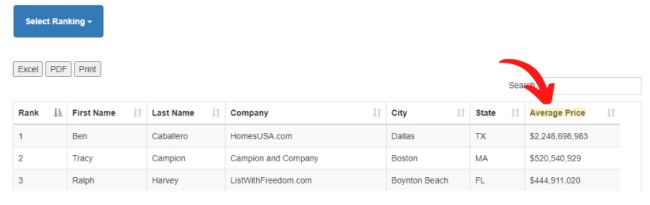
On last year’s list, Ben Caballero, categorized as an “individual” agent on all but the 2020 list, had 5,801 transactions resulting in $2,270,911,643 in sales – nearly four times the volume of the agent in second place.

The list has changed a bit in 2020 and now includes a category for “Agent-Owned Brokerage” stats. Naturally, Caballero dominates this category, with 5,778 transactions with an “average price” of $2,248,698,983.

I don’t know about you, but I can’t think of a market on earth where the average home price is more than $2.2 billion, but apparently there is, if the folks at Real Trends are right.

RealTrends.com


At any rate, whatever that dollar amount reflects, it’s a whole lot of money. The agents in the next two spots aren’t doing too shabby either.

Surprisingly, new construction isn’t a particularly popular niche. With numbers like Caballero’s however, it should be.

If you’d like to get in on some of this impressive income, you may want to give new home sales a whirl.

Do you have what it takes?

From what we’ve read in our research, “tenacity” is a quality that will suit your gig slinging newly-built homes.

John Rymer at ProBuilder.com, however, adds more to the list of traits to look for in an article geared to assist builders when looking for a “New-Home Sales Superstar.”

  • Avid goal setter
  • Asks the right questions
  • Financing expert
  • Passionate about new-home sales
  • Exudes enthusiasm
  • Takes responsibility for results
  • First in the office, last to leave
  • Perfected the follow-up process
  • Always showing value
  • Persistent and fearless closer

If this list sounds like you, selling new construction may just be your dream career.

First, the cons

Let’s get the bad news out of the way up front.

Just as with the broker under which you choose to hang your license, so goes the builder. Some value ethics and high standards. Others, not so much.

For instance, horror stories abound from sales people of one nationwide builder with a highly- recognized name.

“They are not building homes as they say ‘to industry standards,’ and … you will violate your Realtor ethics code if you are successful at [company name] and will be asked and expected to pretend homes built below building codes, with no supervision, with the cheapest material in the industry are worth the over-market prices the customers are paying.”

On this particular website, there is a total of five reviews for this builder, they are all negative.

So, choosing the right builder will be challenging.

Then, there is the commission structure and, no, you won’t be making 3% (minus your broker’s cut) on each sale.

One of the aforementioned reviewers of the unnamed builder stated that “the commission rate is not 1% as I was told in my interview. It is .05%, the lowest in the industry and the lowest rate for any [company name] division. The max you are guaranteed to earn is .07% and you can get 1% if you are lucky.”

Then, when you sign on to become a new home sales consultant, you are no longer an independent contractor, but an employee of the builder. There go all the benefits of owning your own business, such as your schedule being your own.

Naturally, there are other cons, but these are the ones that agents should carefully consider.

The pros of working with a builder

The obvious plus of becoming a new home sales consultant is that prospects come to you. You will need to follow up with buyers (or their agents), but no more cold calling and chasing after business. You may even pick up a listing if a homebuyer has a home to sell and hasn’t chosen a listing agent.

As an employee, you’ll most likely receive benefits, such as medical and dental. It’s also highly likely you won’t work on major holidays, such as Christmas, Thanksgiving and New Year’s Day.

If being a business owner doesn’t agree with you, but you hope to remain in the industry, becoming a new-home sales consultant may just be for you.

How to get your foot in the door

Caballero grew up surrounded by real estate – both parents were in the industry. He took a rather circuitous route to where he is now, but along the way he began building homes, which became challenging due to economic conditions.

There’s more to how he ended up specializing in new-home sales, but suffice it to say, he didn’t just start calling builders to see if they needed an agent.

Starting from ground zero – knowing nothing about working with a builder and how the process differs from selling existing homes – is challenging.

Your best bet is to visit a few sites, introduce yourself and get to know the reps. Don’t be afraid to ask plenty of questions. Everybody has to start somewhere so they may be sympathetic to what you’re going through.

Do some research on your own. Learn all you can about:

  • The different architectural home styles
  • Blueprints (and how to read them)
  • Home construction methods and materials
  • Site layout and design

If, on the other hand, you are a learned, new-home sales scholar, and you have a proven track record of moving 50 to 100 listings a year, you’re way ahead of the pack.

Call the builder to set an appointment and then be fully prepared to wow him or her with a marketing plan to beat all marketing plans.

“All it takes is a little bit of time for an agent to understand builders — why they do what they do — to reap the rewards the new-home market can deliver,” according to Caballero.

Want to be “just like” the best agents in the country? Here’s how.

New real estate agents: There’s stuff you should be doing even before you get your license

The one thing few new real estate agents are prepared for is to hit the ground running the minute they hand over their license to a broker.

Sure, you’ll find lots of information on how to get a license, but zilch about how to productively use that time when you aren’t taking classes or studying for the exam.

That’s time wasted and commission checks pushed into the future.

Let’s take a look at some of the best ways to prepare yourself to enter the world of real estate, ready to take it on as a new real estate agent.

Research and shop for a CRM

Customer relation management will be an ongoing and critical aspect of your business. To make it easier and more efficient, you’ll need CRM software.

Some of the larger brokerages offer in-house CRM software, but most don’t.

The selection of brands is mind-boggling and, without knowing the business and what your future requirements will be, selecting one may be challenging.

If you have real estate friends, pick their brains about what they use, and what they do and don’t like about it.

Surf the internet to find reviews of real estate CRMs. We found a couple of reviews that might help:

Then, learn how to use the software. Once you have that done, start loading it with the names, addresses, email addresses, phone and any other information you have about everyone you know.

Yup, everyone old enough to buy or sell a home.

Later, you can get deeper into the process by segmenting your prospects according to age, gender, hobbies, home seller or buyer – whatever.

Getting this task out of the way up front will streamline your entry into the real estate business and you’ll be forever grateful that you did it.

https://www.easyagentpro.com/leadsites/

The first email campaign for new real estate agents

Take all those email addresses in your CRM and send each one an announcement of your pending licensure.

A strictly text email isn’t going to cut it now that you’re on the threshold of owning your own business. Put on your marketer’s hat and create an email postcard just for this ocassion.

You can make them free at Canva.com. Here’s one we cooked up in about 10 minutes.

As long as you keep the width of the image to 600 pixels, it should show well on any device, including mobile. Resize your image free at WebResizer.com.

To make the email appear more personal, hide the addresses of the other recipients. Learn how at SmallBusiness.chron.com.

Hit send, and you’ve just completed your first marketing campaign.

NOTE: From here on out, get as much detail as possible on everyone that you meet:

  • What they do for a living
  • Single or married?
  • Children?
  • How do they spend their spare time? Golf, gardening, volunteering, traveling, etc.

These are all conversation topics new real estate agents can use in future “touches,” so load that info into your CRM.

Set up a Facebook business page

Yes, there are other social media platforms and some that you may prefer over Facebook. But Facebook is, hands down, the best of them for marketing your real estate business.

So, start with Facebook and work on the others later.

This is a task you can actually begin on your personal page. Post the image included in your email blast for starters. Then, when you get your Facebook business page set up, invite your personal page friends to join you there.

Start engaging with others by responding to their posts.

Join Facebook groups. They don’t have to be real estate-related as long as you’re active and engaging, they will help build your follower list.

New real estate agents should start thinking about the website design you prefer

No, you won’t want to rely solely on your broker’s website. Every agent needs their own, branded website.

And that’s something we are really good at and quite happy to help you with.

Follow real estate website best practices, which you can learn here and here.

To learn more about  how we can help you with your website, click here.

Learn basic business marketing techniques

There are tons of websites that cater to learning the basics of marketing and some are geared to real estate agents specifically.

It’s important to get those basics down – such as getting a clear idea of your audience, targeting, etc. – before diving in to more advanced marketing knowledge.

While you’re brushing up on marketing, here are some tips for Real Estate Marketing on a Shoestring.

Finally, think about the type of broker you want to hang your license with. We can help you with some tips here.

We wish you much success!

Need help generating real estate leads? Here are some tips for beginners!


Real estate holiday card templates for your outreach efforts

I finally ventured out into the world last week, mask firmly in place, to visit one of my favorite home goods stores.

As I write this in September, it was a bit surprising to find that store personnel had entirely cleaned out the massive garden area and employees were busily filling it with winter holiday décor.

In a way, it makes sense. With the pandemic still around, nobody really knows what our holidays will be like but many still have lots of spare time on their hands. Management is likely hoping they choose to fill it by getting a head start on decorating.

As I left the store without the comfy new home that I promised my oversized peace lily, I decided that maybe it’s a good idea for agents to copy the store’s “let’s get a head start” strategy.

If you send holiday greetings to clients every year, now might be a good time to decide what you’ll send, design it or buy ready-made real estate holiday card templates and determine a mailing schedule.

Even if you don’t typically send greetings, if you hold an annual charity program or something similar, let folks know about it, while simultaneously reinforcing your brand into their awareness.

Thinking of an email greeting?

Please. Don’t. Do. That. Sure, it’s cheap and easy. But, email greetings during the holidays most likely won’t even be opened. They will also:

  • Make you appear lazy
  • Give the perception that you lack creativity
  • Give the impression that you are cheap
  • Tell recipients that you don’t really care

If an email holiday greeting is the best you can do, consider not sending greetings at all. Instead, look for real estate holiday card templates that aim to impress.

Use the good old U.S. Postal service or, deliver your card in person. Either of these methods are far more personal than a dashed-off email with a greeting cut and pasted from the internet.

Choosing the right real estate holiday card templates

What will you say?

“Never mention ‘Christmas,’ ‘Hanukkah,’ or any other particular holiday,” says one completely clueless writer of an advice column for agents on this very topic.

She claims the need to be inclusive of everyone and warns not to alienate anyone.

Hogwash.

When I was an agent, I worked with a number of families who were quite religious, both Christians and Jews and I would imagine you do too.

Many of these folks are bitter over the removal of their God from holidays originally based on religion. Sending them a card that doesn’t acknowledge their “reason for the season” is far more alienating.

Dig deep for enough cash to buy a few different cards or postcards for these leads, former clients or those in your sphere. Be daring and actually wish them a Merry Christmas or Happy Chanukah (which begins the evening of December 10, 2020 and ends on December 18, 2020).

On a tight budget? Include a personal note in the signature area of the generic card, wishing them the “blessings of the season,” “Merry Christmas,” or “Happy Chanukah.”

In the sea of generic greetings that they’ll receive, yours will most certainly stand out.

It’s fine to include your branding, but don’t use the card to promote yourself or your business. Let your branding do that. Oh – and remove all that contact info. Just your URL will suffice. The rest is far too blatantly salesy.

When to send

When I was an agent, my sole marketing mission was to make myself stand out from all the other agents in my market. To that end, I didn’t send out my holiday greetings when everyone else did.

I sent two: one at Thanksgiving and then one to wish them a prosperous, healthy and happy New Year. I don’t imagine they received a lot of greeting cards during those two periods, so mine had a far better chance of at least being looked at.

If you prefer the traditional route, many of the experts suggest mailing early to ensure that yours is among the first they receive. No, not stupidly early like department stores setting up their blow-up Santa in September, but two to three weeks before the holiday is sufficient.

If you’ll be ordering online, it’s a good idea to get that head start that the department stores are so fond of. Order them a.s.a.p. We found a few places online that you might want to check out:

Need help getting started? Here are some cheap greeting cards that are sure to brighten anyone’s holiday

Update your website’s real estate community pages for a boost in traffic

“Location, location, location” applies to more than just where a home is situated on the planet. If you think about it, the age-old mantra describes and rules your business.

You sling real estate in a specific location. When a consumer needs an agent, they search for one in their location. As well, when they want to look at homes online, they further define their location by neighborhood or community.

Which is why we harp so much on making it very clear to your website visitors where you work, on creating the perception that you are the local authority and on increasing local SEO on your blogs and other website content.

The most valuable real estate on your website for helping you increase organic traffic are your real estate community pages. The content in this section is so valuable that by tweaking it, you may increase your traffic by 40 percent, according to Neal Patel.

By “tweaking,” we mean breathing new life into old content. So today, let’s look at some ways you can refresh these real estate community pages, starting with…

Look for zombie content

  1. Go through the real estate community pages section of your site, looking for the pages that receive the most traffic. We like Google Search Console for this task.
  2. Once there, click on “Search Traffic” and then “Search Analytics.
  3. This brings up the content that gets the most eyes. Now click on “CTR” (this is located above the list).

Believe it or not, there’s actually a formula that you can use to help figure out which of these posts will give you the highest return on your time invested.

David Schneider, at thehoth.com, offers a walkthrough, but here’s the gist: Look for content with:

  • A click-through rate (CTR) of less than 1%
  • A position between 1 and 30
  • A high impression rate

Instafarm

Schedule a demo with us today to learn more

Take a tour

Now that you know which real estate community pages to resurrect, go to your site and take a critical look at each of these pages.

When you land on them, are they appealing to the eye? Do they contain:

  • A logical search term in the page’s title?
  • Lots of clear, compelling photos?
  • Lots of white space?
  • Short paragraphs (no more than five sentences each?)
  • Subheadings?
  • Bulleted lists?
  • Punctuation and grammar errors?

Then, test all of the links on the page to ensure that none are broken. Are there internal links on the page? If not, make a note to add some.

Head over to the backend of your site

Pull up the first of your most popular neighborhood pages.

  • Start with the copy. Fix any problems we described in the previous section. Ensure that your keywords and phrases are sufficient. Remove anything in the copy that isn’t evergreen, such as outdated average home prices in the community. Add alt images to your photos if they lack them. You’ll find instructions at yoast.com.
  • Add additional copy. If there have been changes to the area, let folks know. New eateries or parks in close proximity? Anything you can add to lengthen the community’s description will help boost your SEO.
  • How is that CTA? Is it compelling? Easy to see?
  • Fix broken links and change the text that surrounds these links. This helps search engine spiders to understand that the page has new “juice,” according to Cyrus Shepard at moz.com.
  • Don’t forget to add internal links if the copy lacks them. You’ll find an example of incorporating an internal link in the third paragraph of this post. The text “where you work” links to a previous Easy Agent Pro blog post on the topic.

Repeat the process for your most popular real estate community pages. Once published, don’t forget to share the URLs on social media.

Need ideas on how to beef up your content? Check out the Arigna Team in Silicon Valley (scroll down past the “Featured Listings). Although the content is brilliant, it’s a pity there aren’t photos.

Instead of a narrative description of Kathleen, GA, Anita Clark sticks to lists of facts and figures, and does it quite well. Unlike the previous site, she includes photos, but they’re the wrong ones.

Visitors to your website’s neighborhood pages want to see photos of the neighborhood. It’s worth it to take some time to drive around and snap some.

Alas, we couldn’t find a “perfect” neighborhood page. Most of the ones we viewed in our research seem like throwaways. Such a pity.

Homebuyers want local information and when your real estate community pages are of value to them they will be to you, too.

Looking for other ways to improve your real estate website? Here are 16 ways to build a better site.

3 Elements of the perfect real estate lead-generating website

Even the best real estate website creators in the world (such as those at Easy Agent Pro) can only go so far in helping the sites they build to generate leads for agents.

The rest is up to the agent. We’re not talking a major overhaul of your site – it’s pretty perfect when you fire it up.

What we mean is that the final step is one that you perform: personalization. And, yes, this step is the lynchpin in your real estate lead-generating website. It holds it all together.

Let’s take a look at 3 things you can do to help nudge those folks who visit your real estate website into the pipeline.

1. Testimonials are front and center on a lead-generating real estate website

Visitors to your website are hoping they’ve found the perfect real estate agent. But, they’re skeptical.

Which is why your website should lead with your most convincing, awe-inspiring testimonial. Above the fold. Prominently displayed so visitors can’t miss it.

You may need to edit that juicy tidbit of trust-inducing text so that it doesn’t interfere with other above-the-fold information. Just one line will suffice (two at the most).

This testimonial shouldn’t replace a dedicated testimonial page. And that page shouldn’t replace the sprinkling of powerful testimonials on pages throughout your site.

Everywhere your visitors land on your website, he or she should see what others say about you as an agent.

You might also consider producing some video testimonials. We discussed that recently, here.

2. Judicious use of lead magnets

Some people just want more than a jolt of trust – and you should offer it to them. A brilliant lead magnet can get visitors to cough up their contact information in exchange.

So, what makes a lead magnet “brilliant?”

  • It must be something of value. Gone are the days that a “free home evaluation” was a lead magnet, so too for a subscription to your newsletter. Consider e-books, or actual, published, you-can-hold-it-in-your-hand books.
  • Don’t delay their gratification. Offering an e-book? Let them know they can download it instantly.
  • Allow your lead magnet to highlight your USP, but ensure that it isn’t over-the-top salesy.

Example: A friend is looking to build a casita on her daughter’s property. She took to the internet to look for builders in her area who specialize in “accessory dwelling units” and found a list of them on HomeAdvisor.com.

One of them offered a free site evaluation in exchange for her contact information. She gladly offered it up for something she considered quite valuable.

3. Lead-generating real estate website have lots of brilliant content

From the perfect agent bio to your blog and neighborhood/community pages, quality content is an important aspect of SEO on your lead-generating real estate website.

Sadly, there are some amazingly skimpy community pages on agent websites. Many don’t have neighborhood descriptions at all.

We’ve also seen descriptions ripped from Wikipedia, stolen from other area agents and even carbon copies of what is on the city’s or Chamber of Commerce’s website.

If your competition is ranking better than you in organic searches, it’s time to take a look at your content. And, the best place to start is with your community pages.

Take a look at some community/neighborhood page tips right here on Easy Agent Pro and check out examples from other agents:

  • Kris Lindahl – Keep scrolling past the listings. Lindahl’s community pages are stuffed with valuable information.
  • The Oppenheim Group – It’s not the description of the community that we were attracted to here. In fact, this description is used, word-for-word, on 27 other websites that we could find. There is absolutely no SEO value in it. But, scroll past it to the “Explore the Town” section. We find the information there quite valuable.
  • Long & Foster – Winner of the “Community” category in Real Trend’s 2019 Website Rankings, there is lots to love here. The photos, which are typically lacking in other agents’ community pages, are yummy, numerous and welcome, we’re sure, by the site’s visitors. We clicked on “Arlington, VA” and landed on a page with information on things to do, housing in the area, public transportation and a section on “What Locals Love,” complete with screen shots of the attractions’ Yelp reviews. And lots and lots of photos. No, there’s not a lot of SEO going on here, but it’s a good start.

Bonus tip

You can’t generate real estate leads on your website if visitors can’t figure out how to contact you. Offer lots of options (call, text, email, etc.).

Then, ensure that your “Contact Us” buttons are easy to find and on each page of your site.

Need a great lead-generating real estate website? Learn how LeadSites can change your business for the better.